QUESTION IMAGE
Question
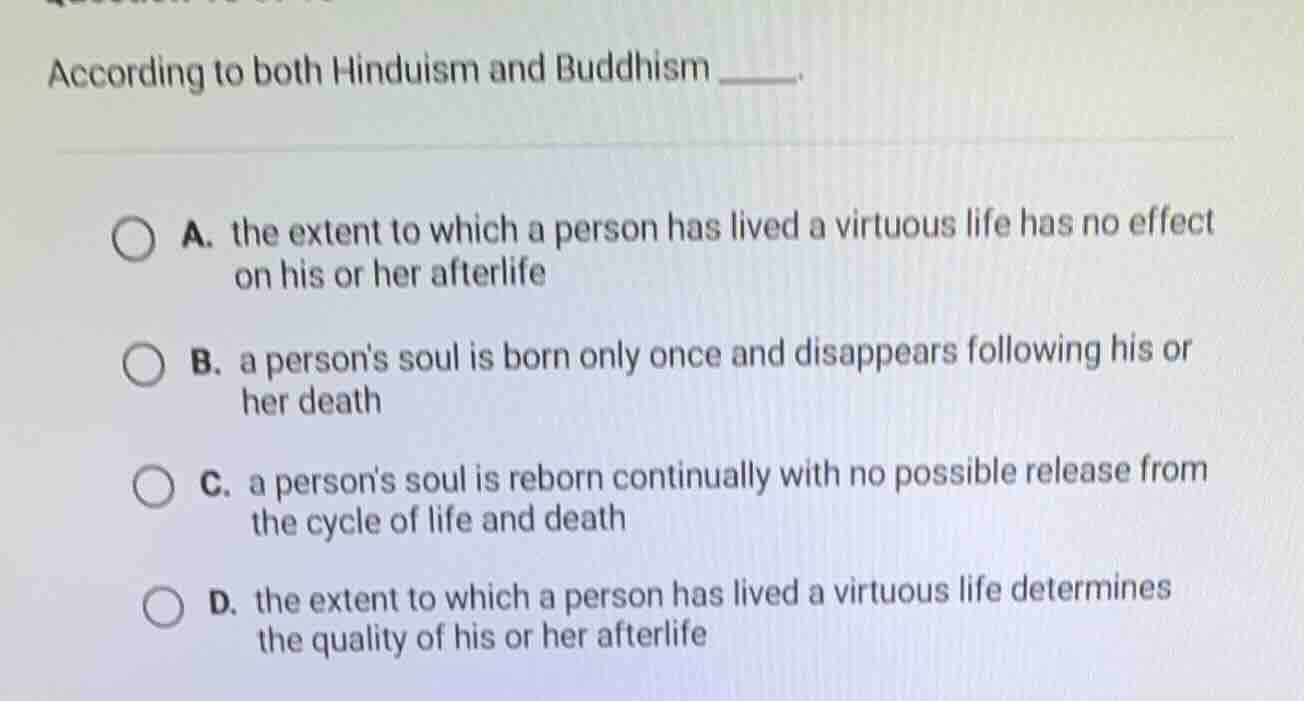
according to both hinduism and buddhism _____. a. the extent to which a person has lived a virtuous life has no effect on his or her afterlife b. a persons soul is born only once and disappears following his or her death c. a persons soul is reborn continually with no possible release from the cycle of life and death d. the extent to which a person has lived a virtuous life determines the quality of his or her afterlife
Both Hinduism and Buddhism uphold the concept of karma, which teaches that a person's actions (including virtuous conduct) directly influence the nature of their future existence or afterlife. Option A contradicts this core belief. Option B is incorrect because both traditions teach reincarnation (soul rebirth, not a single life). Option C is wrong as both religions outline paths to escape the cycle of rebirth (moksha in Hinduism, nirvana in Buddhism).

Snap & solve any problem in the app
Get step-by-step solutions on Sovi AI
Photo-based solutions with guided steps
Explore more problems and detailed explanations
D. the extent to which a person has lived a virtuous life determines the quality of his or her afterlife