QUESTION IMAGE
Question
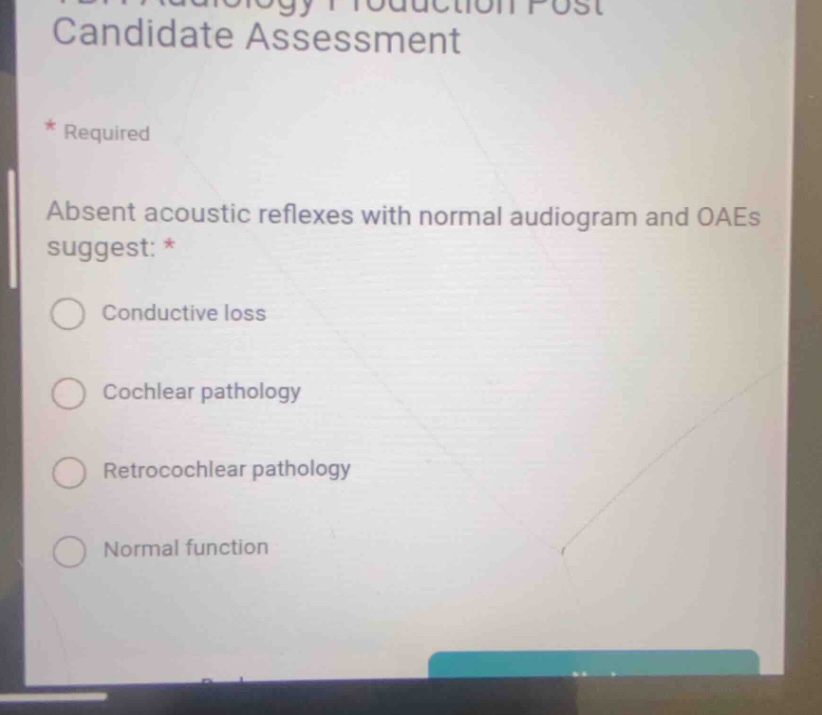
absent acoustic reflexes with normal audiogram and oaes suggest:
conductive loss
cochlear pathology
retrocochlear pathology
normal function
<pre_analysis>
{
"quality": "clear",
"question_count": 1,
"skills_matched": [
"direct_cot",
"multiple_choice_formatter",
"explain_then_answer",
"tutor"
],
"needs_drawing": false,
"concepts_used": [
"Otoacoustic Emissions"
],
"new_concepts": [
"Acoustic Reflex Pathway",
"Retrocochlear Pathology"
],
"current_concepts": [
"Otoacoustic Emissions",
"Acoustic Reflex Pathway",
"Retrocochlear Pathology"
]
}
</pre_analysis>
<reasoning>
Analyze the clinical findings
The clinical presentation describes three key findings:
- Normal audiogram: This indicates that behavioral hearing thresholds are within normal limits, ruling out significant conductive or cochlear hearing loss.
- Normal Otoacoustic Emissions (OAEs): Normal OAEs confirm healthy outer hair cell function within the cochlea, which is a key component of Otoacoustic Emissions. This strongly suggests that the cochlea is functioning normally.
- Absent acoustic reflexes: The acoustic reflex arc involves the middle ear, cochlea, vestibulocochlear nerve (CN VIII), brainstem (cochlear nucleus, superior olivary complex), facial nerve (CN VII), and the stapedius muscle.
Evaluate the diagnostic options
- Conductive loss: A conductive hearing loss would typically result in an abnormal audiogram (air-bone gap) and absent OAEs because conductive barriers block both the stimulus going in and the emission coming out.
- Cochlear pathology: If there were significant cochlear pathology, we would expect an abnormal audiogram (sensory loss) and absent or reduced OAEs.
- Retrocochlear pathology: A lesion or pathology beyond the cochlea (such as on the auditory nerve or within the brainstem reflex pathways) can leave outer hair cell function (OAEs) and behavioral thresholds (audiogram) intact, while disrupting the neural synchrony or transmission required to trigger the acoustic reflex.
- Normal function: Absent acoustic reflexes in the presence of normal hearing thresholds are not considered normal.
Determine the clinical conclusion
Since the cochlea and middle ear function normally (as evidenced by normal OAEs and a normal audiogram), the site of lesion causing the absent acoustic reflexes must lie beyond the cochlea. Therefore, this pattern of results is highly suggestive of a retrocochlear pathology (such as vestibular schwannoma or auditory neuropathy spectrum disorder).
</reasoning>
<answer>
<mcq-option>Conductive loss</mcq-option>
<mcq-option>Cochlear pathology</mcq-option>
<mcq-correct>Retrocochlear pathology</mcq-correct>
<mcq-option>Normal function</mcq-option>
</answer>
<post_analysis>
{
"subject": "Natural Science",
"question_type": "Multiple Choice",
"knowledge_point": [
"Natural Science",
"Medicine",
"Audiology"
]
}
</post_analysis>
Snap & solve any problem in the app
Get step-by-step solutions on Sovi AI
Photo-based solutions with guided steps
Explore more problems and detailed explanations
<pre_analysis>
{
"quality": "clear",
"question_count": 1,
"skills_matched": [
"direct_cot",
"multiple_choice_formatter",
"explain_then_answer",
"tutor"
],
"needs_drawing": false,
"concepts_used": [
"Otoacoustic Emissions"
],
"new_concepts": [
"Acoustic Reflex Pathway",
"Retrocochlear Pathology"
],
"current_concepts": [
"Otoacoustic Emissions",
"Acoustic Reflex Pathway",
"Retrocochlear Pathology"
]
}
</pre_analysis>
<reasoning>
Analyze the clinical findings
The clinical presentation describes three key findings:
- Normal audiogram: This indicates that behavioral hearing thresholds are within normal limits, ruling out significant conductive or cochlear hearing loss.
- Normal Otoacoustic Emissions (OAEs): Normal OAEs confirm healthy outer hair cell function within the cochlea, which is a key component of Otoacoustic Emissions. This strongly suggests that the cochlea is functioning normally.
- Absent acoustic reflexes: The acoustic reflex arc involves the middle ear, cochlea, vestibulocochlear nerve (CN VIII), brainstem (cochlear nucleus, superior olivary complex), facial nerve (CN VII), and the stapedius muscle.
Evaluate the diagnostic options
- Conductive loss: A conductive hearing loss would typically result in an abnormal audiogram (air-bone gap) and absent OAEs because conductive barriers block both the stimulus going in and the emission coming out.
- Cochlear pathology: If there were significant cochlear pathology, we would expect an abnormal audiogram (sensory loss) and absent or reduced OAEs.
- Retrocochlear pathology: A lesion or pathology beyond the cochlea (such as on the auditory nerve or within the brainstem reflex pathways) can leave outer hair cell function (OAEs) and behavioral thresholds (audiogram) intact, while disrupting the neural synchrony or transmission required to trigger the acoustic reflex.
- Normal function: Absent acoustic reflexes in the presence of normal hearing thresholds are not considered normal.
Determine the clinical conclusion
Since the cochlea and middle ear function normally (as evidenced by normal OAEs and a normal audiogram), the site of lesion causing the absent acoustic reflexes must lie beyond the cochlea. Therefore, this pattern of results is highly suggestive of a retrocochlear pathology (such as vestibular schwannoma or auditory neuropathy spectrum disorder).
</reasoning>
<answer>
<mcq-option>Conductive loss</mcq-option>
<mcq-option>Cochlear pathology</mcq-option>
<mcq-correct>Retrocochlear pathology</mcq-correct>
<mcq-option>Normal function</mcq-option>
</answer>
<post_analysis>
{
"subject": "Natural Science",
"question_type": "Multiple Choice",
"knowledge_point": [
"Natural Science",
"Medicine",
"Audiology"
]
}
</post_analysis>