QUESTION IMAGE
Question
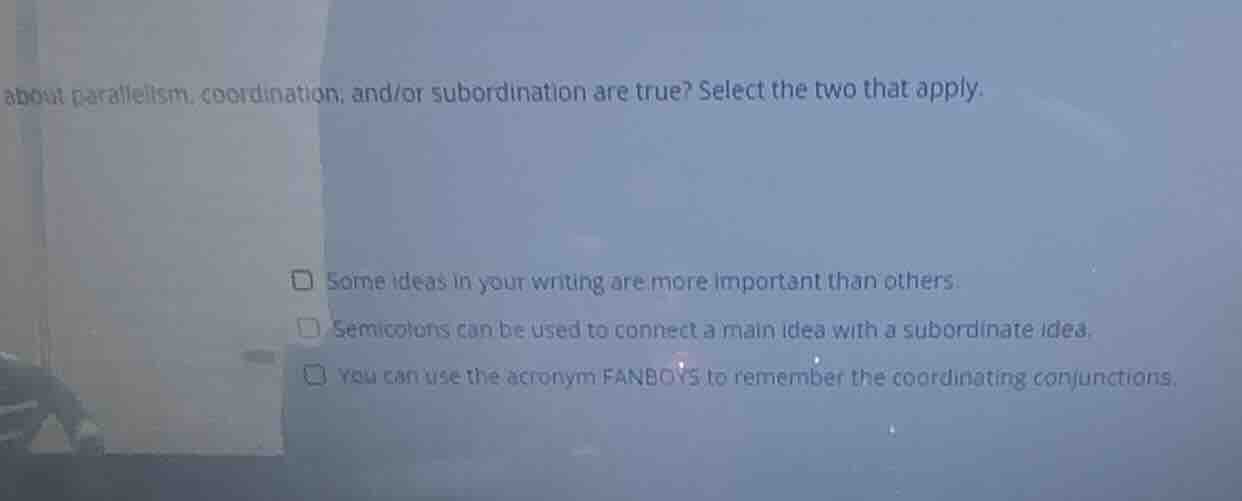
about parallelism, coordination, and/or subordination are true? select the two that apply.
- some ideas in your writing are more important than others.
- semicolons can be used to connect a main idea with a subordinate idea.
- you can use the acronym fanboys to remember the coordinating conjunctions.
🆕 New Concept Discovered: Sentence Coordination and Subordination
Connecting ideas of equal or unequal importance.
Step 1: Analyze the first statement
The first statement is: "Some ideas in your writing are more important than others."
In writing, we use subordination to show that one idea is less important than (or dependent on) another main idea. For example, in the sentence "Although it was raining, we went for a walk," the main idea is that we went for a walk, while the weather is subordinated. Therefore, this statement is true.
Step 2: Analyze the second statement
The second statement is: "Semicolons can be used to connect a main idea with a subordinate idea."
A semicolon is used to link two independent clauses (two main, complete thoughts of equal importance) without a coordinating conjunction. It cannot be used to connect an independent clause (main idea) directly to a dependent clause (subordinate idea) without creating a grammatical error. Therefore, this statement is false.
Step 3: Analyze the third statement
The third statement is: "You can use the acronym FANBOYS to remember the coordinating conjunctions."
The acronym FANBOYS stands for the seven coordinating conjunctions used in coordination to join words, phrases, or independent clauses of equal grammatical importance:
- For
- And
- Nor
- But
- Or
- Yet
- So
Therefore, this statement is true.

Snap & solve any problem in the app
Get step-by-step solutions on Sovi AI
Photo-based solutions with guided steps
Explore more problems and detailed explanations
The two true statements are:
- Some ideas in your writing are more important than others.
- You can use the acronym FANBOYS to remember the coordinating conjunctions.