QUESTION IMAGE
Question
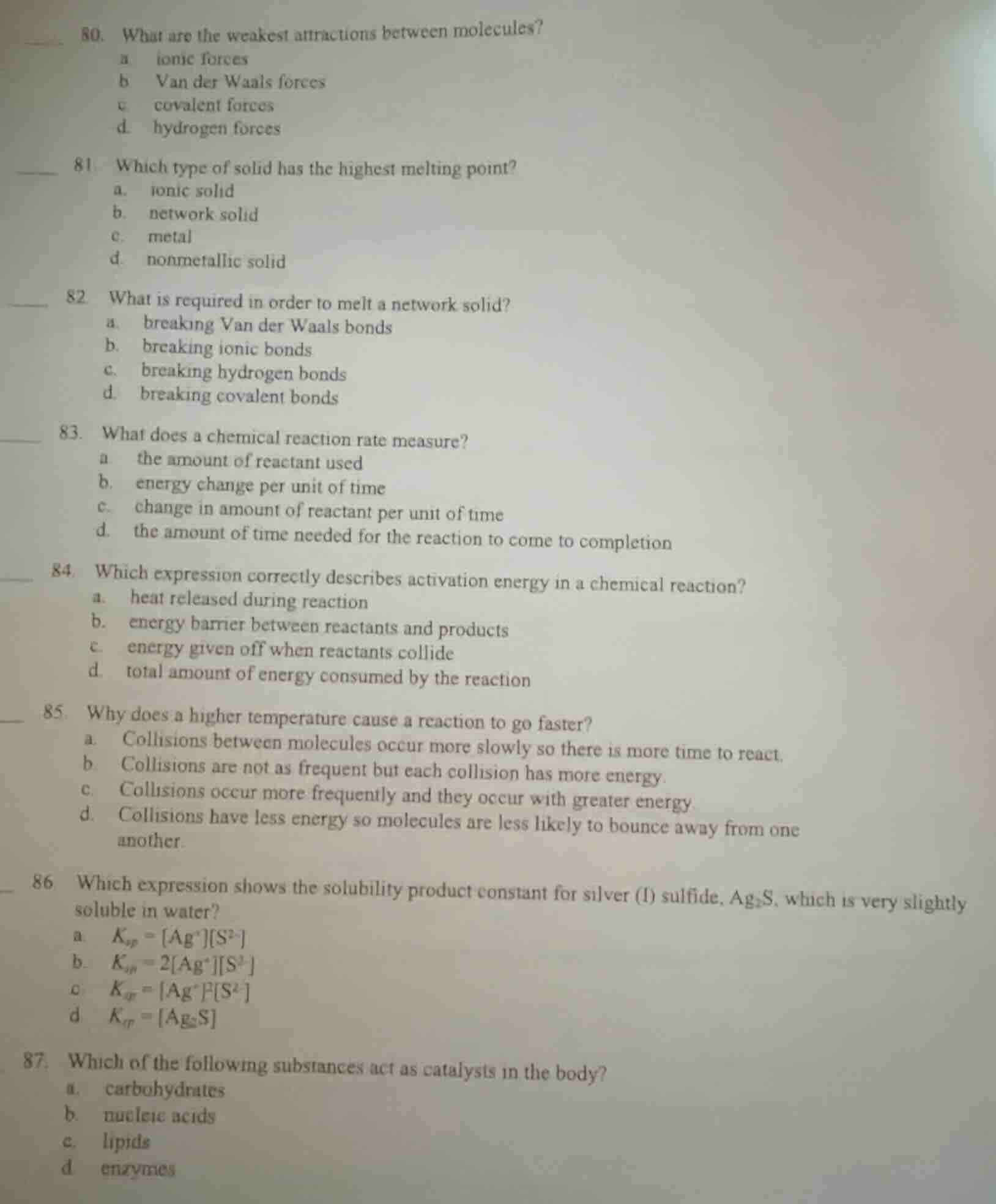
- what are the weakest attractions between molecules?
a. ionic forces
b. van der waals forces
c. covalent forces
d. hydrogen forces
- which type of solid has the highest melting point?
a. ionic solid
b. network solid
c. metal
d. nonmetallic solid
- what is required in order to melt a network solid?
a. breaking van der waals bonds
b. breaking ionic bonds
c. breaking hydrogen bonds
d. breaking covalent bonds
- what does a chemical reaction rate measure?
a. the amount of reactant used
b. energy change per unit of time
c. change in amount of reactant per unit of time
d. the amount of time needed for the reaction to come to completion
- which expression correctly describes activation energy in a chemical reaction?
a. heat released during reaction
b. energy barrier between reactants and products
c. energy given off when reactants collide
d. total amount of energy consumed by the reaction
- why does a higher temperature cause a reaction to go faster?
a. collisions between molecules occur more slowly so there is more time to react.
b. collisions are not as frequent but each collision has more energy.
c. collisions occur more frequently and they occur with greater energy.
d. collisions have less energy so molecules are less likely to bounce away from one another.
- which expression shows the solubility product constant for silver (i) sulfide, \\(\text{ag}_2\text{s}\\), which is very slightly soluble in water?
a. \\(k_{\text{sp}} = \text{ag}^+\text{s}^{2-}\\)
b. \\(k_{\text{sp}} = 2\text{ag}^+\text{s}^{2-}\\)
c. \\(k_{\text{sp}} = \text{ag}^+^2\text{s}^{2-}\\)
d. \\(k_{\text{sp}} = \text{ag}_2\text{s}\\)
- which of the following substances act as catalysts in the body?
a. carbohydrates
b. nucleic acids
c. lipids
d. enzymes
Analyze intermolecular attractions
Using the Intermolecular Forces knowledge point
- Van der Waals forces (dispersion and dipole-dipole) are weak attractions between molecules.
- Ionic, covalent, and metallic bonds are strong intramolecular/chemical bonds.
- Hydrogen bonds are a strong type of intermolecular force, but still stronger than general Van der Waals forces.
- Therefore, Van der Waals forces are the weakest attractions between molecules.
Analyze solid melting points
Using the Chemical Bonding and Covalent Bonding Types knowledge points
- Network solids (like diamond or quartz) are held together by a continuous network of strong covalent bonds.
- Melting a network solid requires breaking these strong covalent bonds throughout the entire structure.
- This requires extremely high temperatures, giving network solids the highest melting points.
- Thus, breaking covalent bonds is required to melt a network solid.
Define chemical reaction rate
Using the Reaction Rates and Activation knowledge point
- Reaction rate measures how quickly reactants are consumed or products are formed.
- This is expressed as the change in the amount (or concentration) of a reactant or product per unit of time.
Define activation energy
Using the Reaction Rates and Activation knowledge point
- Activation energy is the minimum energy required to initiate a chemical reaction.
- It represents the energy barrier that reactants must overcome to transform into products.
Explain temperature effects on rate
Using the Reaction Rates and Activation knowledge point
- Higher temperature increases the average kinetic energy of molecules.
- This causes molecules to move faster, leading to more frequent collisions.
- A larger fraction of these collisions will also have energy exceeding the activation energy barrier.
Determine solubility product expression
- Silver(I) sulfide (\(\text{Ag}_2\text{S}\)) dissociates in water according to the equilibrium:
- The solubility product constant (\(K_{sp}\)) expression is the product of the equilibrium concentrations of the ions, each raised to the power of its stoichiometric coefficient:
Identify biological catalysts
- Catalysts speed up chemical reactions without being consumed.
- In living organisms, specialized proteins called enzymes act as biological catalysts.

Snap & solve any problem in the app
Get step-by-step solutions on Sovi AI
Photo-based solutions with guided steps
Explore more problems and detailed explanations
Question 80
- a. ionic forces
- b. Van der Waals forces (Correct answer)
- c. covalent forces
- d. hydrogen forces
Question 81
- a. ionic solid
- b. network solid (Correct answer)
- c. metal
- d. nonmetallic solid
Question 82
- a. breaking Van der Waals bonds
- b. breaking ionic bonds
- c. breaking hydrogen bonds
- d. breaking covalent bonds (Correct answer)
Question 83
- a. the amount of reactant used
- b. energy change per unit of time
- c. change in amount of reactant per unit of time (Correct answer)
- d. the amount of time needed for the reaction to come to completion
Question 84
- a. heat released during reaction
- b. energy barrier between reactants and products (Correct answer)
- c. energy given off when reactants collide
- d. total amount of energy consumed by the reaction
Question 85
- a. Collisions between molecules occur more slowly so there is more time to react.
- b. Collisions are not as frequent but each collision has more energy.
- c. Collisions occur more frequently and they occur with greater energy. (Correct answer)
- d. Collisions have less energy so molecules are less likely to bounce away from one another.
Question 86
- a. \(K_{sp} = [\text{Ag}^+][\text{S}^{2-}]\)
- b. \(K_{sp} = 2[\text{Ag}^+][\text{S}^{2-}]\)
- c. \(K_{sp} = [\text{Ag}^+]^2[\text{S}^{2-}]\) (Correct answer)
- d. \(K_{sp} = [\text{Ag}_2\text{S}]\)
Question 87
- a. carbohydrates
- b. nucleic acids
- c. lipids
- d. enzymes (Correct answer)