QUESTION IMAGE
Question
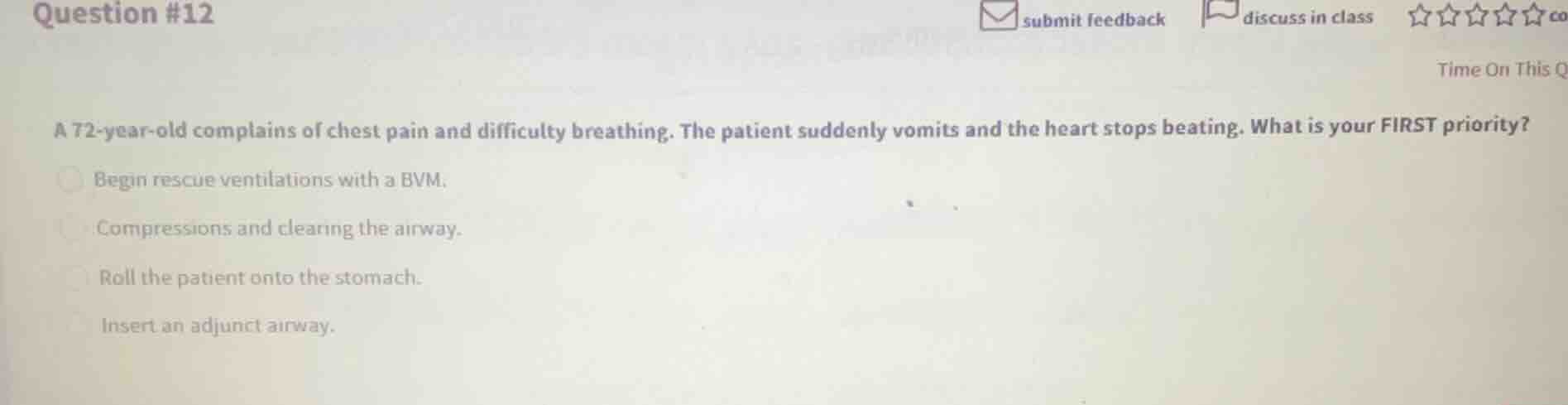
a 72-year-old complains of chest pain and difficulty breathing. the patient suddenly vomits and the heart stops beating. what is your first priority?
begin rescue ventilations with a bvm.
compressions and clearing the airway.
roll the patient onto the stomach.
insert an adjunct airway.
<pre_analysis>
{
"quality": "clear",
"question_count": 1,
"skills_matched": [
"direct_cot",
"multiple_choice_formatter",
"explain_then_answer",
"tutor",
"mastery_adaptive_brevity"
],
"needs_drawing": false,
"concepts_used": [
"Airway Management Protocols",
"BVM Ventilation Protocols"
],
"new_concepts": [
"Cardiac Arrest Airway Management",
"Suctioning and Airway Clearing"
],
"current_concepts": [
"Airway Management Protocols",
"BVM Ventilation Protocols",
"Cardiac Arrest Airway Management",
"Suctioning and Airway Clearing"
]
}
</pre_analysis>
<reasoning>
Analyze the clinical scenario
The patient is a 72-year-old in cardiac arrest ("heart stops beating") immediately after vomiting. In any cardiac arrest, high-quality chest compressions are vital, but a compromised airway due to active vomiting must be cleared immediately to prevent aspiration and allow effective ventilation.
Evaluate the airway priority
Using the Airway Management Protocols knowledge point
- Active vomit in the airway blocks airflow and causes severe aspiration.
- Clearing the airway (via suctioning or manual clearing) must occur alongside starting chest compressions.
- Ventilating with a BVM before clearing the airway would force vomit into the lungs.
Assess the remaining options
Using the BVM Ventilation Protocols knowledge point
- Begin rescue ventilations with a BVM: Contraindicated while the airway is full of vomit, as it causes aspiration.
- Roll the patient onto the stomach: Incorrect; the patient needs to be supine for CPR, though a recovery position or log-roll is used temporarily to drain vomit.
- Insert an adjunct airway: An adjunct (like an OPA) cannot be safely placed or utilized until the airway is cleared of liquid vomit.
</reasoning>
<answer>
<mcq-option>Begin rescue ventilations with a BVM.</mcq-option>
<mcq-correct>Compressions and clearing the airway.</mcq-correct>
<mcq-option>Roll the patient onto the stomach.</mcq-option>
<mcq-option>Insert an adjunct airway.</mcq-option>
</answer>
<post_analysis>
{
"subject": "Natural Science",
"question_type": "Multiple Choice",
"knowledge_point": [
"Natural Science",
"Medicine",
"Emergency Medical Services"
]
}
</post_analysis>
Snap & solve any problem in the app
Get step-by-step solutions on Sovi AI
Photo-based solutions with guided steps
Explore more problems and detailed explanations
<pre_analysis>
{
"quality": "clear",
"question_count": 1,
"skills_matched": [
"direct_cot",
"multiple_choice_formatter",
"explain_then_answer",
"tutor",
"mastery_adaptive_brevity"
],
"needs_drawing": false,
"concepts_used": [
"Airway Management Protocols",
"BVM Ventilation Protocols"
],
"new_concepts": [
"Cardiac Arrest Airway Management",
"Suctioning and Airway Clearing"
],
"current_concepts": [
"Airway Management Protocols",
"BVM Ventilation Protocols",
"Cardiac Arrest Airway Management",
"Suctioning and Airway Clearing"
]
}
</pre_analysis>
<reasoning>
Analyze the clinical scenario
The patient is a 72-year-old in cardiac arrest ("heart stops beating") immediately after vomiting. In any cardiac arrest, high-quality chest compressions are vital, but a compromised airway due to active vomiting must be cleared immediately to prevent aspiration and allow effective ventilation.
Evaluate the airway priority
Using the Airway Management Protocols knowledge point
- Active vomit in the airway blocks airflow and causes severe aspiration.
- Clearing the airway (via suctioning or manual clearing) must occur alongside starting chest compressions.
- Ventilating with a BVM before clearing the airway would force vomit into the lungs.
Assess the remaining options
Using the BVM Ventilation Protocols knowledge point
- Begin rescue ventilations with a BVM: Contraindicated while the airway is full of vomit, as it causes aspiration.
- Roll the patient onto the stomach: Incorrect; the patient needs to be supine for CPR, though a recovery position or log-roll is used temporarily to drain vomit.
- Insert an adjunct airway: An adjunct (like an OPA) cannot be safely placed or utilized until the airway is cleared of liquid vomit.
</reasoning>
<answer>
<mcq-option>Begin rescue ventilations with a BVM.</mcq-option>
<mcq-correct>Compressions and clearing the airway.</mcq-correct>
<mcq-option>Roll the patient onto the stomach.</mcq-option>
<mcq-option>Insert an adjunct airway.</mcq-option>
</answer>
<post_analysis>
{
"subject": "Natural Science",
"question_type": "Multiple Choice",
"knowledge_point": [
"Natural Science",
"Medicine",
"Emergency Medical Services"
]
}
</post_analysis>