QUESTION IMAGE
Question
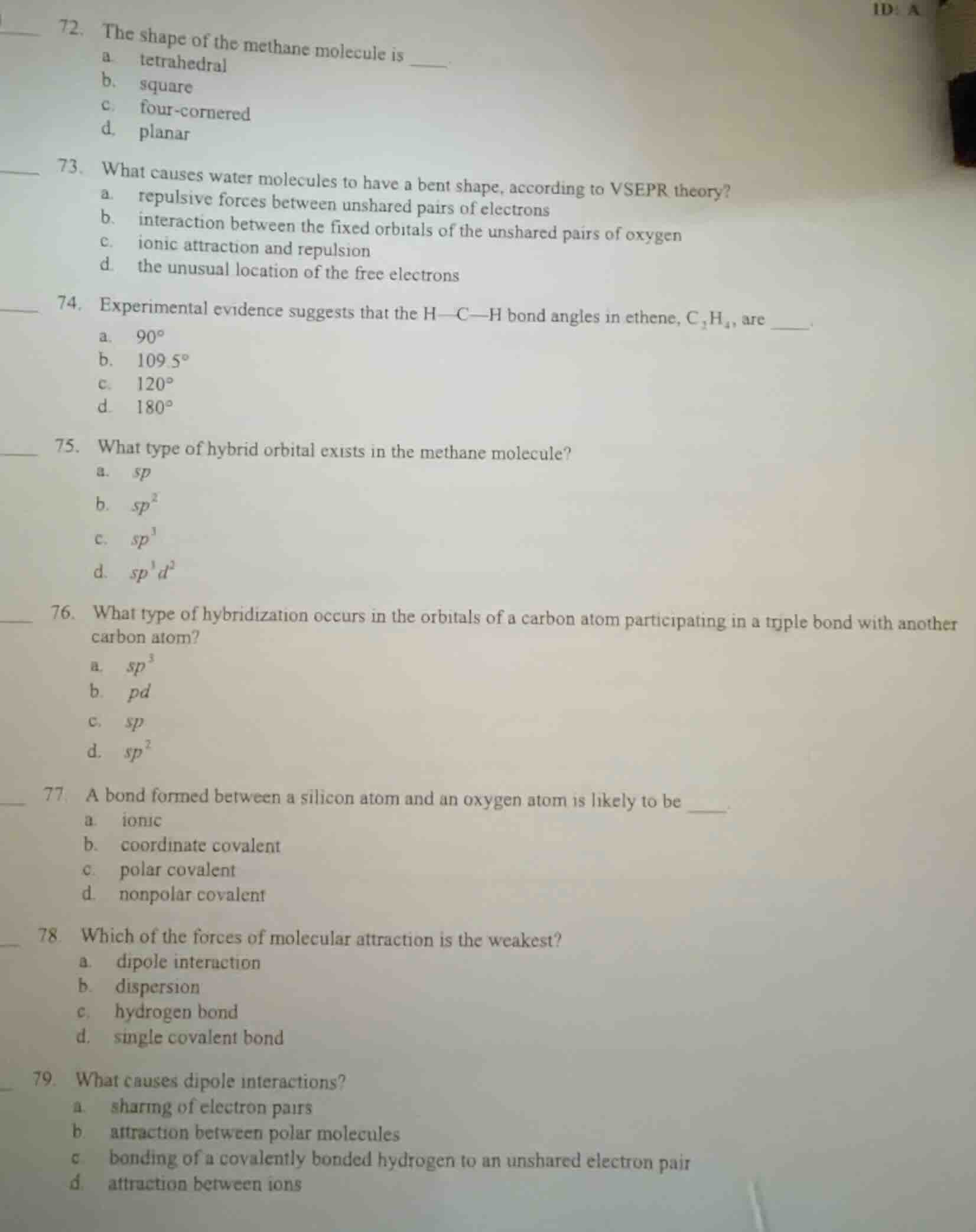
- the shape of the methane molecule is _____
a. tetrahedral
b. square
c. four-cornered
d. planar
- what causes water molecules to have a bent shape, according to vsepr theory?
a. repulsive forces between unshared pairs of electrons
b. interaction between the fixed orbitals of the unshared pairs of oxygen
c. ionic attraction and repulsion
d. the unusual location of the free electrons
- experimental evidence suggests that the \\(\text{h}-\text{c}-\text{h}\\) bond angles in ethene, \\(\text{c}_2\text{h}_4\\), are _____
a. \\(90^\circ\\)
b. \\(109.5^\circ\\)
c. \\(120^\circ\\)
d. \\(180^\circ\\)
- what type of hybrid orbital exists in the methane molecule?
a. \\(sp\\)
b. \\(sp^2\\)
c. \\(sp^3\\)
d. \\(sp^3d^2\\)
- what type of hybridization occurs in the orbitals of a carbon atom participating in a triple bond with another carbon atom?
a. \\(sp^3\\)
b. \\(pd\\)
c. \\(sp\\)
d. \\(sp^2\\)
- a bond formed between a silicon atom and an oxygen atom is likely to be _____
a. ionic
b. coordinate covalent
c. polar covalent
d. nonpolar covalent
- which of the forces of molecular attraction is the weakest?
a. dipole interaction
b. dispersion
c. hydrogen bond
d. single covalent bond
- what causes dipole interactions?
a. sharing of electron pairs
b. attraction between polar molecules
c. bonding of a covalently bonded hydrogen to an unshared electron pair
d. attraction between ions
Question 72: Shape of Methane
Using the VSEPR Theory knowledge point, methane (\(\text{CH}_4\)) has four single covalent bonds and zero lone pairs on the central carbon atom. This corresponds to an \(\text{AX}_4\) system, which adopts a tetrahedral geometry to minimize electron pair repulsion.
Question 73: Bent Shape of Water
Using the VSEPR Theory knowledge point, water (\(\text{H}_2\text{O}\)) has two bonding pairs and two unshared (lone) pairs of electrons on the oxygen atom. According to VSEPR theory, the strong repulsive forces exerted by these unshared pairs of electrons push the hydrogen-oxygen bonds closer together, resulting in a bent molecular shape.
Question 74: Bond Angles in Ethene
Ethene (\(\text{C}_2\text{H}_4\)) contains a carbon-carbon double bond. Each carbon atom is bonded to three other atoms (one carbon and two hydrogens) with zero lone pairs, giving a trigonal planar geometry. The ideal bond angle for a trigonal planar arrangement is \(120^\circ\).
Question 75: Hybrid Orbitals in Methane
The central carbon atom in methane (\(\text{CH}_4\)) forms four single \(\sigma\)-bonds with four hydrogen atoms. To accommodate these four equivalent bonds, the carbon atom's one \(2s\) orbital and three \(2p\) orbitals hybridize to form four equivalent \(sp^3\) hybrid orbitals.
Question 76: Hybridization in a Triple Bond
A carbon atom participating in a triple bond (such as in ethyne, \(\text{C}_2\text{H}_2\)) forms one \(\sigma\)-bond and two \(\pi\)-bonds. The steric number of this carbon is 2 (two \(\sigma\)-bonds, zero lone pairs), which requires the hybridization of one \(s\) orbital and one \(p\) orbital to form two \(sp\) hybrid orbitals.
Question 77: Silicon-Oxygen Bond Character
Silicon (\(\text{Si}\)) has an electronegativity of 1.9, and oxygen (\(\text{O}\)) has an electronegativity of 3.4. The electronegativity difference (\(\Delta \chi = 1.5\)) is significant enough to make the sharing of electrons unequal, but not high enough to form a purely ionic bond. Therefore, the bond is polar covalent.
Question 78: Weakest Intermolecular Force
Among the options, dispersion forces (London dispersion forces) are temporary dipole-induced dipole interactions present in all molecules and are generally the weakest of all intermolecular forces. Note that a single covalent bond is an intramolecular chemical bond, which is much stronger than any intermolecular force.
Question 79: Cause of Dipole Interactions
Dipole interactions (dipole-dipole forces) occur when the electrostatic attraction exists between the partially positive end of one polar molecule and the partially negative end of another polar molecule.

Snap & solve any problem in the app
Get step-by-step solutions on Sovi AI
Photo-based solutions with guided steps
Explore more problems and detailed explanations
Question 72
- a. tetrahedral (Correct answer)
- b. square
- c. four-cornered
- d. planar
Question 73
- a. repulsive forces between unshared pairs of electrons (Correct answer)
- b. interaction between the fixed orbitals of the unshared pairs of oxygen
- c. ionic attraction and repulsion
- d. the unusual location of the free electrons
Question 74
- a. \(90^\circ\)
- b. \(109.5^\circ\)
- c. \(120^\circ\) (Correct answer)
- d. \(180^\circ\)
Question 75
- a. \(sp\)
- b. \(sp^2\)
- c. \(sp^3\) (Correct answer)
- d. \(sp^3d^2\)
Question 76
- a. \(sp^3\)
- b. \(pd\)
- c. \(sp\) (Correct answer)
- d. \(sp^2\)
Question 77
- a. ionic
- b. coordinate covalent
- c. polar covalent (Correct answer)
- d. nonpolar covalent
Question 78
- a. dipole interaction
- b. dispersion (Correct answer)
- c. hydrogen bond
- d. single covalent bond
Question 79
- a. sharing of electron pairs
- b. attraction between polar molecules (Correct answer)
- c. bonding of a covalently bonded hydrogen to an unshared electron pair
- d. attraction between ions