QUESTION IMAGE
Question
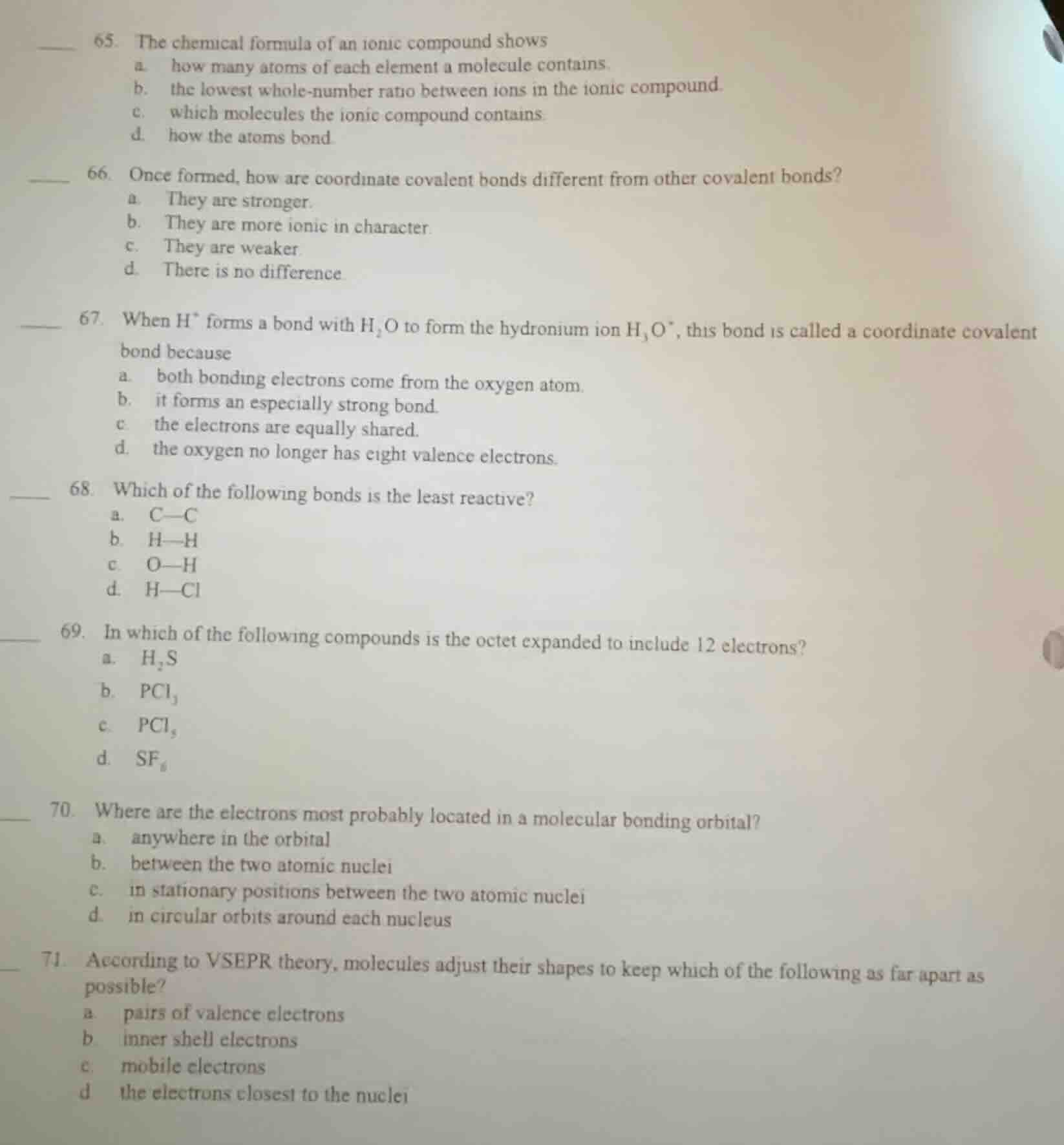
- the chemical formula of an ionic compound shows
a. how many atoms of each element a molecule contains.
b. the lowest whole-number ratio between ions in the ionic compound.
c. which molecules the ionic compound contains.
d. how the atoms bond.
- once formed, how are coordinate covalent bonds different from other covalent bonds?
a. they are stronger.
b. they are more ionic in character.
c. they are weaker.
d. there is no difference.
- when \\(\text{h}^+\\) forms a bond with \\(\text{h}_2\text{o}\\) to form the hydronium ion \\(\text{h}_3\text{o}^+\\), this bond is called a coordinate covalent bond because
a. both bonding electrons come from the oxygen atom.
b. it forms an especially strong bond.
c. the electrons are equally shared.
d. the oxygen no longer has eight valence electrons.
- which of the following bonds is the least reactive?
a. \\(\text{c}-\text{c}\\)
b. \\(\text{h}-\text{h}\\)
c. \\(\text{o}-\text{h}\\)
d. \\(\text{h}-\text{cl}\\)
- in which of the following compounds is the octet expanded to include 12 electrons?
a. \\(\text{h}_2\text{s}\\)
b. \\(\text{pcl}_3\\)
c. \\(\text{pcl}_5\\)
d. \\(\text{sf}_6\\)
- where are the electrons most probably located in a molecular bonding orbital?
a. anywhere in the orbital
b. between the two atomic nuclei
c. in stationary positions between the two atomic nuclei
d. in circular orbits around each nucleus
- according to vsepr theory, molecules adjust their shapes to keep which of the following as far apart as possible?
a. pairs of valence electrons
b. inner shell electrons
c. mobile electrons
d. the electrons closest to the nuclei
Analyze ionic chemical formulas
Using the Chemical Bonding knowledge point, we examine the nature of ionic compounds. Ionic compounds form continuous three-dimensional crystal lattices rather than discrete molecules. Therefore, their chemical formulas represent the simplest whole-number ratio of the constituent ions, known as the empirical formula.
Compare coordinate covalent bonds
Using the Covalent Bonding Types knowledge point, we analyze coordinate covalent bonds. A coordinate covalent bond is formed when one atom provides both bonding electrons. Once formed, however, the electrons are shared between the nuclei just like in a standard covalent bond. Thus, there is no physical or chemical difference between a coordinate covalent bond and any other single covalent bond.
Identify coordinate covalent bond formation
Using the Covalent Bonding Types knowledge point, we look at the hydronium ion \(\text{H}_3\text{O}^+\). A hydrogen ion \(\text{H}^+\) has no electrons, while a water molecule \(\text{H}_2\text{O}\) has two unshared pairs of electrons on its oxygen atom. When they bond, both electrons in the new covalent bond are donated solely by the oxygen atom.
Determine bond reactivity
We compare the chemical stability of the given single bonds: \(\text{C}-\text{H}\), \(\text{H}-\text{H}\), \(\text{O}-\text{H}\), and \(\text{H}-\text{Cl}\). The hydrogen molecule \(\text{H}_2\) (\(\text{H}-\text{H}\) bond) is highly stable with a very high bond dissociation energy (\(436\text{ kJ/mol}\)) and lacks polar character, making it exceptionally unreactive under standard conditions compared to polar bonds or bonds in larger organic frameworks.
Identify expanded octet molecules
We calculate the valence electrons around the central atoms. Sulfur in \(\text{SF}_6\) has \(6\) valence electrons and forms \(6\) single covalent bonds with fluorine atoms. This results in a total of \(12\) shared valence electrons surrounding the central sulfur atom, which represents an expanded octet.
Locate electrons in bonding orbitals
In molecular orbital theory, a bonding molecular orbital is characterized by a high electron density concentrated in the region directly between the two nuclei of the bonded atoms, which helps hold the nuclei together.
Apply VSEPR theory
Valence Shell Electron Pair Repulsion (VSEPR) theory states that electron pairs in the valence shell of a central atom repel each other. Consequently, these valence electron pairs adjust their spatial orientation to remain as far apart as possible to minimize electrostatic repulsion.

Snap & solve any problem in the app
Get step-by-step solutions on Sovi AI
Photo-based solutions with guided steps
Explore more problems and detailed explanations
Question 65
- a. how many atoms of each element a molecule contains.
- b. the lowest whole-number ratio between ions in the ionic compound. (Correct answer)
- c. which molecules the ionic compound contains.
- d. how the atoms bond.
Question 66
- a. They are stronger.
- b. They are more ionic in character.
- c. They are weaker.
- d. There is no difference. (Correct answer)
Question 67
- a. both bonding electrons come from the oxygen atom. (Correct answer)
- b. it forms an especially strong bond.
- c. the electrons are equally shared.
- d. the oxygen no longer has eight valence electrons.
Question 68
- a. C—H
- b. H—H (Correct answer)
- c. O—H
- d. H—Cl
Question 69
- a. H₂S
- b. PCl₃
- c. PCl₅
- d. SF₆ (Correct answer)
Question 70
- a. anywhere in the orbital
- b. between the two atomic nuclei (Correct answer)
- c. in stationary positions between the two atomic nuclei
- d. in circular orbits around each nucleus
Question 71
- a. pairs of valence electrons (Correct answer)
- b. inner shell electrons
- c. mobile electrons
- d. the electrons closest to the nuclei