QUESTION IMAGE
Question
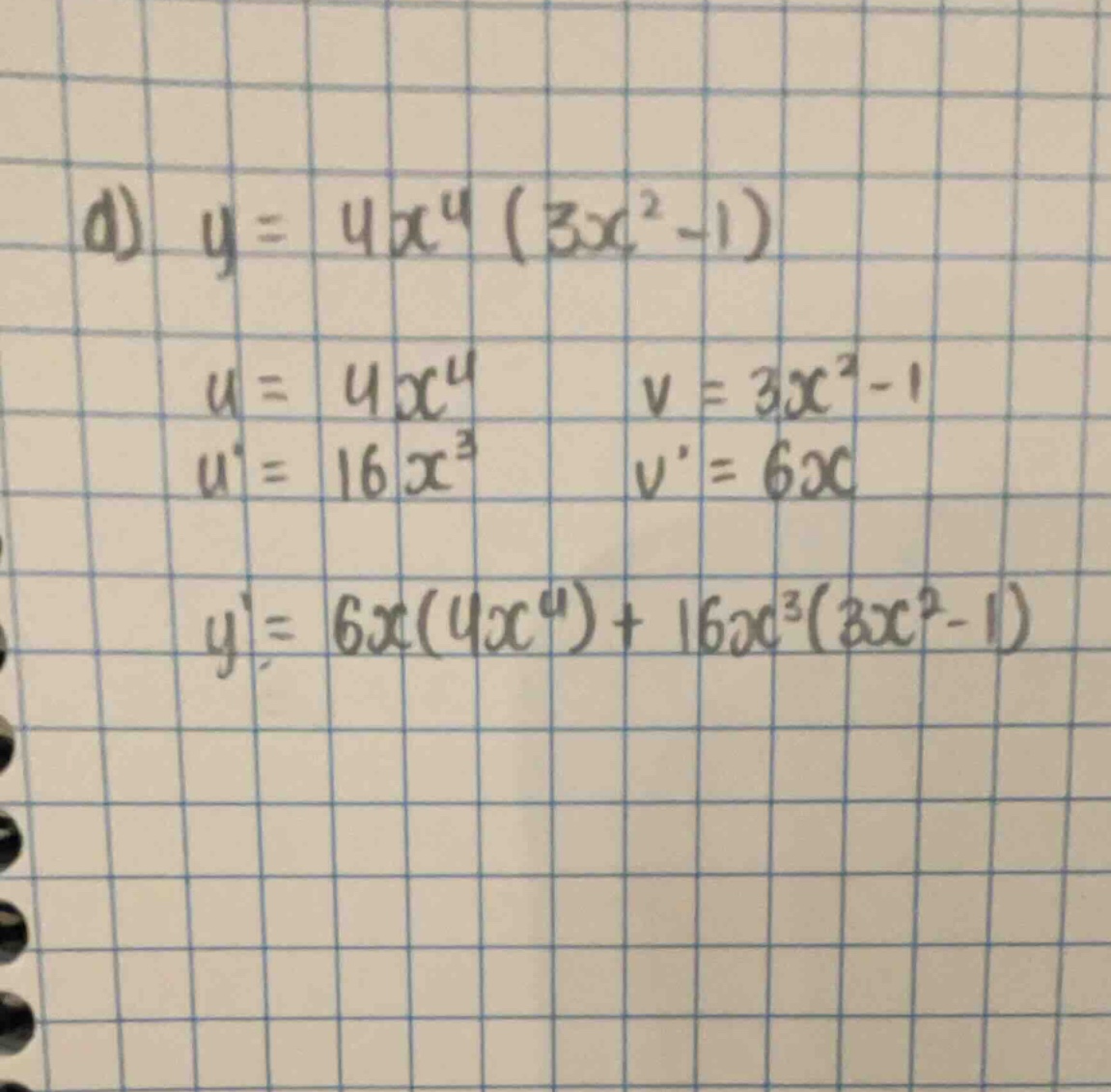
d) \\(y = 4x^4(3x^2 - 1)\\)
\\(u = 4x^4\\) \t \\(v = 3x^2 - 1\\)
\\(u = 16x^3\\) \t \\(v = 6x\\)
\\(y = 6x(4x^4) + 16x^3(3x^2 - 1)\\)
<pre_analysis>
{
"quality": "clear",
"question_count": 1,
"skills_matched": [
"step_cot",
"explain_then_answer",
"tutor"
],
"needs_drawing": false,
"concepts_used": [],
"new_concepts": [
"Product Rule",
"Power Rule",
"Polynomial Derivative"
],
"current_concepts": [
"Product Rule",
"Power Rule",
"Polynomial Derivative"
]
}
</pre_analysis>
<reasoning>
Identify the function and components
The given function is:
\[ y = 4x^4(3x^2 - 1) \]
We can define the two factors as:
\[ u = 4x^4 \]
\[ v = 3x^2 - 1 \]
Find the individual derivatives
Using the power rule for differentiation:
\[ u' = \frac{d}{dx}(4x^4) = 16x^3 \]
\[ v' = \frac{d}{dx}(3x^2 - 1) = 6x \]
Apply the product rule formula
The product rule states:
\[ y' = u v' + v u' \]
Substituting our functions and their derivatives:
\[ y' = (4x^4)(6x) + (3x^2 - 1)(16x^3) \]
This matches the expression written in the image:
\[ y' = 6x(4x^4) + 16x^3(3x^2 - 1) \]
Simplify the derivative expression
Now we expand and combine like terms to find the fully simplified derivative:
\[ y' = 24x^5 + 16x^3(3x^2) - 16x^3 \]
\[ y' = 24x^5 + 48x^5 - 16x^3 \]
\[ y' = 72x^5 - 16x^3 \]
Factor the final simplified result
We can factor out the greatest common factor, which is \(8x^3\):
\[ y' = 8x^3(9x^2 - 2) \]
</reasoning>
<answer>
\[ y' = 72x^5 - 16x^3 = 8x^3(9x^2 - 2) \]
</answer>
<post_analysis>
{
"subject": "Mathematics",
"question_type": "Free Response",
"knowledge_point": [
"Mathematics",
"Calculus",
"Product Rule"
]
}
</post_analysis>
Snap & solve any problem in the app
Get step-by-step solutions on Sovi AI
Photo-based solutions with guided steps
Explore more problems and detailed explanations
<pre_analysis>
{
"quality": "clear",
"question_count": 1,
"skills_matched": [
"step_cot",
"explain_then_answer",
"tutor"
],
"needs_drawing": false,
"concepts_used": [],
"new_concepts": [
"Product Rule",
"Power Rule",
"Polynomial Derivative"
],
"current_concepts": [
"Product Rule",
"Power Rule",
"Polynomial Derivative"
]
}
</pre_analysis>
<reasoning>
Identify the function and components
The given function is:
\[ y = 4x^4(3x^2 - 1) \]
We can define the two factors as:
\[ u = 4x^4 \]
\[ v = 3x^2 - 1 \]
Find the individual derivatives
Using the power rule for differentiation:
\[ u' = \frac{d}{dx}(4x^4) = 16x^3 \]
\[ v' = \frac{d}{dx}(3x^2 - 1) = 6x \]
Apply the product rule formula
The product rule states:
\[ y' = u v' + v u' \]
Substituting our functions and their derivatives:
\[ y' = (4x^4)(6x) + (3x^2 - 1)(16x^3) \]
This matches the expression written in the image:
\[ y' = 6x(4x^4) + 16x^3(3x^2 - 1) \]
Simplify the derivative expression
Now we expand and combine like terms to find the fully simplified derivative:
\[ y' = 24x^5 + 16x^3(3x^2) - 16x^3 \]
\[ y' = 24x^5 + 48x^5 - 16x^3 \]
\[ y' = 72x^5 - 16x^3 \]
Factor the final simplified result
We can factor out the greatest common factor, which is \(8x^3\):
\[ y' = 8x^3(9x^2 - 2) \]
</reasoning>
<answer>
\[ y' = 72x^5 - 16x^3 = 8x^3(9x^2 - 2) \]
</answer>
<post_analysis>
{
"subject": "Mathematics",
"question_type": "Free Response",
"knowledge_point": [
"Mathematics",
"Calculus",
"Product Rule"
]
}
</post_analysis>