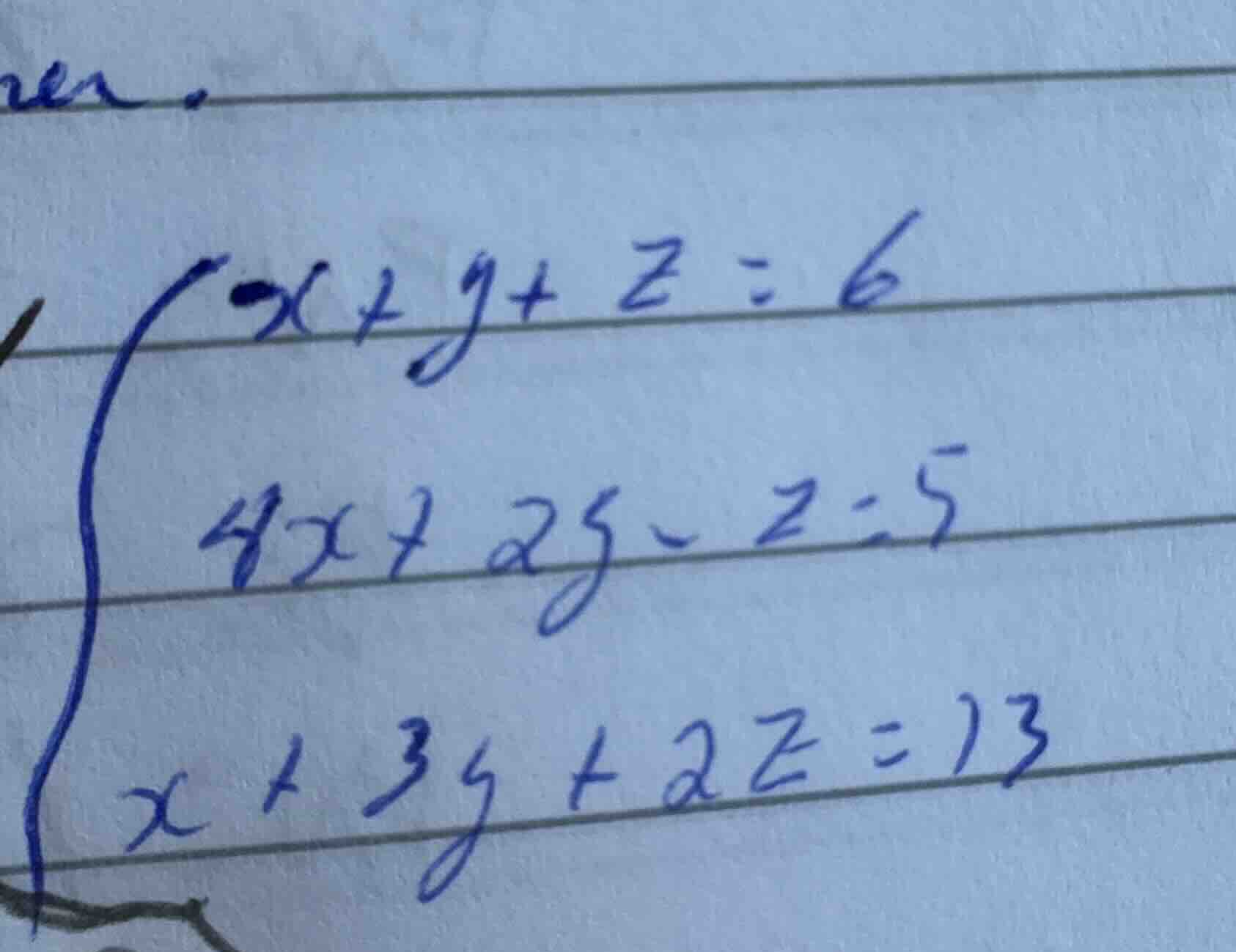
QUESTION IMAGE
Question
\\\
\\
<pre_analysis>
{
"quality": "clear",
"question_count": 1,
"skills_matched": [
"step_cot",
"explain_then_answer",
"tutor"
],
"needs_drawing": false,
"concepts_used": [],
"new_concepts": [
"System of Three Linear Equations",
"Elimination Method"
],
"current_concepts": [
"System of Three Linear Equations",
"Elimination Method"
]
}
</pre_analysis>
<reasoning>
列出方程组
设给定的三元一次方程组为:
\[
\]
消去未知数 z
将方程 (1) 与方程 (2) 相加:
\[
(x + y + z) + (4x + 2y - z) = 6 + 5
\]
\[
5x + 3y = 11 \quad \text{--- (4)}
\]
将方程 (1) 乘以 2,再与方程 (3) 相减:
\[
2(x + y + z) = 12 \quad \text{--- (5)}
\]
用方程 (3) 减去方程 (5):
\[
(x + 3y + 2z) - (2x + 2y + 2z) = 13 - 12
\]
\[
-x + y = 1 \quad \text{--- (6)}
\]
求解二元一次方程组
由方程 (6) 可得:
\[
y = x + 1 \quad \text{--- (7)}
\]
将 (7) 代入 (4):
\[
5x + 3(x + 1) = 11
\]
\[
8x + 3 = 11
\]
\[
8x = 8 \implies x = 1
\]
将 \(x = 1\) 代入 (7) 求得 \(y\):
\[
y = 1 + 1 = 2
\]
求解未知数 z
将 \(x = 1\) 和 \(y = 2\) 代入方程 (1):
\[
1 + 2 + z = 6
\]
\[
3 + z = 6 \implies z = 3
\]
检验方程组的解
将 \(x = 1, y = 2, z = 3\) 代入方程 (2) 和 (3) 进行验证:
对于 (2):\(4(1) + 2(2) - 3 = 4 + 4 - 3 = 5\) (成立)
对于 (3):\(1 + 3(2) + 2(3) = 1 + 6 + 6 = 13\) (成立)
</reasoning>
<answer>
\[
\]
</answer>
<post_analysis>
{
"subject": "Mathematics",
"question_type": "Free Response",
"knowledge_point": [
"Mathematics",
"Algebra",
"System of Three Linear Equations"
]
}
</post_analysis>
Snap & solve any problem in the app
Get step-by-step solutions on Sovi AI
Photo-based solutions with guided steps
Explore more problems and detailed explanations
<pre_analysis>
{
"quality": "clear",
"question_count": 1,
"skills_matched": [
"step_cot",
"explain_then_answer",
"tutor"
],
"needs_drawing": false,
"concepts_used": [],
"new_concepts": [
"System of Three Linear Equations",
"Elimination Method"
],
"current_concepts": [
"System of Three Linear Equations",
"Elimination Method"
]
}
</pre_analysis>
<reasoning>
列出方程组
设给定的三元一次方程组为:
\[
\]
消去未知数 z
将方程 (1) 与方程 (2) 相加:
\[
(x + y + z) + (4x + 2y - z) = 6 + 5
\]
\[
5x + 3y = 11 \quad \text{--- (4)}
\]
将方程 (1) 乘以 2,再与方程 (3) 相减:
\[
2(x + y + z) = 12 \quad \text{--- (5)}
\]
用方程 (3) 减去方程 (5):
\[
(x + 3y + 2z) - (2x + 2y + 2z) = 13 - 12
\]
\[
-x + y = 1 \quad \text{--- (6)}
\]
求解二元一次方程组
由方程 (6) 可得:
\[
y = x + 1 \quad \text{--- (7)}
\]
将 (7) 代入 (4):
\[
5x + 3(x + 1) = 11
\]
\[
8x + 3 = 11
\]
\[
8x = 8 \implies x = 1
\]
将 \(x = 1\) 代入 (7) 求得 \(y\):
\[
y = 1 + 1 = 2
\]
求解未知数 z
将 \(x = 1\) 和 \(y = 2\) 代入方程 (1):
\[
1 + 2 + z = 6
\]
\[
3 + z = 6 \implies z = 3
\]
检验方程组的解
将 \(x = 1, y = 2, z = 3\) 代入方程 (2) 和 (3) 进行验证:
对于 (2):\(4(1) + 2(2) - 3 = 4 + 4 - 3 = 5\) (成立)
对于 (3):\(1 + 3(2) + 2(3) = 1 + 6 + 6 = 13\) (成立)
</reasoning>
<answer>
\[
\]
</answer>
<post_analysis>
{
"subject": "Mathematics",
"question_type": "Free Response",
"knowledge_point": [
"Mathematics",
"Algebra",
"System of Three Linear Equations"
]
}
</post_analysis>