QUESTION IMAGE
Question
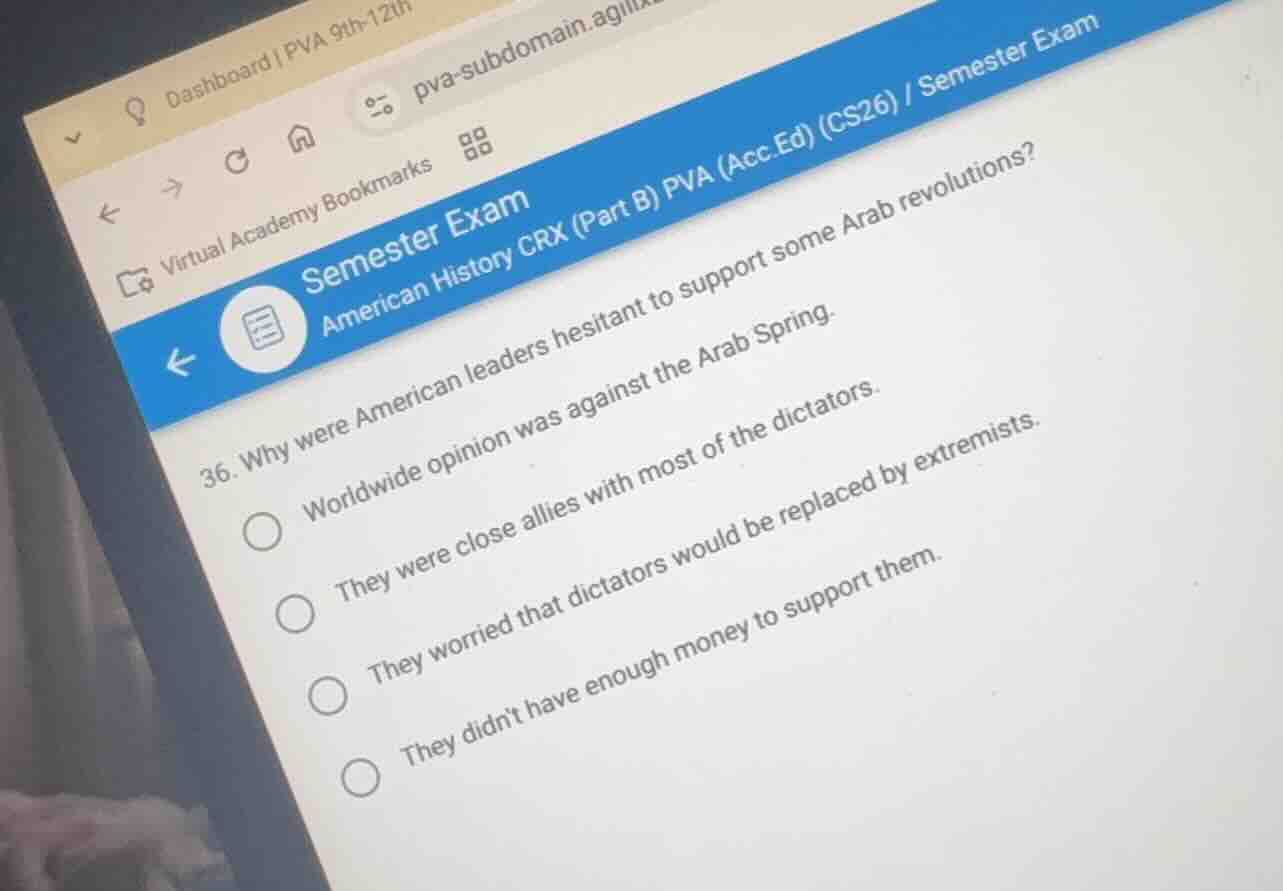
- why were american leaders hesitant to support some arab revolutions?
worldwide opinion was against the arab spring.
they were close allies with most of the dictators.
they worried that dictators would be replaced by extremists.
they didnt have enough money to support them.
<pre_analysis>
{
"quality": "clear",
"question_count": 1,
"skills_matched": [
"direct_cot",
"multiple_choice_formatter",
"explain_then_answer",
"tutor"
],
"needs_drawing": false,
"concepts_used": [],
"new_concepts": [
"Arab Spring",
"US Foreign Policy",
"Middle East Geopolitics"
],
"current_concepts": [
"Arab Spring",
"US Foreign Policy",
"Middle East Geopolitics"
]
}
</pre_analysis>
<reasoning>
Identify the historical context
The question asks why American leaders were hesitant to support some Arab revolutions, referring to the events of the Arab Spring that began in late 2010.
Analyze the options
- Worldwide opinion was against the Arab Spring: Incorrect. Global public opinion was generally supportive of democratic movements and protests against authoritarian regimes.
- They were close allies with most of the dictators: While the US had strategic partnerships with some deposed leaders (like Hosni Mubarak in Egypt), this does not fully capture the primary strategic hesitation regarding the revolutions themselves.
- They worried that dictators would be replaced by extremists: Correct. A major concern for US foreign policy during the Arab Spring was that the collapse of secular authoritarian regimes would create power vacuums filled by radical Islamist groups or hostile extremist factions.
- They didn't have enough money to support them: Incorrect. US hesitation was based on geopolitical and security concerns, not financial constraints.
Formulate the explanation
Explain that the primary concern for US policymakers during the Arab Spring was regional stability and the potential rise of extremist groups (such as ISIS or Al-Qaeda affiliates) in the power vacuums left by ousted dictators.
</reasoning>
<answer>
<mcq-option>Worldwide opinion was against the Arab Spring.</mcq-option>
<mcq-option>They were close allies with most of the dictators.</mcq-option>
<mcq-correct>They worried that dictators would be replaced by extremists.</mcq-correct>
<mcq-option>They didn't have enough money to support them.</mcq-option>
</answer>
<post_analysis>
{
"subject": "Social Science",
"question_type": "Multiple Choice",
"knowledge_point": [
"Social Science",
"US History",
"Modern US Foreign Policy"
]
}
</post_analysis>
Snap & solve any problem in the app
Get step-by-step solutions on Sovi AI
Photo-based solutions with guided steps
Explore more problems and detailed explanations
<pre_analysis>
{
"quality": "clear",
"question_count": 1,
"skills_matched": [
"direct_cot",
"multiple_choice_formatter",
"explain_then_answer",
"tutor"
],
"needs_drawing": false,
"concepts_used": [],
"new_concepts": [
"Arab Spring",
"US Foreign Policy",
"Middle East Geopolitics"
],
"current_concepts": [
"Arab Spring",
"US Foreign Policy",
"Middle East Geopolitics"
]
}
</pre_analysis>
<reasoning>
Identify the historical context
The question asks why American leaders were hesitant to support some Arab revolutions, referring to the events of the Arab Spring that began in late 2010.
Analyze the options
- Worldwide opinion was against the Arab Spring: Incorrect. Global public opinion was generally supportive of democratic movements and protests against authoritarian regimes.
- They were close allies with most of the dictators: While the US had strategic partnerships with some deposed leaders (like Hosni Mubarak in Egypt), this does not fully capture the primary strategic hesitation regarding the revolutions themselves.
- They worried that dictators would be replaced by extremists: Correct. A major concern for US foreign policy during the Arab Spring was that the collapse of secular authoritarian regimes would create power vacuums filled by radical Islamist groups or hostile extremist factions.
- They didn't have enough money to support them: Incorrect. US hesitation was based on geopolitical and security concerns, not financial constraints.
Formulate the explanation
Explain that the primary concern for US policymakers during the Arab Spring was regional stability and the potential rise of extremist groups (such as ISIS or Al-Qaeda affiliates) in the power vacuums left by ousted dictators.
</reasoning>
<answer>
<mcq-option>Worldwide opinion was against the Arab Spring.</mcq-option>
<mcq-option>They were close allies with most of the dictators.</mcq-option>
<mcq-correct>They worried that dictators would be replaced by extremists.</mcq-correct>
<mcq-option>They didn't have enough money to support them.</mcq-option>
</answer>
<post_analysis>
{
"subject": "Social Science",
"question_type": "Multiple Choice",
"knowledge_point": [
"Social Science",
"US History",
"Modern US Foreign Policy"
]
}
</post_analysis>