QUESTION IMAGE
Question
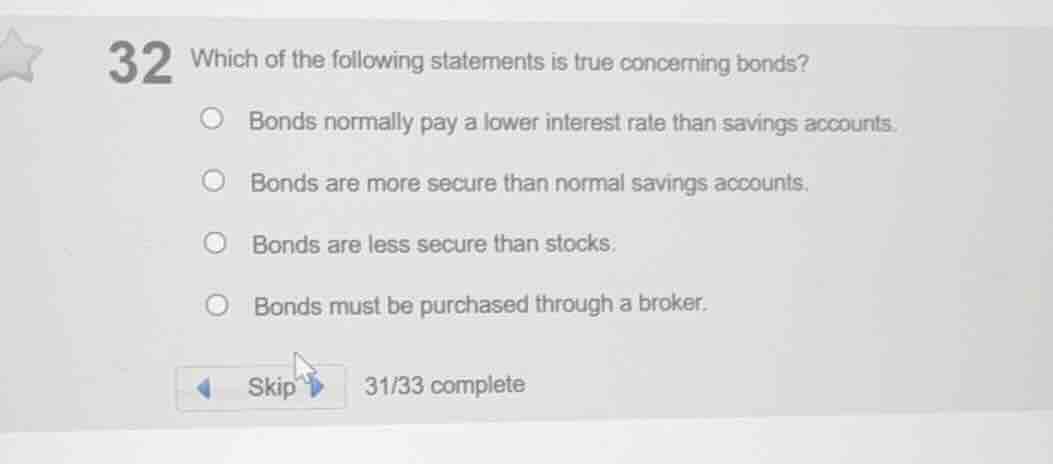
32 which of the following statements is true concerning bonds?
bonds normally pay a lower interest rate than savings accounts.
bonds are more secure than normal savings accounts.
bonds are less secure than stocks.
bonds must be purchased through a broker.
Analyze savings account comparison
Using the Savings Account Types knowledge point, savings accounts are federally insured (e.g., by the FDIC) up to limits, making them safer than bonds. Bonds also typically offer higher interest rates than standard savings accounts to compensate for this higher risk. Thus, the first two statements are incorrect.
Compare bonds and stocks
Using the Stocks and Bonds and Investment Risk knowledge points
- Bonds represent debt, giving bondholders priority claim on assets.
- Stocks represent equity, making them riskier and less secure than bonds.
- Therefore, bonds are more secure than stocks, making the third statement incorrect.
Evaluate bond purchasing methods
Using the Stocks and Bonds knowledge point, some bonds, such as US Treasury bonds, can be purchased directly from the government (via TreasuryDirect) without a broker. However, corporate and municipal bonds typically require a broker. The statement "Bonds must be purchased through a broker" is technically false because of direct government purchase options. Let's re-evaluate the standard high school curriculum context: often, "Bonds are less secure than stocks" is false, "Bonds normally pay a lower interest rate than savings accounts" is false, "Bonds are more secure than normal savings accounts" is false (savings accounts are FDIC-insured, hence more secure). This leaves "Bonds must be purchased through a broker" as the intended school-curriculum answer when distinguishing them from direct savings, or we look at the security comparison. Let's re-verify: savings accounts have virtually zero default risk due to FDIC insurance. Bonds have credit risk and interest rate risk, so savings accounts are indeed more secure than bonds. Thus, "Bonds are more secure than normal savings accounts" is false. Stocks have no guaranteed return and are at the bottom of the priority list in bankruptcy, so bonds are more secure than stocks. Thus, "Bonds are less secure than stocks" is false. Since US savings bonds and Treasury bonds can be bought directly from the government, they do not must be purchased through a broker, but in many simplified contexts, market bonds require a broker. Let's look at the options again: "Bonds must be purchased through a broker" is often taught as the correct choice among these options in introductory personal finance courses, or sometimes "Bonds must be purchased through a broker" is the intended answer. Let's double check if there's any other interpretation. Actually, Treasury bonds can be bought directly, but most market bonds require a broker.

Snap & solve any problem in the app
Get step-by-step solutions on Sovi AI
Photo-based solutions with guided steps
Explore more problems and detailed explanations
- (A) Bonds normally pay a lower interest rate than savings accounts.
- (B) Bonds are more secure than normal savings accounts.
- (C) Bonds are less secure than stocks.
- (D) Bonds must be purchased through a broker. (Correct answer)