QUESTION IMAGE
Question
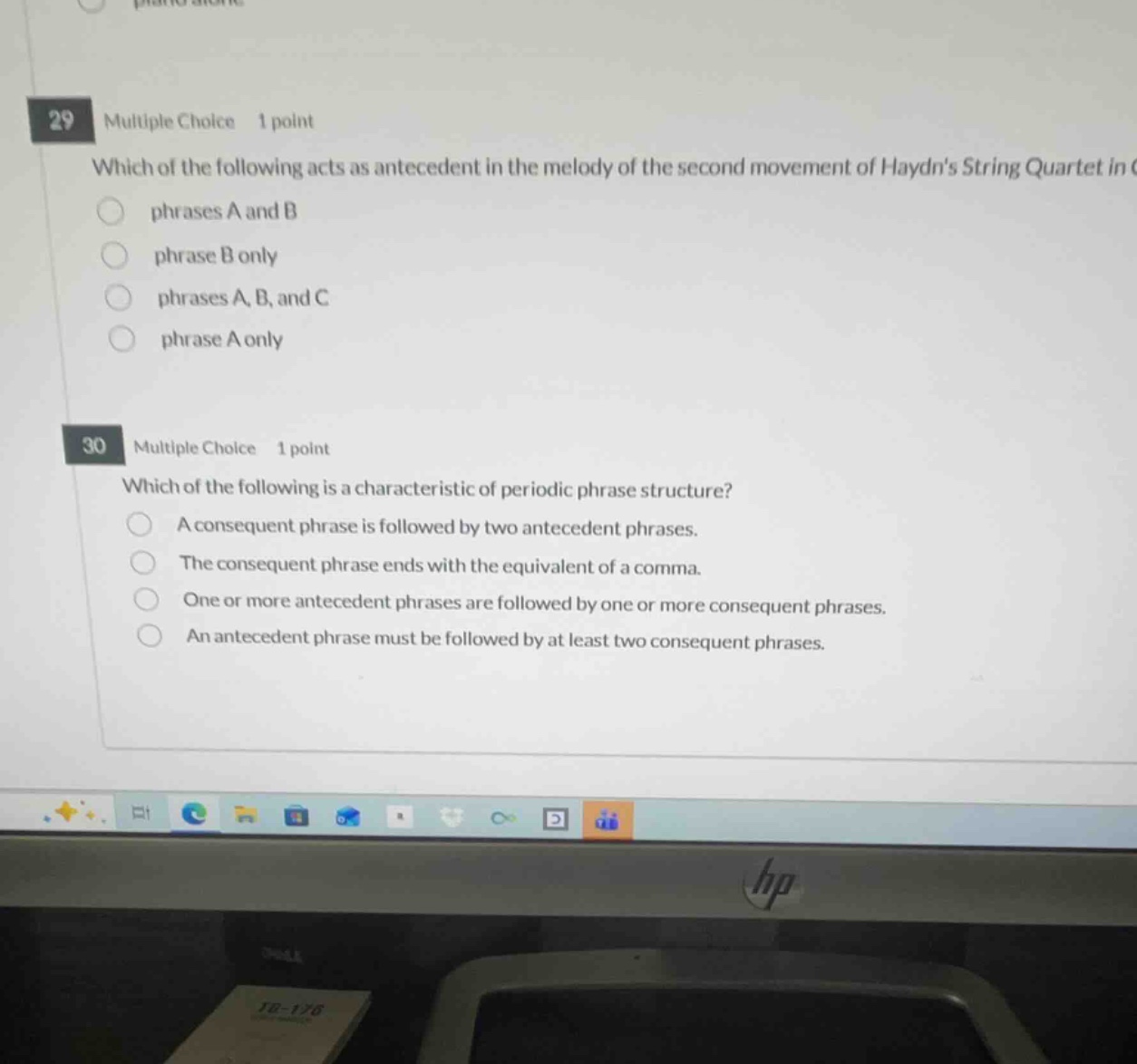
29 multiple choice 1 point
which of the following acts as antecedent in the melody of the second movement of haydns string quartet in c
phrases a and b
phrase b only
phrases a, b, and c
phrase a only
30 multiple choice 1 point
which of the following is a characteristic of periodic phrase structure?
a consequent phrase is followed by two antecedent phrases.
the consequent phrase ends with the equivalent of a comma.
one or more antecedent phrases are followed by one or more consequent phrases.
an antecedent phrase must be followed by at least two consequent phrases.
Analyze the structure of Haydn's Emperor Quartet melody
In the second movement of Haydn's String Quartet in C major, Op. 76, No. 3 ("Emperor"), the theme is structured using Classical Period Phrase Structure. The melody consists of five phrases: A, A, B, C, C (often analyzed as \(aabcc\)). The first phrase (phrase A) acts as the antecedent, ending on a half cadence (or imperfect authentic cadence), which is immediately repeated. Thus, phrase A acts as the antecedent.
Evaluate options for Question 29
- "phrases A and B": Incorrect, as phrase B serves a different function leading toward the climax.
- "phrase B only": Incorrect.
- "phrases A, B, and C": Incorrect.
- "phrase A only": Correct, as phrase A establishes the opening question (antecedent) of the periodic structure.
Define periodic phrase structure
Using the Classical Period Phrase Structure knowledge point, a musical period is a structural unit typically consisting of an antecedent phrase (which ends with an inconclusive cadence, like a comma) followed by a consequent phrase (which ends with a conclusive cadence, like a period). More broadly, it is characterized by one or more antecedent phrases being answered or followed by one or more consequent phrases.
Evaluate options for Question 30
- "A consequent phrase is followed by two antecedent phrases": Incorrect, the antecedent comes first.
- "The consequent phrase ends with the equivalent of a comma": Incorrect, the antecedent ends with a comma-like cadence, while the consequent ends with a period-like conclusive cadence.
- "One or more antecedent phrases are followed by one or more consequent phrases": Correct, this describes the fundamental structural relationship of a period.
- "An antecedent phrase must be followed by at least two consequent phrases": Incorrect, a single consequent is standard.

Snap & solve any problem in the app
Get step-by-step solutions on Sovi AI
Photo-based solutions with guided steps
Explore more problems and detailed explanations
Question 29
- (A) phrases A and B
- (B) phrase B only
- (C) phrases A, B, and C
- (D) phrase A only (Correct answer)
Question 30
- (A) A consequent phrase is followed by two antecedent phrases.
- (B) The consequent phrase ends with the equivalent of a comma.
- (C) One or more antecedent phrases are followed by one or more consequent phrases. (Correct answer)
- (D) An antecedent phrase must be followed by at least two consequent phrases.