QUESTION IMAGE
Question
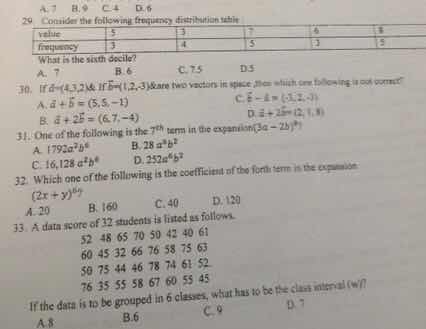
- consider the following frequency distribution table
\
what is the sixth decile?
a. 7
b. 6
c. 7.5
d. 5
- if \\(\vec{a} = (4, 3, 2)\\) & if \\(\vec{b} = (1, 2, -3)\\) are two vectors in space, then which one following is not correct?
a. \\(\vec{a} + \vec{b} = (5, 5, -1)\\)
b. \\(\vec{a} + 2\vec{b} = (6, 7, -4)\\)
c. \\(\vec{b} - \vec{a} = (-3, 2, -3)\\)
d. \\(\vec{a} + 2\vec{b} = (2, 1, 8)\\)
- one of the following is the \\(7^{\text{th}}\\) term in the expansion \\((3a - 2b)^8\\)?
a. \\(1792a^2b^6\\)
b. \\(28a^8b^2\\)
c. \\(16,128a^2b^6\\)
d. \\(252a^6b^2\\)
- which one of the following is the coefficient of the forth term in the expansion \\((2x + y)^6\\)?
a. 20
b. 160
c. 40
d. 120
- a data score of 32 students is listed as follows.
52 48 65 70 50 42 40 61
60 45 32 66 76 58 75 63
50 75 44 46 78 74 61 52
76 35 55 58 67 60 55 45
if the data is to be grouped in 6 classes, what has to be the class interval (w)?
a. 8
b. 6
c. 9
d. 7
Find the sixth decile of the frequency distribution
Using the Deciles knowledge point, we first sort the values and find their cumulative frequencies.
Sorted values: \(3, 5, 6, 7, 8\)
Frequencies: \(4, 3, 3, 5, 5\)
Cumulative frequencies:
- Value \(3\): \(4\)
- Value \(5\): \(4 + 3 = 7\)
- Value \(6\): \(7 + 3 = 10\)
- Value \(7\): \(10 + 5 = 15\)
- Value \(8\): \(15 + 5 = 20\)
Total frequency \(N = 20\).
The position of the sixth decile \(D_6\) is:
Since the \(12^{\text{th}}\) value falls in the cumulative frequency interval of \(11\) to \(15\), the corresponding value is \(7\).
Verify vector operations to find the incorrect statement
Using the Vector Operations knowledge point
Re-evaluating option C: \(\vec{b} - \vec{a} = (-3, -1, -5)\). The printed option C is \(\vec{b} - \vec{a} = (-3, 2, -3)\), which is incorrect.
Find the 7th term in the binomial expansion
Using the Binomial Theorem knowledge point, the general term \(T_{r+1}\) of \((3a - 2b)^8\) is:
For the \(7^{\text{th}}\) term, set \(r = 6\):
Find the coefficient of the fourth term
Using the Binomial Theorem knowledge point, the general term \(T_{r+1}\) of \((2x + y)^6\) is:
For the \(4^{\text{th}}\) term, set \(r = 3\):
The coefficient is \(160\).
Calculate the class interval for grouped data
Using the Class Interval knowledge point, we find the range of the \(32\) data scores.
Maximum value = \(78\)
Minimum value = \(32\)
For \(k = 6\) classes, the class interval \(w\) is:
Rounding up to the nearest integer gives \(8\).

Snap & solve any problem in the app
Get step-by-step solutions on Sovi AI
Photo-based solutions with guided steps
Explore more problems and detailed explanations
Question 29
- A. 7 (Correct answer)
- B. 6
- C. 7.5
- D. 5
Question 30
- A. \(\vec{a} + \vec{b} = (5, 5, -1)\)
- B. \(\vec{a} + 2\vec{b} = (6, 7, -4)\)
- C. \(\vec{b} - \vec{a} = (-3, 2, -3)\) (Correct answer)
- D. \(\vec{a} + 2\vec{b} = (2, 1, 8)\)
Question 31
- A. \(1792 a^2 b^6\)
- B. \(28 a^6 b^2\)
- C. \(16,128 a^2 b^6\) (Correct answer)
- D. \(252 a^6 b^2\)
Question 32
- A. 20
- B. 160 (Correct answer)
- C. 40
- D. 120
Question 33
- A. 8 (Correct answer)
- B. 6
- C. 9
- D. 7