QUESTION IMAGE
Question
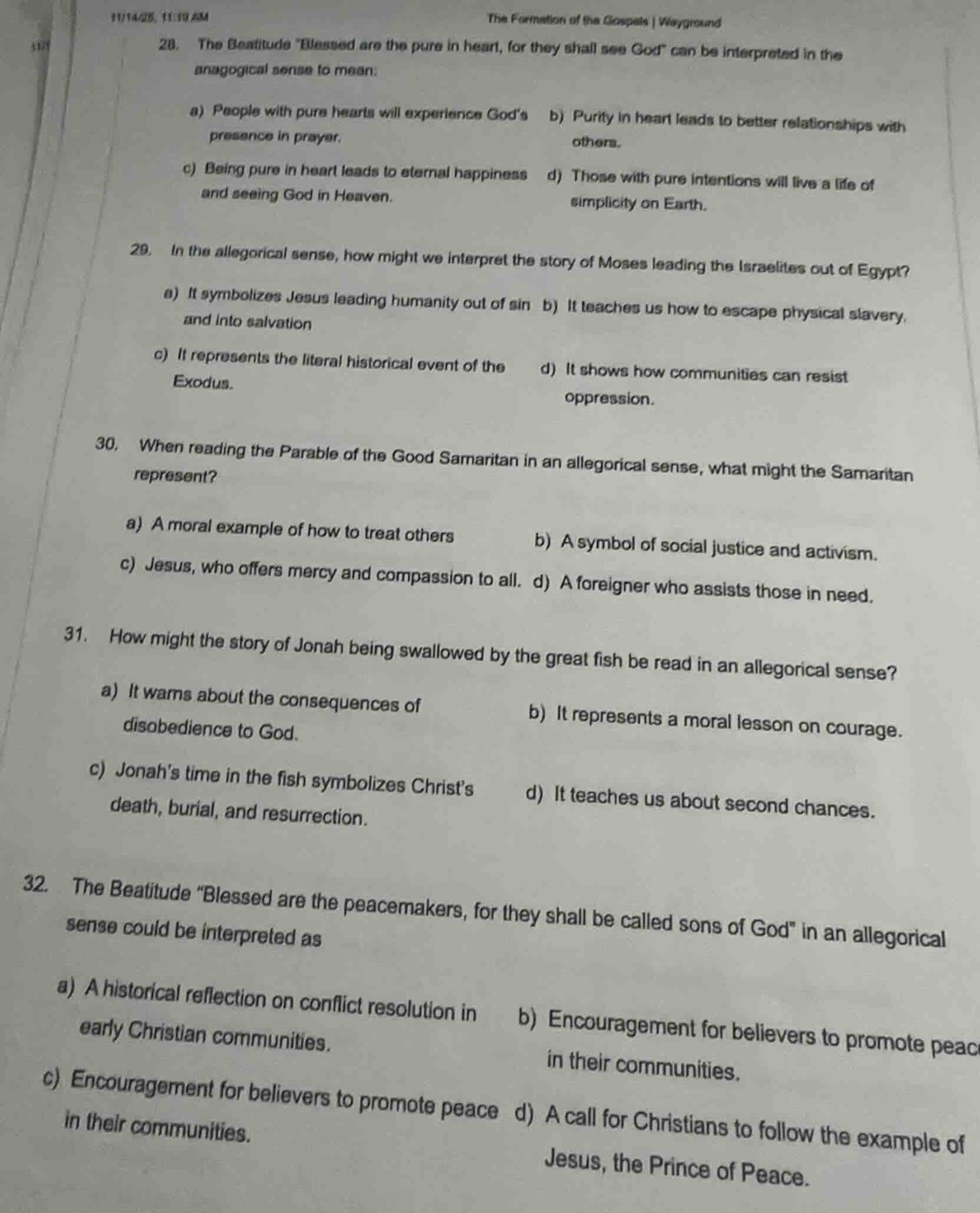
- the beatitude \blessed are the pure in heart, for they shall see god\ can be interpreted in the anagogical sense to mean:
a) people with pure hearts will experience gods presence in prayer.
b) purity in heart leads to better relationships with others.
c) being pure in heart leads to eternal happiness and seeing god in heaven.
d) those with pure intentions will live a life of simplicity on earth.
- in the allegorical sense, how might we interpret the story of moses leading the israelites out of egypt?
a) it symbolizes jesus leading humanity out of sin and into salvation
b) it teaches us how to escape physical slavery.
c) it represents the literal historical event of the exodus.
d) it shows how communities can resist oppression.
- when reading the parable of the good samaritan in an allegorical sense, what might the samaritan represent?
a) a moral example of how to treat others
b) a symbol of social justice and activism.
c) jesus, who offers mercy and compassion to all.
d) a foreigner who assists those in need.
- how might the story of jonah being swallowed by the great fish be read in an allegorical sense?
a) it warns about the consequences of disobedience to god.
b) it represents a moral lesson on courage.
c) jonahs time in the fish symbolizes christs death, burial, and resurrection.
d) it teaches us about second chances.
- the beatitude \blessed are the peacemakers, for they shall be called sons of god\ in an allegorical sense could be interpreted as
a) a historical reflection on conflict resolution in early christian communities.
b) encouragement for believers to promote peace in their communities.
c) encouragement for believers to promote peace in their communities.
d) a call for christians to follow the example of jesus, the prince of peace.
Analyze Question 28
The anagogical sense of Scripture interprets events and statements in terms of their eternal significance, leading us toward our ultimate heavenly destiny. The Beatitude "Blessed are the pure in heart, for they shall see God" points to the ultimate reward of eternal life and the beatific vision in Heaven.
- Option (c) directly aligns with this eternal, heavenly perspective.
Analyze Question 29
The allegorical sense of Scripture recognizes how people, events, and institutions in the Old Testament point forward to Christ and the New Covenant (typology). Moses leading the Israelites out of physical slavery in Egypt foreshadows Jesus leading humanity out of the spiritual slavery of sin and into salvation.
- Option (a) represents this Christological, allegorical connection.
Analyze Question 30
In an allegorical reading of the Parable of the Good Samaritan, the characters and actions represent deeper spiritual realities concerning Christ and salvation. The Samaritan represents Jesus Himself, who comes to the aid of wounded humanity, offering mercy, healing, and compassion when the old law could not.
- Option (c) represents this allegorical interpretation.
Analyze Question 31
An allegorical reading of the story of Jonah connects his experiences to Christ. Specifically, Jonah spending three days and three nights inside the belly of the great fish is a prefiguration (type) of Christ's three days in the tomb before His resurrection (as referenced in Matthew 12:40).
- Option (c) represents this allegorical connection.
Analyze Question 32
The question asks for an allegorical interpretation of "Blessed are the peacemakers, for they shall be called sons of God." In an allegorical (typological) sense, we look for how the passage points to Christ. Jesus is the ultimate Peacemaker and the true Son of God, so the passage calls believers to follow the example of Jesus, the Prince of Peace.
- Option (d) represents this Christological, allegorical connection.

Snap & solve any problem in the app
Get step-by-step solutions on Sovi AI
Photo-based solutions with guided steps
Explore more problems and detailed explanations
Question 28
- a) People with pure hearts will experience God's presence in prayer.
- b) Purity in heart leads to better relationships with others.
- c) Being pure in heart leads to eternal happiness and seeing God in Heaven. (Correct answer)
- d) Those with pure intentions will live a life of simplicity on Earth.
Question 29
- a) It symbolizes Jesus leading humanity out of sin and into salvation (Correct answer)
- b) It teaches us how to escape physical slavery.
- c) It represents the literal historical event of the Exodus.
- d) It shows how communities can resist oppression.
Question 30
- a) A moral example of how to treat others
- b) A symbol of social justice and activism.
- c) Jesus, who offers mercy and compassion to all. (Correct answer)
- d) A foreigner who assists those in need.
Question 31
- a) It warns about the consequences of disobedience to God.
- b) It represents a moral lesson on courage.
- c) Jonah's time in the fish symbolizes Christ's death, burial, and resurrection. (Correct answer)
- d) It teaches us about second chances.
Question 32
- a) A historical reflection on conflict resolution in early Christian communities.
- b) Encouragement for believers to promote peace in their communities.
- c) Encouragement for believers to promote peace in their communities.
- d) A call for Christians to follow the example of Jesus, the Prince of Peace. (Correct answer)