QUESTION IMAGE
Question
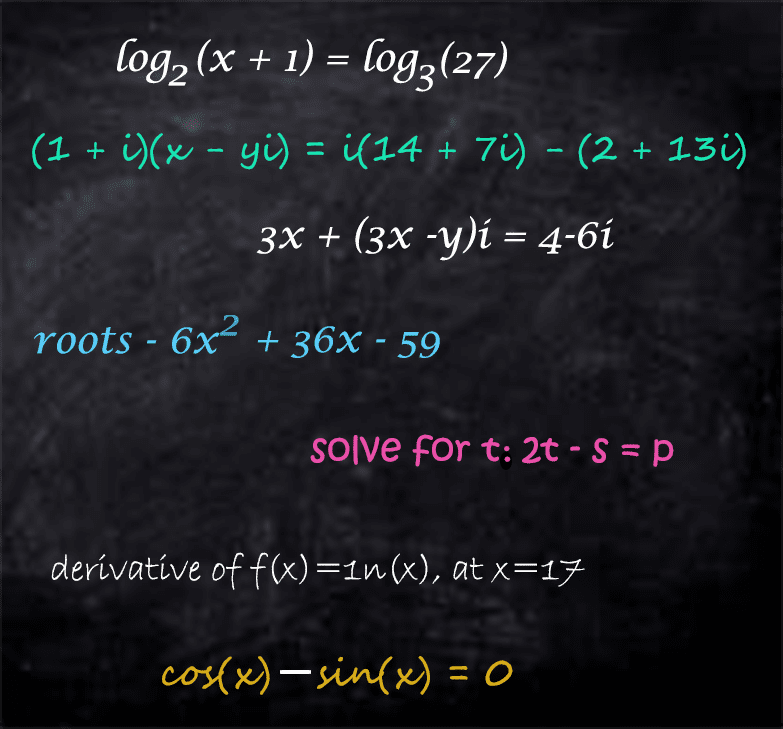
\\\log_2(x + 1) = \log_3(27)\\
\\(1 + i)(x - yi) = i(14 + 7i) - (2 + 13i)\\
\\3x + (3x - y)i = 4 - 6i\\
\\\text{roots } -6x^2 + 36x - 59\\
\\\text{solve for } t\text{: } 2t - s = p\\
\\\text{derivative of } f(x) = \ln(x)\text{, at } x = 17\\
\\\cos(x) - \sin(x) = 0\\
🆕 New Concept Discovered: Solving Multi-Topic Math Problems
A collection of algebra, complex numbers, calculus, and trigonometry.
Step 1: Solve the logarithmic equation
First, we simplify the right side of the equation:
Now, substitute this back into the equation:
Convert the logarithmic equation to its exponential form:
Step 2: Solve the complex equation for \(x\) and \(y\)
We are given:
First, expand the left side:
Since \(i^2 = -1\):
Next, expand and simplify the right side:
Now, equate the real and imaginary parts from both sides:
- Real parts:
- Imaginary parts:
Add the two equations:
Substitute \(x = -4\) into the second equation:
Step 3: Solve the complex equality
We are given:
Equate the real parts:
Equate the imaginary parts:
Substitute \(3x = 4\):
Step 4: Find the roots of the quadratic expression
We want to find the roots of:
Using the quadratic formula \(x = \frac{-b \pm \sqrt{b^2 - 4ac}}{2a}\), where \(a = -6\), \(b = 36\), and \(c = -59\):
Step 5: Solve the literal equation for \(t\)
We are given:
Add \(s\) to both sides:
Divide by 2:
Step 6: Find the derivative of \(f(x) = \ln(x)\) at \(x = 17\)
The derivative of \(f(x) = \ln(x)\) is:
Evaluating this at \(x = 17\):
Step 7: Solve the trigonometric equation
We are given:
Rearrange the equation:
Divide both sides by \(\cos(x)\) (assuming \(\cos(x)
eq 0\)):
The general solution for \(x\) is:

Snap & solve any problem in the app
Get step-by-step solutions on Sovi AI
Photo-based solutions with guided steps
Explore more problems and detailed explanations
- Logarithmic Equation: \(x = 7\)
- First Complex Equation: \(x = -4, y = -5\)
- Second Complex Equation: \(x = \frac{4}{3}, y = 10\)
- Quadratic Roots: \(x = 3 \pm \frac{\sqrt{30}}{6}i\)
- Literal Equation: \(t = \frac{p + s}{2}\)
- Derivative: \(f'(17) = \frac{1}{17}\)
- Trigonometric Equation: \(x = \frac{\pi}{4} + k\pi\) (where \(k\) is any integer)