QUESTION IMAGE
Question
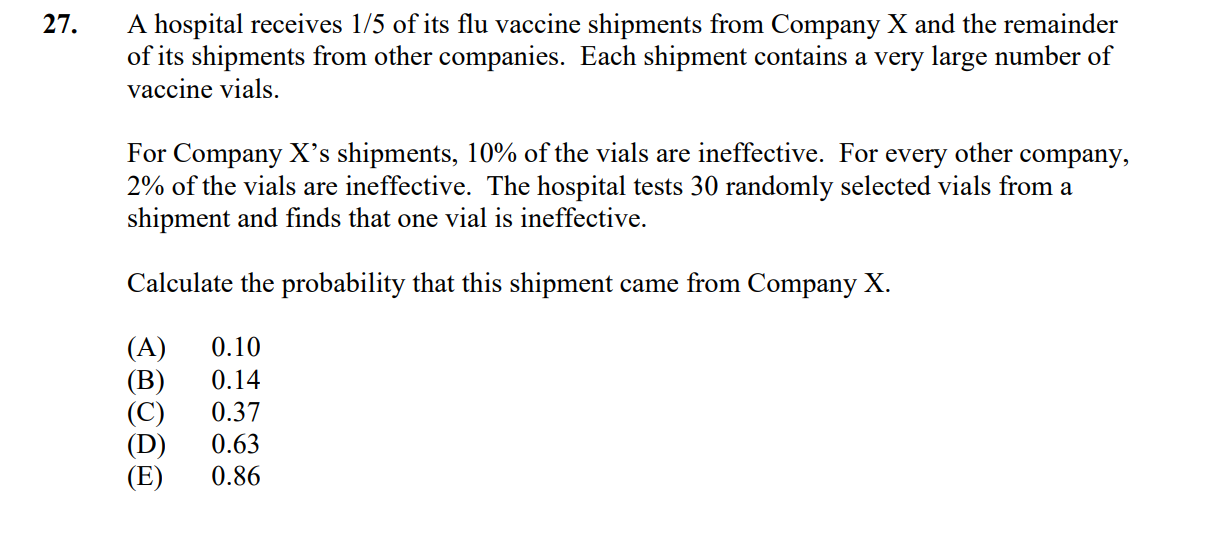
- a hospital receives \\(1/5\\) of its flu vaccine shipments from company x and the remainder of its shipments from other companies. each shipment contains a very large number of vaccine vials.
for company xs shipments, \\(10\\%\\) of the vials are ineffective. for every other company, \\(2\\%\\) of the vials are ineffective. the hospital tests 30 randomly selected vials from a shipment and finds that one vial is ineffective.
calculate the probability that this shipment came from company x.
(a) 0.10
(b) 0.14
(c) 0.37
(d) 0.63
(e) 0.86
⚡ Using what you learned: Conditional Probability · 🆕 New: Bayes' Theorem
Updating beliefs when new evidence is observed
Step 1: Define the Events and Prior Probabilities
Let \( X \) be the event that the shipment comes from Company X, and \( X^c \) be the event that it comes from another company.
The prior probabilities are:
Step 2: Define the Likelihoods using Binomial Distribution
Let \( E \) be the event that exactly 1 vial out of 30 randomly selected vials is ineffective. Since the shipments contain a very large number of vials, we model the number of ineffective vials using a binomial distribution with \( n = 30 \).
For Company X, the probability of a vial being ineffective is \( p_X = 0.10 \):
For other companies, the probability of a vial being ineffective is \( p_O = 0.02 \):
Step 3: Calculate the Likelihood Values
Calculate the numerical values for both likelihoods:
Step 4: Apply Bayes' Theorem
We want to find the posterior probability \( P(X \mid E) \):
Substitute the values into the formula:
Rounding to two decimal places gives \( 0.10 \).

Snap & solve any problem in the app
Get step-by-step solutions on Sovi AI
Photo-based solutions with guided steps
Explore more problems and detailed explanations
(A) 0.10