QUESTION IMAGE
Question
226 chapter 18
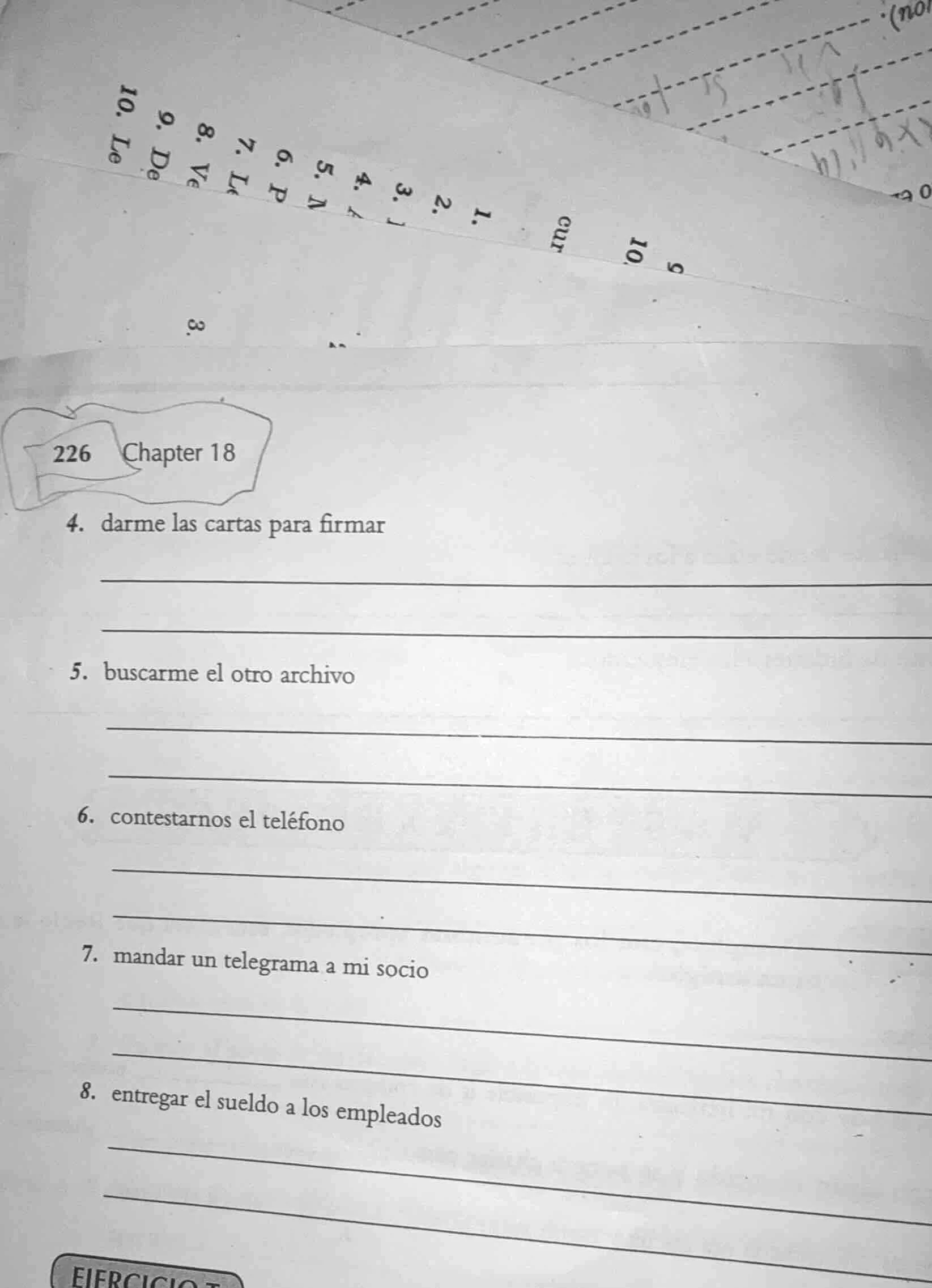
- darme las cartas para firmar
- buscarme el otro archivo
- contestarnos el teléfono
- mandar un telegrama a mi socio
- entregar el sueldo a los empleados
These seem to be Spanish grammar exercises, likely involving forming commands or using the appropriate verb forms (maybe the "usted" or "tú" form, or the subjunctive/imperative). Let's handle each one:
4. darme las cartas para firmar
To form the command (let's assume it's the formal "usted" command, common in business/official contexts), the verb "dar" (to give) has the formal command form "dé". The indirect object "me" (to me) and the direct object "las cartas" (the letters) need to be placed correctly. In formal commands, the indirect object pronoun comes before the verb, and the direct object pronoun as well? Wait, no: for "dar" (which is a verb that takes indirect and direct objects), the structure for formal command (usted) is: Déme las cartas para firmar (the "me" is attached to the end of the command verb when it's a single word; wait, actually, for affirmative formal commands (usted), the pronoun (if indirect) is attached to the end. Wait, "dar" is irregular. The formal command (usted) of "dar" is "dé". Then, "darme" (to give me) in command form: "Déme las cartas para firmar" (or "Dé las cartas para firmar a mí", but the first is more common in commands).
5. buscarme el otro archivo
The verb "buscar" (to look for). Formal command (usted) of "buscar" is "busque". The indirect object "me" (for me) is attached to the end: Busqueme el otro archivo (or "Busque el otro archivo para mí", but attaching the pronoun is common in commands).
6. contestarnos el teléfono
"Contestar" (to answer). Formal command (usted) is "conteste". The indirect object "nos" (to us) is attached: Contéstarnos el teléfono (or "Conteste el teléfono para nosotros", but attaching the pronoun is standard in commands).
7. mandar un telegrama a mi socio
"Mandarse" no, "mandar" (to send). Formal command (usted) is "mande". So: Mande un telegrama a mi socio (or "Mándele un telegrama a mi socio" if using the indirect object pronoun "le" for "mi socio", but the original is "a mi socio" as a prepositional phrase, so "Mande un telegrama a mi socio" is correct).
8. entregar el sueldo a los empleados
"Entregar" (to deliver). Formal command (usted) is "entregue". So: Entregue el sueldo a los empleados
Let me verify the command forms:
- Dar (usted command): dé (affirmative)
- Buscar (usted command): busque (affirmative)
- Contestar (usted command): conteste (affirmative)
- Mandar (usted command): mande (affirmative)
- Entregar (usted command): entregue (affirmative)
And for the pronouns:
- For "darme", the "me" is attached to the end of the command verb: dé + me = déme (but sometimes written as "dé me" with a space, but usually attached: déme)
- For "buscarme", "busque" + "me" = busqueme (or busque me, but attached: busqueme)
- For "contestarnos", "conteste" + "nos" = contéstarnos (attached)
- For "mandar un telegrama a mi socio", no pronoun attachment needed here as it's a prepositional phrase "a mi socio"
- For "entregar el sueldo a los empleados", same, prepositional phrase "a los empleados"
So the answers would be:
- Déme las cartas para firmar
- Busqueme el otro archivo
- Contéstarnos el teléfono
- Mande un telegrama a mi socio
- Entregue el sueldo a los empleados
(Note: Depending on the textbook's convention, sometimes the pronouns are placed before the verb in formal commands, but for affirmative commands with usted, the pronouns are usually attached to the end. Let me check a reference: For affirmative formal commands (usted), the structure is: verb (command form) + indirect object pronoun (attached) + direct…

Snap & solve any problem in the app
Get step-by-step solutions on Sovi AI
Photo-based solutions with guided steps
Explore more problems and detailed explanations
These seem to be Spanish grammar exercises, likely involving forming commands or using the appropriate verb forms (maybe the "usted" or "tú" form, or the subjunctive/imperative). Let's handle each one:
4. darme las cartas para firmar
To form the command (let's assume it's the formal "usted" command, common in business/official contexts), the verb "dar" (to give) has the formal command form "dé". The indirect object "me" (to me) and the direct object "las cartas" (the letters) need to be placed correctly. In formal commands, the indirect object pronoun comes before the verb, and the direct object pronoun as well? Wait, no: for "dar" (which is a verb that takes indirect and direct objects), the structure for formal command (usted) is: Déme las cartas para firmar (the "me" is attached to the end of the command verb when it's a single word; wait, actually, for affirmative formal commands (usted), the pronoun (if indirect) is attached to the end. Wait, "dar" is irregular. The formal command (usted) of "dar" is "dé". Then, "darme" (to give me) in command form: "Déme las cartas para firmar" (or "Dé las cartas para firmar a mí", but the first is more common in commands).
5. buscarme el otro archivo
The verb "buscar" (to look for). Formal command (usted) of "buscar" is "busque". The indirect object "me" (for me) is attached to the end: Busqueme el otro archivo (or "Busque el otro archivo para mí", but attaching the pronoun is common in commands).
6. contestarnos el teléfono
"Contestar" (to answer). Formal command (usted) is "conteste". The indirect object "nos" (to us) is attached: Contéstarnos el teléfono (or "Conteste el teléfono para nosotros", but attaching the pronoun is standard in commands).
7. mandar un telegrama a mi socio
"Mandarse" no, "mandar" (to send). Formal command (usted) is "mande". So: Mande un telegrama a mi socio (or "Mándele un telegrama a mi socio" if using the indirect object pronoun "le" for "mi socio", but the original is "a mi socio" as a prepositional phrase, so "Mande un telegrama a mi socio" is correct).
8. entregar el sueldo a los empleados
"Entregar" (to deliver). Formal command (usted) is "entregue". So: Entregue el sueldo a los empleados
Let me verify the command forms:
- Dar (usted command): dé (affirmative)
- Buscar (usted command): busque (affirmative)
- Contestar (usted command): conteste (affirmative)
- Mandar (usted command): mande (affirmative)
- Entregar (usted command): entregue (affirmative)
And for the pronouns:
- For "darme", the "me" is attached to the end of the command verb: dé + me = déme (but sometimes written as "dé me" with a space, but usually attached: déme)
- For "buscarme", "busque" + "me" = busqueme (or busque me, but attached: busqueme)
- For "contestarnos", "conteste" + "nos" = contéstarnos (attached)
- For "mandar un telegrama a mi socio", no pronoun attachment needed here as it's a prepositional phrase "a mi socio"
- For "entregar el sueldo a los empleados", same, prepositional phrase "a los empleados"
So the answers would be:
- Déme las cartas para firmar
- Busqueme el otro archivo
- Contéstarnos el teléfono
- Mande un telegrama a mi socio
- Entregue el sueldo a los empleados
(Note: Depending on the textbook's convention, sometimes the pronouns are placed before the verb in formal commands, but for affirmative commands with usted, the pronouns are usually attached to the end. Let me check a reference: For affirmative formal commands (usted), the structure is: verb (command form) + indirect object pronoun (attached) + direct object (if any). Wait, "dar" is a verb that takes indirect object (to whom) and direct object (what). So "dar las cartas a mí" (give the letters to me). In command form (usted): "Dé las cartas a mí" or "Déme las cartas" (attaching "me" to "dé"). Yes, that's correct. So "Déme las cartas para firmar" is correct.
Similarly, "buscarme el archivo" (look for the file for me) becomes "Busqueme el archivo" (attaching "me" to "busque").
"Contestarnos el teléfono" (answer the phone for us) becomes "Contéstarnos el teléfono" (attaching "nos" to "conteste").
"Mandar un telegrama a mi socio" (send a telegram to my partner) is "Mande un telegrama a mi socio" (command form "mande" of "mandar").
"Entregar el sueldo a los empleados" (deliver the salary to the employees) is "Entregue el sueldo a los empleados" (command form "entregue" of "entregar").