QUESTION IMAGE
Question
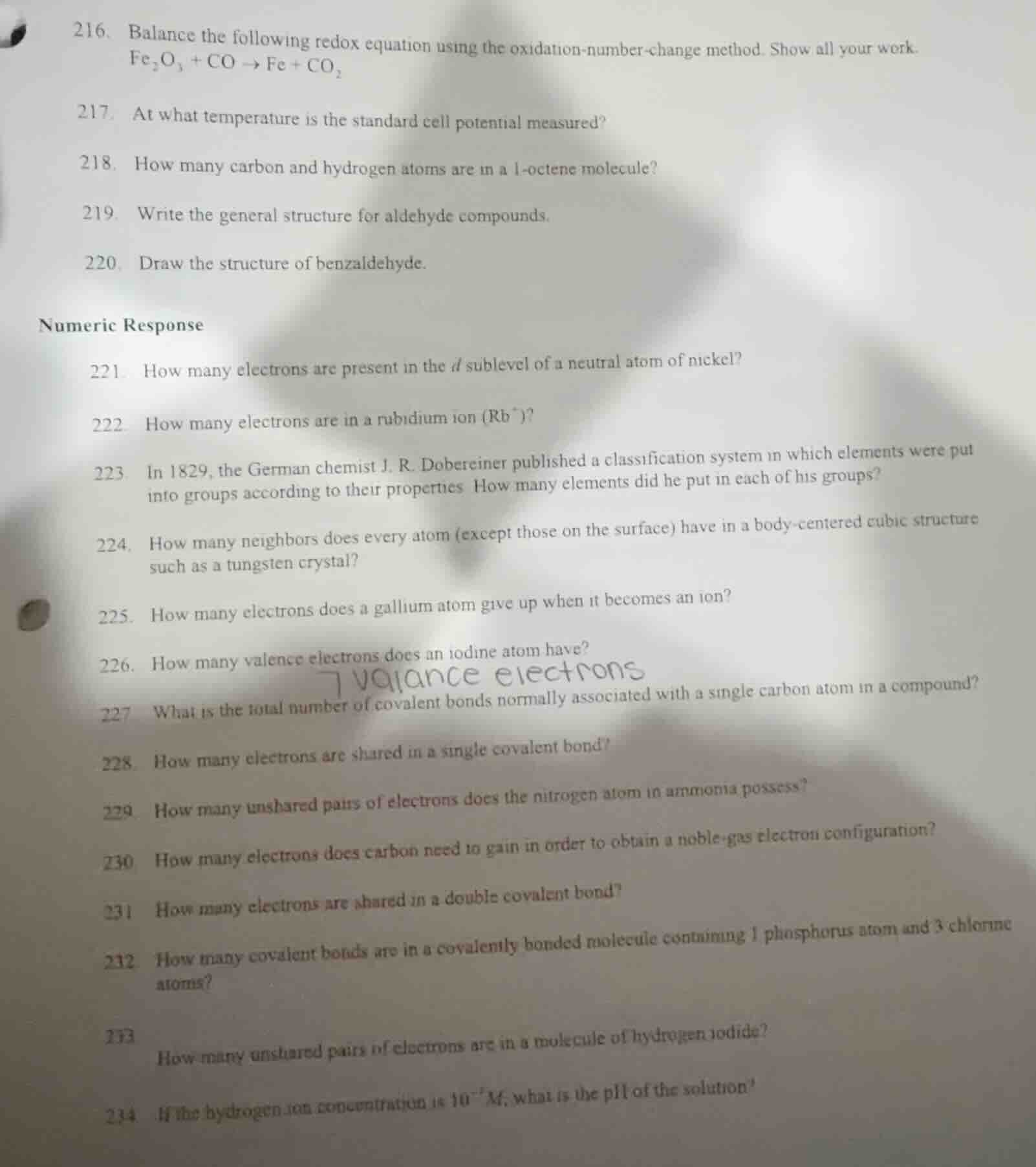
- balance the following redox equation using the oxidation-number-change method. show all your work.
\\(\text{fe}_2\text{o}_3 + \text{co} \
ightarrow \text{fe} + \text{co}_2\\)
- at what temperature is the standard cell potential measured?
- how many carbon and hydrogen atoms are in a 1-octene molecule?
- write the general structure for aldehyde compounds.
- draw the structure of benzaldehyde.
numeric response
- how many electrons are present in the \\(d\\) sublevel of a neutral atom of nickel?
- how many electrons are in a rubidium ion (\\(\text{rb}^+\\))?
- in 1829, the german chemist j. r. dobereiner published a classification system in which elements were put into groups according to their properties. how many elements did he put in each of his groups?
- how many neighbors does every atom (except those on the surface) have in a body-centered cubic structure such as a tungsten crystal?
- how many electrons does a gallium atom give up when it becomes an ion?
- how many valence electrons does an iodine atom have?
- what is the total number of covalent bonds normally associated with a single carbon atom in a compound?
- how many electrons are shared in a single covalent bond?
- how many unshared pairs of electrons does the nitrogen atom in ammonia possess?
- how many electrons does carbon need to gain in order to obtain a noble-gas electron configuration?
- how many electrons are shared in a double covalent bond?
- how many covalent bonds are in a covalently bonded molecule containing 1 phosphorus atom and 3 chlorine atoms?
- how many unshared pairs of electrons are in a molecule of hydrogen iodide?
- if the hydrogen ion concentration is \\(10^{-4}\text{ m}\\), what is the ph of the solution?
<pre_analysis>
{
"quality": "clear",
"question_count": 19,
"skills_matched": [
"step_cot",
"table_formatter",
"explain_then_answer",
"tutor",
"mastery_adaptive_brevity"
],
"needs_drawing": false,
"concepts_used": [
"Redox Balancing",
"Standard Cell Potential Calculation",
"Alkane Nomenclature",
"Electron Configuration Blocks",
"Crystal Structures",
"Valence Electron Shells",
"Covalent Bonding Types",
"Coordinate Covalent Bonds",
"Neutral Solution pH"
],
"new_concepts": [
"Aldehyde Structure",
"Dobereiner Triads",
"Benzaldehyde Structure"
],
"current_concepts": [
"Redox Balancing",
"Standard Cell Potential Calculation",
"Alkane Nomenclature",
"Aldehyde Structure",
"Benzaldehyde Structure",
"Electron Configuration Blocks",
"Crystal Structures",
"Valence Electron Shells",
"Covalent Bonding Types",
"Coordinate Covalent Bonds",
"Neutral Solution pH",
"Dobereiner Triads"
]
}
</pre_analysis>
<reasoning>
Balance the redox equation (216)
Using the Redox Balancing knowledge point
\[
\]
Standard cell potential temperature (217)
Using the Standard Cell Potential Calculation knowledge point
Standard thermodynamic conditions specify a temperature of \(25^\circ\text{C}\) (which is \(298.15\text{ K}\)).
Octene molecular formula (218)
Using the Alkane Nomenclature knowledge point
1-octene is an alkene with 8 carbon atoms. The general formula for alkenes is \(\mathrm{C_nH_{2n}}\).
\[
\]
General structure for aldehydes (219)
An aldehyde contains a carbonyl group (\(\mathrm{C=O}\)) bonded to at least one hydrogen atom. The general formula is \(\mathrm{R-CHO}\), where \(\mathrm{R}\) represents a hydrogen atom or an alkyl/aryl group.
Structure of benzaldehyde (220)
Benzaldehyde consists of a benzene ring (\(\mathrm{C_6H_5-}\)) attached to a formyl group (\(\mathrm{-CHO}\)). Its chemical formula is \(\mathrm{C_6H_5CHO}\).
Nickel d-sublevel electrons (221)
Using the Electron Configuration Blocks knowledge point
\[
\]
Rubidium ion electrons (222)
Using the Electron Configuration Blocks knowledge point
\[
\]
Dobereiner's groups (223)
Johann Wolfgang Döbereiner classified elements into groups of three based on similar chemical properties, known as Döbereiner's Triads. Thus, he put 3 elements in each of his groups.
Body-centered cubic coordination number (224)
Using the Crystal Structures knowledge point
In a body-centered cubic (BCC) unit cell, the central atom is in direct contact with the 8 corner atoms. Therefore, the coordination number (number of nearest neighbors) is 8.
Gallium ion formation (225)
Usi…
Snap & solve any problem in the app
Get step-by-step solutions on Sovi AI
Photo-based solutions with guided steps
Explore more problems and detailed explanations
<pre_analysis>
{
"quality": "clear",
"question_count": 19,
"skills_matched": [
"step_cot",
"table_formatter",
"explain_then_answer",
"tutor",
"mastery_adaptive_brevity"
],
"needs_drawing": false,
"concepts_used": [
"Redox Balancing",
"Standard Cell Potential Calculation",
"Alkane Nomenclature",
"Electron Configuration Blocks",
"Crystal Structures",
"Valence Electron Shells",
"Covalent Bonding Types",
"Coordinate Covalent Bonds",
"Neutral Solution pH"
],
"new_concepts": [
"Aldehyde Structure",
"Dobereiner Triads",
"Benzaldehyde Structure"
],
"current_concepts": [
"Redox Balancing",
"Standard Cell Potential Calculation",
"Alkane Nomenclature",
"Aldehyde Structure",
"Benzaldehyde Structure",
"Electron Configuration Blocks",
"Crystal Structures",
"Valence Electron Shells",
"Covalent Bonding Types",
"Coordinate Covalent Bonds",
"Neutral Solution pH",
"Dobereiner Triads"
]
}
</pre_analysis>
<reasoning>
Balance the redox equation (216)
Using the Redox Balancing knowledge point
\[
\]
Standard cell potential temperature (217)
Using the Standard Cell Potential Calculation knowledge point
Standard thermodynamic conditions specify a temperature of \(25^\circ\text{C}\) (which is \(298.15\text{ K}\)).
Octene molecular formula (218)
Using the Alkane Nomenclature knowledge point
1-octene is an alkene with 8 carbon atoms. The general formula for alkenes is \(\mathrm{C_nH_{2n}}\).
\[
\]
General structure for aldehydes (219)
An aldehyde contains a carbonyl group (\(\mathrm{C=O}\)) bonded to at least one hydrogen atom. The general formula is \(\mathrm{R-CHO}\), where \(\mathrm{R}\) represents a hydrogen atom or an alkyl/aryl group.
Structure of benzaldehyde (220)
Benzaldehyde consists of a benzene ring (\(\mathrm{C_6H_5-}\)) attached to a formyl group (\(\mathrm{-CHO}\)). Its chemical formula is \(\mathrm{C_6H_5CHO}\).
Nickel d-sublevel electrons (221)
Using the Electron Configuration Blocks knowledge point
\[
\]
Rubidium ion electrons (222)
Using the Electron Configuration Blocks knowledge point
\[
\]
Dobereiner's groups (223)
Johann Wolfgang Döbereiner classified elements into groups of three based on similar chemical properties, known as Döbereiner's Triads. Thus, he put 3 elements in each of his groups.
Body-centered cubic coordination number (224)
Using the Crystal Structures knowledge point
In a body-centered cubic (BCC) unit cell, the central atom is in direct contact with the 8 corner atoms. Therefore, the coordination number (number of nearest neighbors) is 8.
Gallium ion formation (225)
Using the Valence Electron Shells knowledge point
Gallium (\(\mathrm{Ga}\)) is in Group 13 and has 3 valence electrons (\(4s^2\,4p^1\)). To achieve a stable pseudo-noble-gas configuration, it loses these 3 valence electrons to form a \(\mathrm{Ga^{3+}}\) ion.
Iodine valence electrons (226)
Using the Valence Electron Shells knowledge point
Iodine (\(\mathrm{I}\)) is a halogen in Group 17. All halogens have 7 valence electrons in their outermost shell (\(ns^2\,np^5\)).
Carbon covalent bonds (227)
Using the Covalent Bonding Types knowledge point
Carbon has 4 valence electrons and requires 4 more to complete its octet. Therefore, it normally forms 4 covalent bonds in stable compounds.
Electrons in a single covalent bond (228)
Using the Covalent Bonding Types knowledge point
A single covalent bond consists of 1 shared pair of electrons, which equals 2 electrons.
Nitrogen unshared pairs in ammonia (229)
Using the Coordinate Covalent Bonds knowledge point
Ammonia (\(\mathrm{NH_3}\)) has nitrogen as the central atom bonded to 3 hydrogen atoms. Nitrogen has 5 valence electrons; 3 are shared in bonds, leaving 1 unshared pair (lone pair) of electrons.
Carbon electrons needed for octet (230)
Using the Valence Electron Shells knowledge point
Carbon has 4 valence electrons. To obtain a stable noble-gas configuration (octet), it needs to gain or share 4 more electrons.
Electrons in a double covalent bond (231)
Using the Covalent Bonding Types knowledge point
A double covalent bond consists of 2 shared pairs of electrons, which equals 4 electrons.
Covalent bonds in phosphorus trichloride (232)
Using the Covalent Bonding Types knowledge point
Phosphorus trichloride (\(\mathrm{PCl_3}\)) contains 1 central phosphorus atom single-bonded to 3 chlorine atoms. This results in a total of 3 covalent bonds.
Unshared pairs in hydrogen iodide (233)
Using the Covalent Bonding Types knowledge point
In hydrogen iodide (\(\mathrm{HI}\)), hydrogen shares its 1 electron with iodine to form a single bond. Iodine (Group 17) has 7 valence electrons, 1 of which is shared. The remaining 6 valence electrons form 3 unshared pairs (lone pairs).
pH of hydrogen ion solution (234)
Using the Neutral Solution pH knowledge point
\[
\]
</reasoning>
<answer>
| No. | Answer |
|---|
| 216 | \(\mathrm{Fe_2O_3 + 3CO
ightarrow 2Fe + 3CO_2}\) |
| 217 | \(25^\circ\text{C}\) (or \(298.15\text{ K}\)) |
| 218 | 8 carbon atoms and 16 hydrogen atoms |
| 219 | \(\mathrm{R-CHO}\) (where \(\mathrm{R}\) is \(\mathrm{H}\) or an alkyl/aryl group) |
| 220 | \(\mathrm{C_6H_5CHO}\) (a benzene ring attached to a \(\mathrm{-CHO}\) group) |
| 221 | 8 |
| 222 | 36 |
| 223 | 3 |
| 224 | 8 |
| 225 | 3 |
| 226 | 7 |
| 227 | 4 |
| 228 | 2 |
| 229 | 1 |
| 230 | 4 |
| 231 | 4 |
| 232 | 3 |
| 233 | 3 |
| 234 | 4 |
</answer>
<post_analysis>
{
"subject": "Natural Science",
"question_type": "Multi-part",
"knowledge_point": [
"Natural Science",
"Chemistry",
"General Chemistry"
]
}
</post_analysis>