QUESTION IMAGE
Question
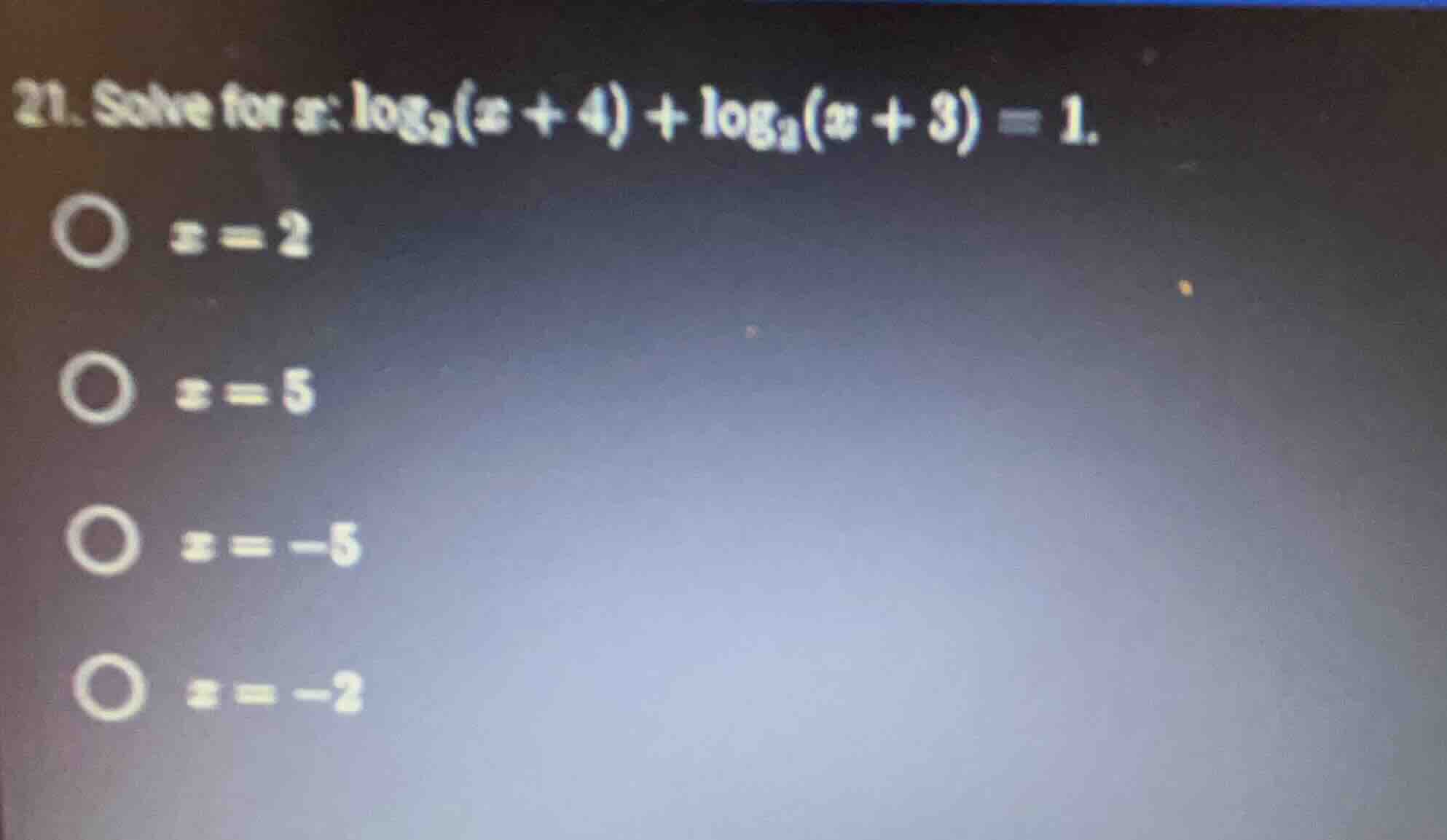
- solve for (x): (log_2(x + 4) + log_2(x + 3) = 1).
\\(x = 2\\)
\\(x = 5\\)
\\(x = -5\\)
\\(x = -2\\)
🆕 New Concept Discovered: Solving Logarithmic Equations
Combine logs and convert to exponential form.
Step 1: Apply the product rule of logarithms
The product rule states that \(\log_b(A) + \log_b(B) = \log_b(A \cdot B)\). We can use this to combine the two logarithmic terms on the left side:
Step 2: Convert to exponential form
To get rid of the logarithm, we rewrite the equation in its exponential form. Since \(\log_b(Y) = X\) is equivalent to \(b^X = Y\), we have:
Step 3: Solve the quadratic equation
First, expand the left side:
Subtract \(2\) from both sides to set the quadratic equation to zero:
Factor the quadratic equation:
This gives two potential solutions:
Step 4: Check for extraneous solutions
Logarithms are only defined for positive real numbers, so the arguments inside the original logarithms, \((x + 4)\) and \((x + 3)\), must be strictly greater than \(0\).
- For \(x = -5\):
Thus, \(x = -5\) is an extraneous solution.
- For \(x = -2\):
Thus, \(x = -2\) is the only valid solution.

Snap & solve any problem in the app
Get step-by-step solutions on Sovi AI
Photo-based solutions with guided steps
Explore more problems and detailed explanations
\(x = -2\)