QUESTION IMAGE
Question
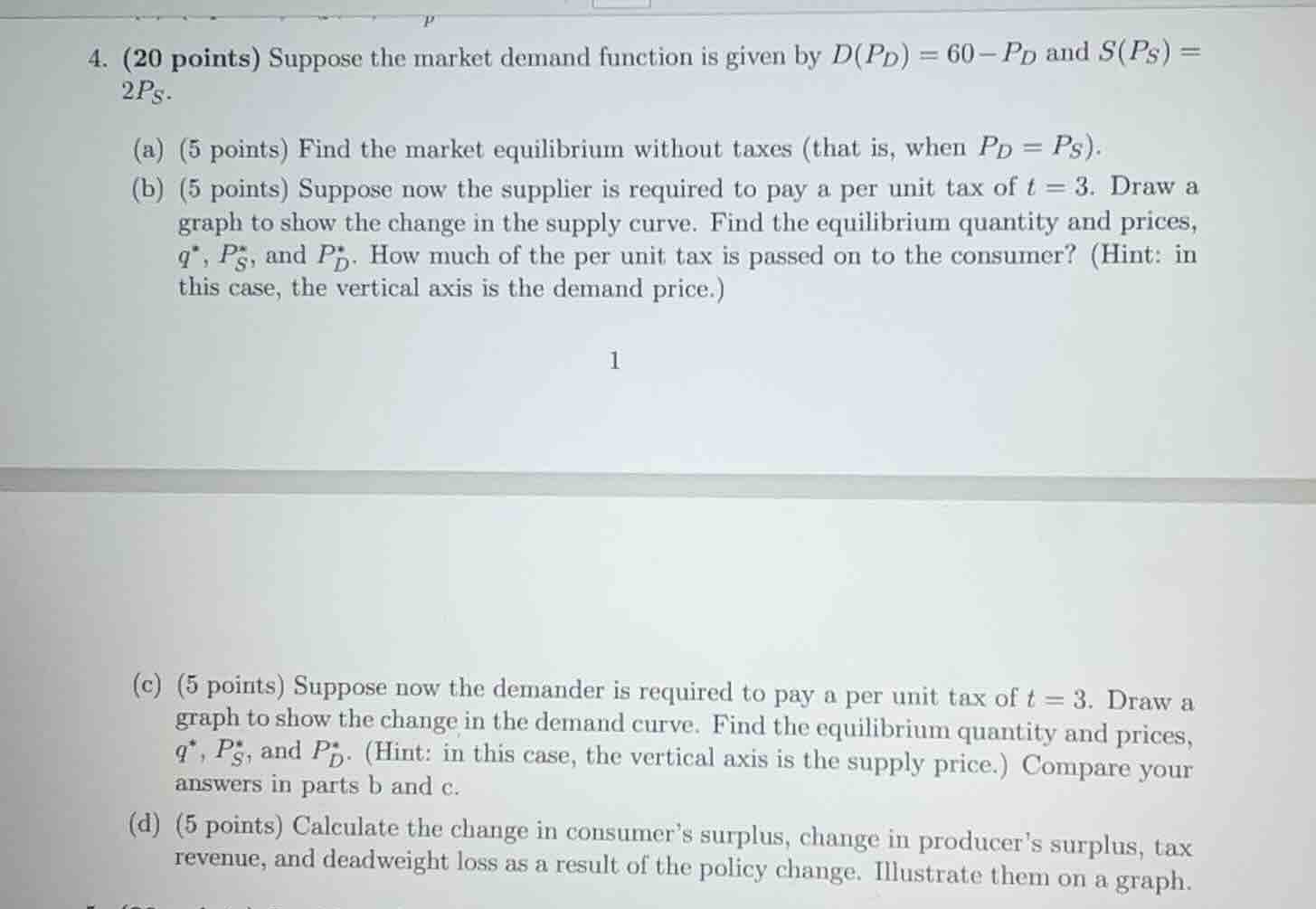
- (20 points) suppose the market demand function is given by (d(p_d) = 60 - p_d) and (s(p_s) = 2p_s).
(a) (5 points) find the market equilibrium without taxes (that is, when (p_d = p_s)).
(b) (5 points) suppose now the supplier is required to pay a per unit tax of (t = 3). draw a graph to show the change in the supply curve. find the equilibrium quantity and prices, (q^), (p_s^), and (p_d^*). how much of the per unit tax is passed on to the consumer? (hint: in this case, the vertical axis is the demand price.)
(c) (5 points) suppose now the demander is required to pay a per unit tax of (t = 3). draw a graph to show the change in the demand curve. find the equilibrium quantity and prices, (q^), (p_s^), and (p_d^*). (hint: in this case, the vertical axis is the supply price.) compare your answers in parts b and c.
(d) (5 points) calculate the change in consumers surplus, change in producers surplus, tax revenue, and deadweight loss as a result of the policy change. illustrate them on a graph.
Find the market equilibrium without taxes
Using the Market Equilibrium knowledge point
Analyze tax on supplier
Using the Tax Incidence knowledge point
Analyze tax on demander
Using the Tax Incidence knowledge point
Calculate welfare changes
Using the Deadweight Loss and Welfare Analysis knowledge points

Snap & solve any problem in the app
Get step-by-step solutions on Sovi AI
Photo-based solutions with guided steps
Explore more problems and detailed explanations
Question 4
(a)
- Equilibrium Price (\(P^*\)): \(20\)
- Equilibrium Quantity (\(Q^*\)): \(40\)
(b)
- Equilibrium Quantity (\(q^*\)): \(38\)
- Producer Price (\(P_S^*\)): \(19\)
- Consumer Price (\(P_D^*\)): \(22\)
- Tax Passed to Consumer: \(2\) per unit
(c)
- Equilibrium Quantity (\(q^*\)): \(38\)
- Producer Price (\(P_S\)): \(19\)
- Consumer Price (\(P_D\)): \(22\)
- Comparison: The economic incidence is identical to part (b); the statutory burden does not affect the final equilibrium outcome.
(d)
- Change in Consumer Surplus (\(\Delta CS\)): \(-78\)
- Change in Producer Surplus (\(\Delta PS\)): \(-39\)
- Tax Revenue: \(114\)
- Deadweight Loss (\(DWL\)): \(3\)