QUESTION IMAGE
Question
2-5 study guide and intervention
postulates and paragraph proofs
points, lines, and planes in geometry, a postulate is a statement that is accepted as true. postulates describe fundamental relationships in geometry.
postulate: through any two points, there is exactly one line.
postulate: through any three points not on the same line, there is exactly one plane.
postulate: a line contains at least two points.
postulate: a plane contains at least three points not on the same line.
postulate: if two points lie in a plane, then the line containing those points lies in the plane.
postulate: if two lines intersect, then their intersection is exactly one point.
postulate: if two planes intersect, then their intersection is a line.
exercises
use postulates to determine whether each statement is always, sometimes, or never true.
- a line contains exactly one point.
- noncollinear points \\(r\\), \\(s\\), and \\(t\\) are contained in exactly one plane.
- any two lines \\(\ell\\) and \\(m\\) intersect.
- if points \\(g\\) and \\(h\\) are contained in plane \\(\mathcal{m}\\), then \\(\overline{gh}\\) is perpendicular to plane \\(\mathcal{m}\\).
- planes \\(\mathcal{r}\\) and \\(\mathcal{s}\\) intersect in point \\(t\\).
- if points \\(a\\), \\(b\\), and \\(c\\) are noncollinear, then segments \\(\overline{ab}\\), \\(\overline{bc}\\), and \\(\overline{ca}\\) are contained in exactly one plane.
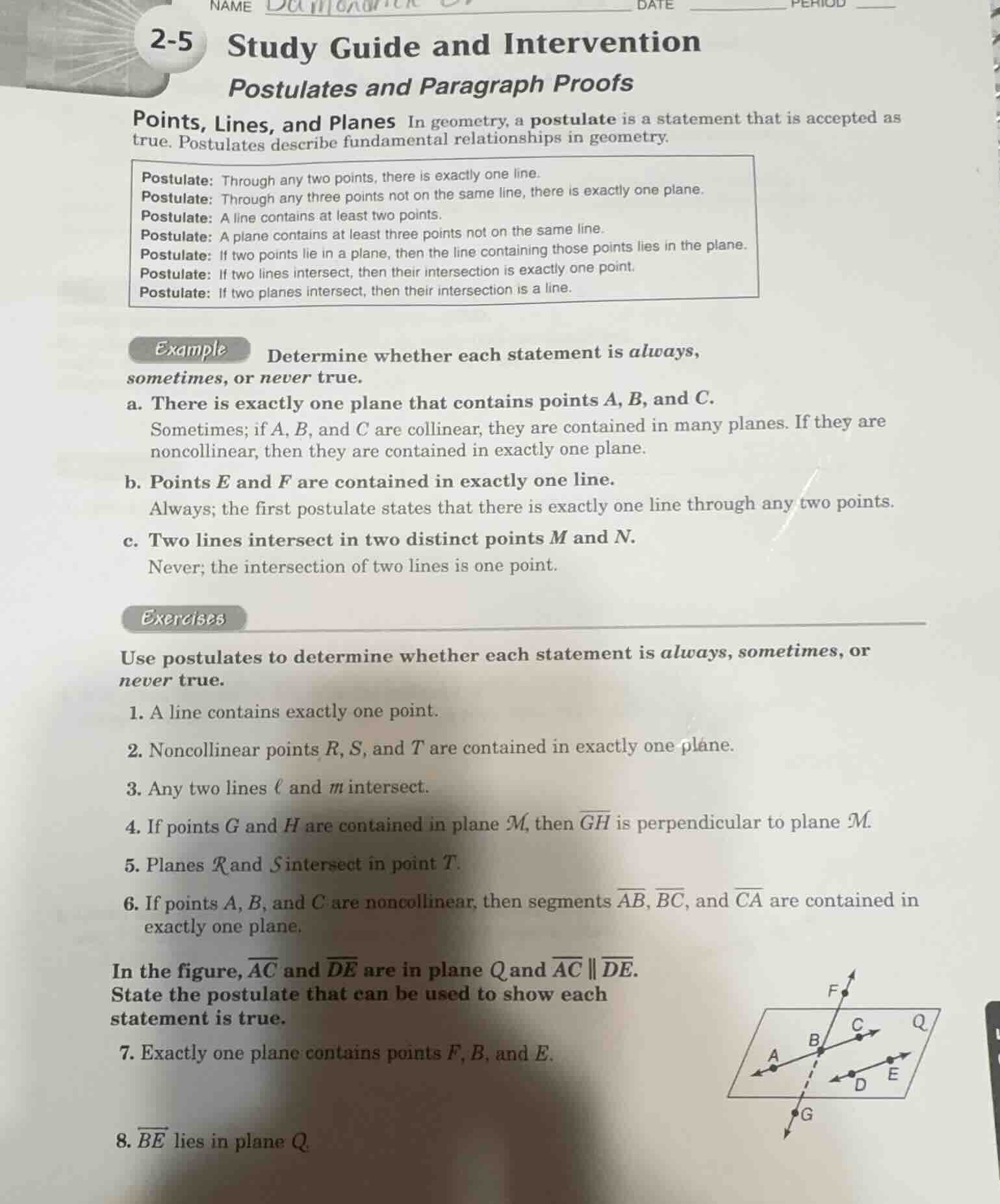
in the figure, \\(\overleftrightarrow{ac}\\) and \\(\overleftrightarrow{de}\\) are in plane \\(\mathcal{q}\\) and \\(\overleftrightarrow{ac} \parallel \overleftrightarrow{de}\\).
state the postulate that can be used to show each statement is true.
- exactly one plane contains points \\(f\\), \\(b\\), and \\(e\\).
- \\(\overleftrightarrow{be}\\) lies in plane \\(\mathcal{q}\\).
Analyze Exercises 1 to 6
We evaluate each statement using the provided geometric postulates:
- Exercise 1: "A line contains exactly one point."
- Postulate: "A line contains at least two points."
- Since a line must have at least two points, it can never contain exactly one point.
- Result: Never
- Exercise 2: "Noncollinear points \(R\), \(S\), and \(T\) are contained in exactly one plane."
- Postulate: "Through any three points not on the same line, there is exactly one plane."
- Noncollinear means not on the same line.
- Result: Always
- Exercise 3: "Any two lines \(\ell\) and \(m\) intersect."
- In geometry, two lines can be parallel or skew (not intersecting).
- Result: Sometimes
- Exercise 4: "If points \(G\) and \(H\) are contained in plane \(\mathcal{M}\), then \(\overline{GH}\) is perpendicular to plane \(\mathcal{M}\)."
- Postulate: "If two points lie in a plane, then the line containing those points lies in the plane."
- If the line lies entirely within the plane, it cannot be perpendicular to it (unless it is a single point, which a line is not).
- Result: Never
- Exercise 5: "Planes \(\mathcal{R}\) and \(\mathcal{S}\) intersect in point \(T\)."
- Postulate: "If two planes intersect, then their intersection is a line."
- Two planes cannot intersect in only a single point.
- Result: Never
- Exercise 6: "If points \(A\), \(B\), and \(C\) are noncollinear, then segments \(\overline{AB}\), \(\overline{BC}\), and \(\overline{CA}\) are contained in exactly one plane."
- Since \(A\), \(B\), and \(C\) are noncollinear, they define exactly one plane.
- Any line (or segment) connecting these points must lie entirely within that same plane.
- Result: Always
Analyze Exercise 7
- Statement: "Exactly one plane contains points \(F\), \(B\), and \(E\)."
- Analysis: Looking at the figure, points \(F\), \(B\), and \(E\) are three noncollinear points.
- Postulate: "Through any three points not on the same line, there is exactly one plane." (or "Through any three noncollinear points, there is exactly one plane.")
Analyze Exercise 8
- Statement: "\(\overleftrightarrow{BE}\) lies in plane \(\mathcal{Q}\)."
- Analysis: Points \(B\) and \(E\) both lie in plane \(\mathcal{Q}\).
- Postulate: "If two points lie in a plane, then the line containing those points lies in the plane."

Snap & solve any problem in the app
Get step-by-step solutions on Sovi AI
Photo-based solutions with guided steps
Explore more problems and detailed explanations
Question 1
Never
Question 2
Always
Question 3
Sometimes
Question 4
Never
Question 5
Never
Question 6
Always
Question 7
Through any three points not on the same line, there is exactly one plane.
Question 8
If two points lie in a plane, then the line containing those points lies in the plane.