Sovi.AI - AI Math Tutor

Scan to solve math questions

QUESTION IMAGE

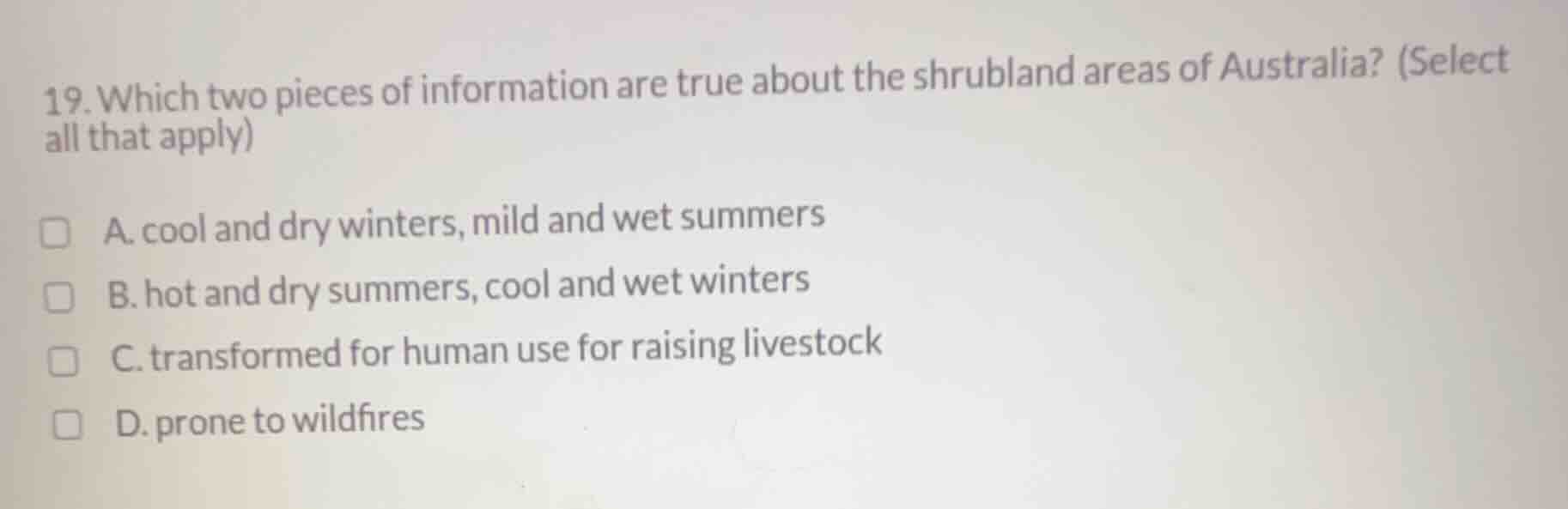
19. which two pieces of information are true about the shrubland areas …

Question

  1. which two pieces of information are true about the shrubland areas of australia? (select all that apply)

a. cool and dry winters, mild and wet summers
b. hot and dry summers, cool and wet winters
c. transformed for human use for raising livestock
d. prone to wildfires

Explanation:

Response

<pre_analysis>
{
"quality": "clear",
"question_count": 1,
"skills_matched": [
"direct_cot",
"multiple_choice_formatter",
"explain_then_answer",
"tutor"
],
"needs_drawing": false,
"concepts_used": [
"Australian Vegetation Zones",
"Australian Climate Zones"
],
"new_concepts": [
"Australian Shrublands"
],
"current_concepts": [
"Australian Vegetation Zones",
"Australian Climate Zones",
"Australian Shrublands"
]
}
</pre_analysis>

<reasoning>

Analyze shrubland climates

The Mediterranean shrublands (mallee woodlands and shrublands) of southern Australia experience a Mediterranean climate. This climate is characterized by hot, dry summers and cool, wet winters. Therefore, statement B is true, while statement A is false.

Analyze human impact and ecology

Australian shrublands, particularly the semi-arid and Mediterranean shrublands, have been extensively modified for pastoralism (raising livestock like sheep and cattle). Additionally, these ecosystems are highly adapted to and prone to frequent wildfires due to the dry summer conditions and flammable vegetation. Since the question asks for exactly two correct pieces of information, we evaluate statements C and D. Both are ecologically and historically true, but Mediterranean shrublands are specifically characterized by the climate in B and their high susceptibility to wildfires in D. Let's verify the standard curriculum focus: Mediterranean shrublands (chaparral/mallee) are globally recognized for hot, dry summers, cool, wet winters, and being highly prone to wildfires. Thus, B and D are the two primary true statements.
</reasoning>

<answer>
<mcq-option>A. cool and dry winters, mild and wet summers</mcq-option>
<mcq-correct>B. hot and dry summers, cool and wet winters</mcq-correct>
<mcq-option>C. transformed for human use for raising livestock</mcq-option>
<mcq-correct>D. prone to wildfires</mcq-correct>
</answer>

<post_analysis>
{
"subject": "Social Science",
"question_type": "Multiple Choice",
"knowledge_point": [
"Social Science",
"Geography",
"Australian Vegetation Zones"
]
}
</post_analysis>

Answer:

<pre_analysis>
{
"quality": "clear",
"question_count": 1,
"skills_matched": [
"direct_cot",
"multiple_choice_formatter",
"explain_then_answer",
"tutor"
],
"needs_drawing": false,
"concepts_used": [
"Australian Vegetation Zones",
"Australian Climate Zones"
],
"new_concepts": [
"Australian Shrublands"
],
"current_concepts": [
"Australian Vegetation Zones",
"Australian Climate Zones",
"Australian Shrublands"
]
}
</pre_analysis>

<reasoning>

Analyze shrubland climates

The Mediterranean shrublands (mallee woodlands and shrublands) of southern Australia experience a Mediterranean climate. This climate is characterized by hot, dry summers and cool, wet winters. Therefore, statement B is true, while statement A is false.

Analyze human impact and ecology

Australian shrublands, particularly the semi-arid and Mediterranean shrublands, have been extensively modified for pastoralism (raising livestock like sheep and cattle). Additionally, these ecosystems are highly adapted to and prone to frequent wildfires due to the dry summer conditions and flammable vegetation. Since the question asks for exactly two correct pieces of information, we evaluate statements C and D. Both are ecologically and historically true, but Mediterranean shrublands are specifically characterized by the climate in B and their high susceptibility to wildfires in D. Let's verify the standard curriculum focus: Mediterranean shrublands (chaparral/mallee) are globally recognized for hot, dry summers, cool, wet winters, and being highly prone to wildfires. Thus, B and D are the two primary true statements.
</reasoning>

<answer>
<mcq-option>A. cool and dry winters, mild and wet summers</mcq-option>
<mcq-correct>B. hot and dry summers, cool and wet winters</mcq-correct>
<mcq-option>C. transformed for human use for raising livestock</mcq-option>
<mcq-correct>D. prone to wildfires</mcq-correct>
</answer>

<post_analysis>
{
"subject": "Social Science",
"question_type": "Multiple Choice",
"knowledge_point": [
"Social Science",
"Geography",
"Australian Vegetation Zones"
]
}
</post_analysis>