QUESTION IMAGE
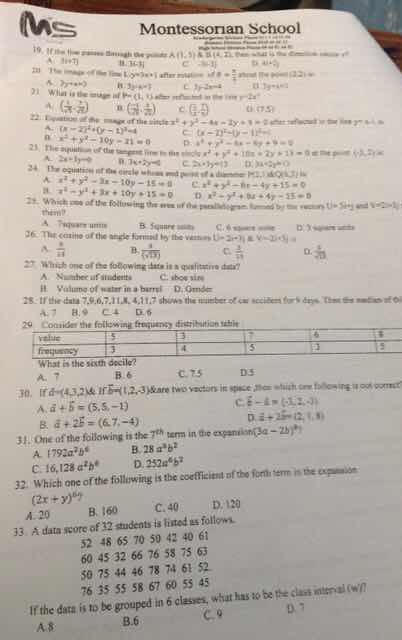
Question
- if the line passes through the points a (1, 5) & b (4, 2), then what is the direction vector v?
a. 3i+7j
b. 3i-3j
c. -3i-3j
d. 4i+2j
- the image of the line l: y=3x+1 after rotation of \\(\theta = \frac{\pi}{2}\\) about the point (2,2) is:
a. 3y+x=3
b. 3y-x=7
c. 3y-2x=4
d. 3y+x=1
- what is the image of p= (1, 1) after reflected in the line y=2x?
a. \\(\left(-\frac{3}{5}, \frac{9}{5}\
ight)\\)
b. \\(\left(-\frac{3}{5}, -\frac{9}{5}\
ight)\\)
c. \\(\left(\frac{3}{5}, \frac{9}{5}\
ight)\\)
d. (7,5)
- equation of the image of the circle \\(x^2 + y^2 - 6x - 2y + 1 = 0\\) after reflected in the line y=x-1 is:
a. \\((x-2)^2 + (y-1)^2 = 4\\)
b. \\(x^2 + y^2 - 10y - 21 = 0\\)
c. \\((x-2)^2 - (y-1)^2 = 1\\)
d. \\(x^2 + y^2 - 6x - 8y + 9 = 0\\)
- the equation of the tangent line to the circle \\(x^2 + y^2 + 10x + 2y + 13 = 0\\) at the point (-3, 2) is:
a. 2x-3y=0
b. 3x+2y=0
c. 2x-3y=12
d. 2x+3y=0
- the equation of the circle whose end point of a diameter p(2, 1) & q(6, 7) is:
a. \\(x^2 + y^2 - 3x - 10y - 15 = 0\\)
b. \\(x^2 - y^2 + 3x + 10y + 15 = 0\\)
c. \\(x^2 + y^2 - 8x - 4y + 15 = 0\\)
d. \\(x^2 - y^2 + 8x + 4y - 15 = 0\\)
- which one of the following the area of the parallelogram formed by the vectors u= 5i+j and v=2i+3j?
a. 7square units
b. 5square units
c. 6 square units
d. 3 square units
- the cosine of the angle formed by the vectors u= 2i-3j & v=2i+3j is:
a. \\(\frac{8}{13}\\)
b. \\(\frac{8}{\sqrt{13}}\\)
c. \\(-\frac{5}{13}\\)
d. \\(-\frac{5}{\sqrt{13}}\\)
- which one of the following data is a qualitative data?
a. number of students
b. volume of water in a barrel
c. shoe size
d. gender
- if the data 7,9,6,7,11,8, 4,11,7 shows the number of car accidents for 9 days. then the median of the data is:
a. 7
b. 9
c. 4
d. 6
- consider the following frequency distribution table:
\
what is the sixth decile?
a. 7
b. 6
c. 7.5
d. 5
- if \\(\vec{a} = (4,3,2)\\) & if \\(\vec{b} = (1,2,-3)\\) are two vectors in space, then which one following is not correct?
a. \\(\vec{a} + \vec{b} = (5,5,-1)\\)
b. \\(\vec{a} + 2\vec{b} = (6,7,-4)\\)
c. \\(\vec{b} - \vec{a} = (-3,2,-3)\\)
d. \\(\vec{a} + 2\vec{b} = (2,1,8)\\)
- one of the following is the \\(7^{\text{th}}\\) term in the expansion \\((3a - 2b)^8\\)?
a. \\(1792a^2b^6\\)
b. \\(28 a^8b^2\\)
c. \\(16,128 a^2b^6\\)
d. \\(252a^6b^2\\)
- which one of the following is the coefficient of the forth term in the expansion \\((2x + y)^6\\)?
a. 20
b. 160
c. 40
d. 120
- a data score of 32 students is listed as follows.
52 48 65 70 50 42 40 61
60 45 32 66 76 58 75 63
50 75 44 46 78 74 61 52
76 35 55 58 67 60 55 45
if the data is to be grouped in 6 classes, what has to be the class interval (w)?
a. 8
b. 6
c. 9
d. 7
Identify the given vectors
Using the 3D Vectors knowledge point
Evaluate option A
Using the Vector Operations knowledge point
This matches option A, so option A is correct.
Evaluate option B
Using the Vector Operations knowledge point
This matches option B, so option B is correct.
Evaluate option C
Using the Vector Operations knowledge point
This matches option C, so option C is correct.
Evaluate option D
Using the Vector Operations knowledge point
This does not match option D, so option D is not correct.

Snap & solve any problem in the app
Get step-by-step solutions on Sovi AI
Photo-based solutions with guided steps
Explore more problems and detailed explanations
Question 30
- (A) \(\vec{a} + \vec{b} = (5, 5, -1)\)
- (B) \(\vec{a} + 2\vec{b} = (6, 7, -4)\)
- (C) \(\vec{b} - \vec{a} = (-3, -1, -5)\)
- (D) \(\vec{a} + 2\vec{b} = (2, 1, 8)\) (Correct answer)