QUESTION IMAGE
Question
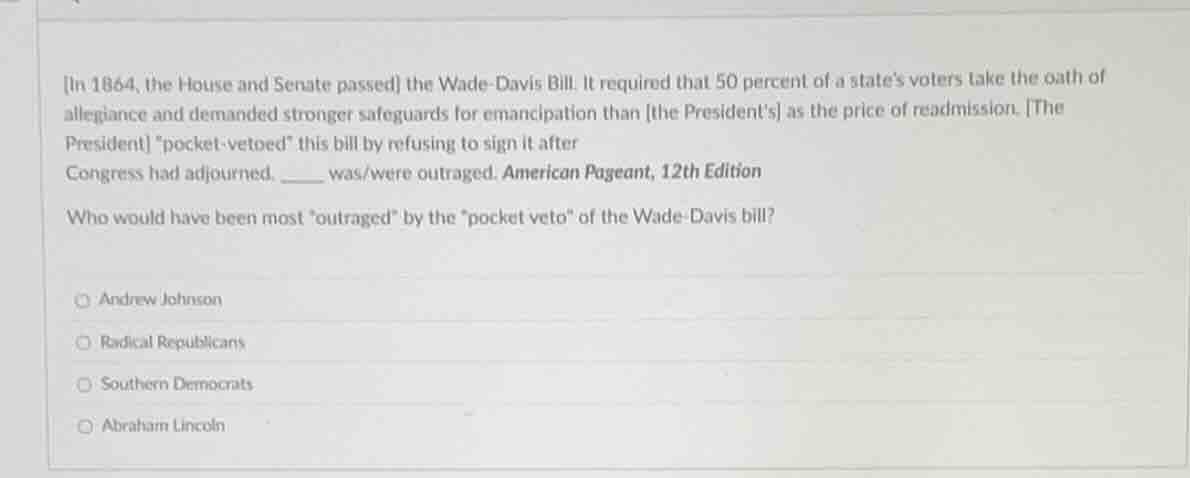
in 1864, the house and senate passed the wade-davis bill. it required that 50 percent of a states voters take the oath of allegiance and demanded stronger safeguards for emancipation than the presidents as the price of readmission. the president \pocket-vetoed\ this bill by refusing to sign it after congress had adjourned. ____ was/were outraged. american pageant, 12th edition
who would have been most \outraged\ by the \pocket veto\ of the wade-davis bill?
- andrew johnson
- radical republicans
- southern democrats
- abraham lincoln
<pre_analysis>
{
"quality": "clear",
"question_count": 1,
"skills_matched": [
"direct_cot",
"multiple_choice_formatter",
"explain_then_answer",
"tutor"
],
"needs_drawing": false,
"concepts_used": [
"Radical vs Moderate Republicans"
],
"new_concepts": [
"Wade-Davis Bill"
],
"current_concepts": [
"Wade-Davis Bill",
"Radical vs Moderate Republicans",
"Wartime Reconstruction"
]
}
</pre_analysis>
<reasoning>
Analyze the Wade-Davis Bill
The Wade-Davis Bill of 1864 was a Reconstruction plan proposed by Senator Benjamin Wade and Representative Henry Winter Davis. Unlike President Abraham Lincoln's lenient Ten Percent Plan, this bill required 50 percent of a seceded state's white male voters to take an "Ironclad Oath" of allegiance to the Union before the state could be readmitted.
Identify the political factions
Using the Radical vs Moderate Republicans knowledge point, we can distinguish the reactions to Lincoln's Reconstruction policies. The Radical Republicans believed Lincoln's plan was too mild and did not sufficiently protect the rights of newly freed African Americans or punish former Confederates. They drafted the Wade-Davis Bill to enforce a much stricter path to readmission.
Determine the reaction to the pocket veto
When President Lincoln used a pocket veto to block the Wade-Davis Bill, he asserted presidential authority over Reconstruction. This action deeply angered the sponsors and supporters of the bill, who believed Congress should control the process. Therefore, the Radical Republicans were the group most "outraged" by Lincoln's pocket veto.
</reasoning>
<answer>
<mcq-option>Andrew Johnson</mcq-option>
<mcq-correct>Radical Republicans</mcq-correct>
<mcq-option>Southern Democrats</mcq-option>
<mcq-option>Abraham Lincoln</mcq-option>
</answer>
<post_analysis>
{
"subject": "Social Science",
"question_type": "Multiple Choice",
"knowledge_point": [
"Social Science",
"US History",
"Reconstruction Era"
]
}
</post_analysis>
Snap & solve any problem in the app
Get step-by-step solutions on Sovi AI
Photo-based solutions with guided steps
Explore more problems and detailed explanations
<pre_analysis>
{
"quality": "clear",
"question_count": 1,
"skills_matched": [
"direct_cot",
"multiple_choice_formatter",
"explain_then_answer",
"tutor"
],
"needs_drawing": false,
"concepts_used": [
"Radical vs Moderate Republicans"
],
"new_concepts": [
"Wade-Davis Bill"
],
"current_concepts": [
"Wade-Davis Bill",
"Radical vs Moderate Republicans",
"Wartime Reconstruction"
]
}
</pre_analysis>
<reasoning>
Analyze the Wade-Davis Bill
The Wade-Davis Bill of 1864 was a Reconstruction plan proposed by Senator Benjamin Wade and Representative Henry Winter Davis. Unlike President Abraham Lincoln's lenient Ten Percent Plan, this bill required 50 percent of a seceded state's white male voters to take an "Ironclad Oath" of allegiance to the Union before the state could be readmitted.
Identify the political factions
Using the Radical vs Moderate Republicans knowledge point, we can distinguish the reactions to Lincoln's Reconstruction policies. The Radical Republicans believed Lincoln's plan was too mild and did not sufficiently protect the rights of newly freed African Americans or punish former Confederates. They drafted the Wade-Davis Bill to enforce a much stricter path to readmission.
Determine the reaction to the pocket veto
When President Lincoln used a pocket veto to block the Wade-Davis Bill, he asserted presidential authority over Reconstruction. This action deeply angered the sponsors and supporters of the bill, who believed Congress should control the process. Therefore, the Radical Republicans were the group most "outraged" by Lincoln's pocket veto.
</reasoning>
<answer>
<mcq-option>Andrew Johnson</mcq-option>
<mcq-correct>Radical Republicans</mcq-correct>
<mcq-option>Southern Democrats</mcq-option>
<mcq-option>Abraham Lincoln</mcq-option>
</answer>
<post_analysis>
{
"subject": "Social Science",
"question_type": "Multiple Choice",
"knowledge_point": [
"Social Science",
"US History",
"Reconstruction Era"
]
}
</post_analysis>