QUESTION IMAGE
Question
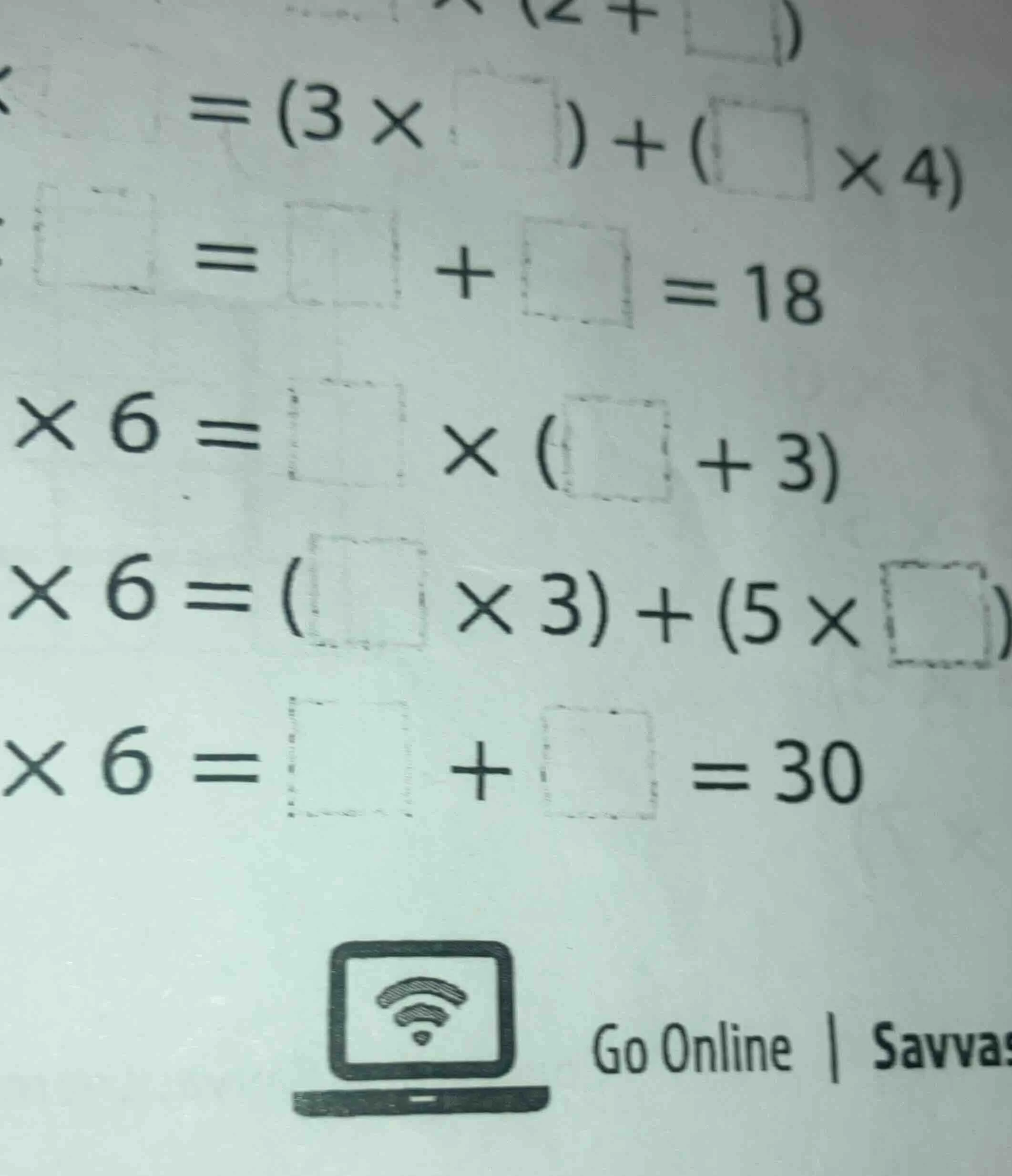
=(3×□)+(□×4)
=□+□=18
×6=□×(□+3)
×6=(□×3)+(5×□)
×6=□+□=30
go online | savva
Looking at the second set of equations (the one with \( \times 6 \)):
Step 1: Analyze the Distributive Property
We know the distributive property is \( a \times (b + c) = (a \times b) + (a \times c) \). Here, we have \( 5 \times 6 = 5 \times (\square + 3) \). By distributive property, \( 5 \times (\square + 3)=(5\times\square)+(5\times 3) \), and \( 5\times 6 = 30 \), so \( 5\times(\square + 3)=30 \), then \( \square + 3=\frac{30}{5}=6 \), so \( \square=6 - 3 = 3 \). So the first blank in the parentheses is \( 3 \).
Step 2: Fill in the Next Blanks
Now, \( 5\times 6=(5\times 3)+(5\times\square) \). Calculate \( 5\times 3 = 15 \), and \( 5\times 6=30 \), so \( 30=15+(5\times\square) \). Then \( 5\times\square=30 - 15 = 15 \), so \( \square=\frac{15}{5}=3 \).
Step 3: Verify the Sum
Then \( 5\times 6=(5\times 3)+(5\times 3)=15 + 15=30 \), which matches.
For the first set (with sum 18), let's assume the left - hand side is \( 3\times(2 + 4) \) (since we can work backwards). By distributive property \( 3\times(2 + 4)=(3\times 2)+(3\times 4) \). Calculate \( 3\times 2 = 6 \) and \( 3\times 4 = 12 \), and \( 6+12 = 18 \).
Final Filling (First Set)
- The first equation: \( 3\times(2 + 4)=(3\times 2)+(3\times 4) \)
- Then \( 6+12 = 18 \)
Final Filling (Second Set)
- \( 5\times 6=5\times(3 + 3) \)
- \( 5\times 6=(5\times 3)+(5\times 3) \)
- \( 15 + 15=30 \)
First Set Answers:
- In \( 3\times(2 + 4)=(3\times 2)+(3\times 4) \), the blanks are \( 2 \), \( 3 \), \( 6 \), \( 12 \) (in order of the blanks from left to right in the first set) and \( 6+12 = 18 \)
Second Set Answers:
- In \( 5\times 6=5\times(3 + 3) \), \( 5\times 6=(5\times 3)+(5\times 3) \), the blanks are \( 3 \), \( 5 \), \( 3 \), \( 15 \), \( 15 \) (in order of the blanks from left to right in the second set) and \( 15+15 = 30 \)
(Note: If we assume the first set starts with \( 3\times(2 + 4) \) as a common distributive property example, and the second with \( 5\times(3 + 3) \))
First Set Step - by - Step (Detailed)
- Let the original expression be \( a\times(b + c)=(a\times b)+(a\times c) \) and \( (a\times b)+(a\times c)=18 \)
- Assume \( a = 3 \), we know that if \( b + c \) is split such that \( 3\times b+3\times c = 18 \), or \( 3\times(b + c)=18 \), then \( b + c=\frac{18}{3}=6 \)
- A common split for \( b + c = 6 \) is \( b = 2 \) and \( c = 4 \) (or vice - versa)
- Then \( 3\times(2 + 4)=(3\times 2)+(3\times 4) \)
- Calculate \( 3\times 2=6 \) and \( 3\times 4 = 12 \)
- And \( 6 + 12=18 \)
Second Set Step - by - Step (Detailed)
- Let the original expression be \( a\times6=a\times(b + 3) \) and \( a\times6=(a\times 3)+(a\times c) \) and \( (a\times 3)+(a\times c)=30 \)
- Assume \( a = 5 \), then \( 5\times6 = 30 \), and \( 5\times(b + 3)=30 \), so \( b + 3=\frac{30}{5}=6 \), then \( b = 3 \)
- Also, \( 5\times6=(5\times 3)+(5\times c) \), \( 30=15+(5\times c) \), so \( 5\times c=15 \), \( c = 3 \)
- Then \( 5\times6=(5\times 3)+(5\times 3)=15 + 15=30 \)
Final Answers (First Set, blanks from left to right):
- The first equation blanks: \( 3\times(2 + 4)=(3\times 2)+(3\times 4) \), then \( 6+12 = 18 \)
Final Answers (Second Set, blanks from left to right):
- The second equation blanks: \( 5\times 6=5\times(3 + 3) \), \( 5\times 6=(5\times 3)+(5\times 3) \), then \( 15+15 = 30 \)

Snap & solve any problem in the app
Get step-by-step solutions on Sovi AI
Photo-based solutions with guided steps
Explore more problems and detailed explanations
Looking at the second set of equations (the one with \( \times 6 \)):
Step 1: Analyze the Distributive Property
We know the distributive property is \( a \times (b + c) = (a \times b) + (a \times c) \). Here, we have \( 5 \times 6 = 5 \times (\square + 3) \). By distributive property, \( 5 \times (\square + 3)=(5\times\square)+(5\times 3) \), and \( 5\times 6 = 30 \), so \( 5\times(\square + 3)=30 \), then \( \square + 3=\frac{30}{5}=6 \), so \( \square=6 - 3 = 3 \). So the first blank in the parentheses is \( 3 \).
Step 2: Fill in the Next Blanks
Now, \( 5\times 6=(5\times 3)+(5\times\square) \). Calculate \( 5\times 3 = 15 \), and \( 5\times 6=30 \), so \( 30=15+(5\times\square) \). Then \( 5\times\square=30 - 15 = 15 \), so \( \square=\frac{15}{5}=3 \).
Step 3: Verify the Sum
Then \( 5\times 6=(5\times 3)+(5\times 3)=15 + 15=30 \), which matches.
For the first set (with sum 18), let's assume the left - hand side is \( 3\times(2 + 4) \) (since we can work backwards). By distributive property \( 3\times(2 + 4)=(3\times 2)+(3\times 4) \). Calculate \( 3\times 2 = 6 \) and \( 3\times 4 = 12 \), and \( 6+12 = 18 \).
Final Filling (First Set)
- The first equation: \( 3\times(2 + 4)=(3\times 2)+(3\times 4) \)
- Then \( 6+12 = 18 \)
Final Filling (Second Set)
- \( 5\times 6=5\times(3 + 3) \)
- \( 5\times 6=(5\times 3)+(5\times 3) \)
- \( 15 + 15=30 \)
First Set Answers:
- In \( 3\times(2 + 4)=(3\times 2)+(3\times 4) \), the blanks are \( 2 \), \( 3 \), \( 6 \), \( 12 \) (in order of the blanks from left to right in the first set) and \( 6+12 = 18 \)
Second Set Answers:
- In \( 5\times 6=5\times(3 + 3) \), \( 5\times 6=(5\times 3)+(5\times 3) \), the blanks are \( 3 \), \( 5 \), \( 3 \), \( 15 \), \( 15 \) (in order of the blanks from left to right in the second set) and \( 15+15 = 30 \)
(Note: If we assume the first set starts with \( 3\times(2 + 4) \) as a common distributive property example, and the second with \( 5\times(3 + 3) \))
First Set Step - by - Step (Detailed)
- Let the original expression be \( a\times(b + c)=(a\times b)+(a\times c) \) and \( (a\times b)+(a\times c)=18 \)
- Assume \( a = 3 \), we know that if \( b + c \) is split such that \( 3\times b+3\times c = 18 \), or \( 3\times(b + c)=18 \), then \( b + c=\frac{18}{3}=6 \)
- A common split for \( b + c = 6 \) is \( b = 2 \) and \( c = 4 \) (or vice - versa)
- Then \( 3\times(2 + 4)=(3\times 2)+(3\times 4) \)
- Calculate \( 3\times 2=6 \) and \( 3\times 4 = 12 \)
- And \( 6 + 12=18 \)
Second Set Step - by - Step (Detailed)
- Let the original expression be \( a\times6=a\times(b + 3) \) and \( a\times6=(a\times 3)+(a\times c) \) and \( (a\times 3)+(a\times c)=30 \)
- Assume \( a = 5 \), then \( 5\times6 = 30 \), and \( 5\times(b + 3)=30 \), so \( b + 3=\frac{30}{5}=6 \), then \( b = 3 \)
- Also, \( 5\times6=(5\times 3)+(5\times c) \), \( 30=15+(5\times c) \), so \( 5\times c=15 \), \( c = 3 \)
- Then \( 5\times6=(5\times 3)+(5\times 3)=15 + 15=30 \)
Final Answers (First Set, blanks from left to right):
- The first equation blanks: \( 3\times(2 + 4)=(3\times 2)+(3\times 4) \), then \( 6+12 = 18 \)
Final Answers (Second Set, blanks from left to right):
- The second equation blanks: \( 5\times 6=5\times(3 + 3) \), \( 5\times 6=(5\times 3)+(5\times 3) \), then \( 15+15 = 30 \)