QUESTION IMAGE
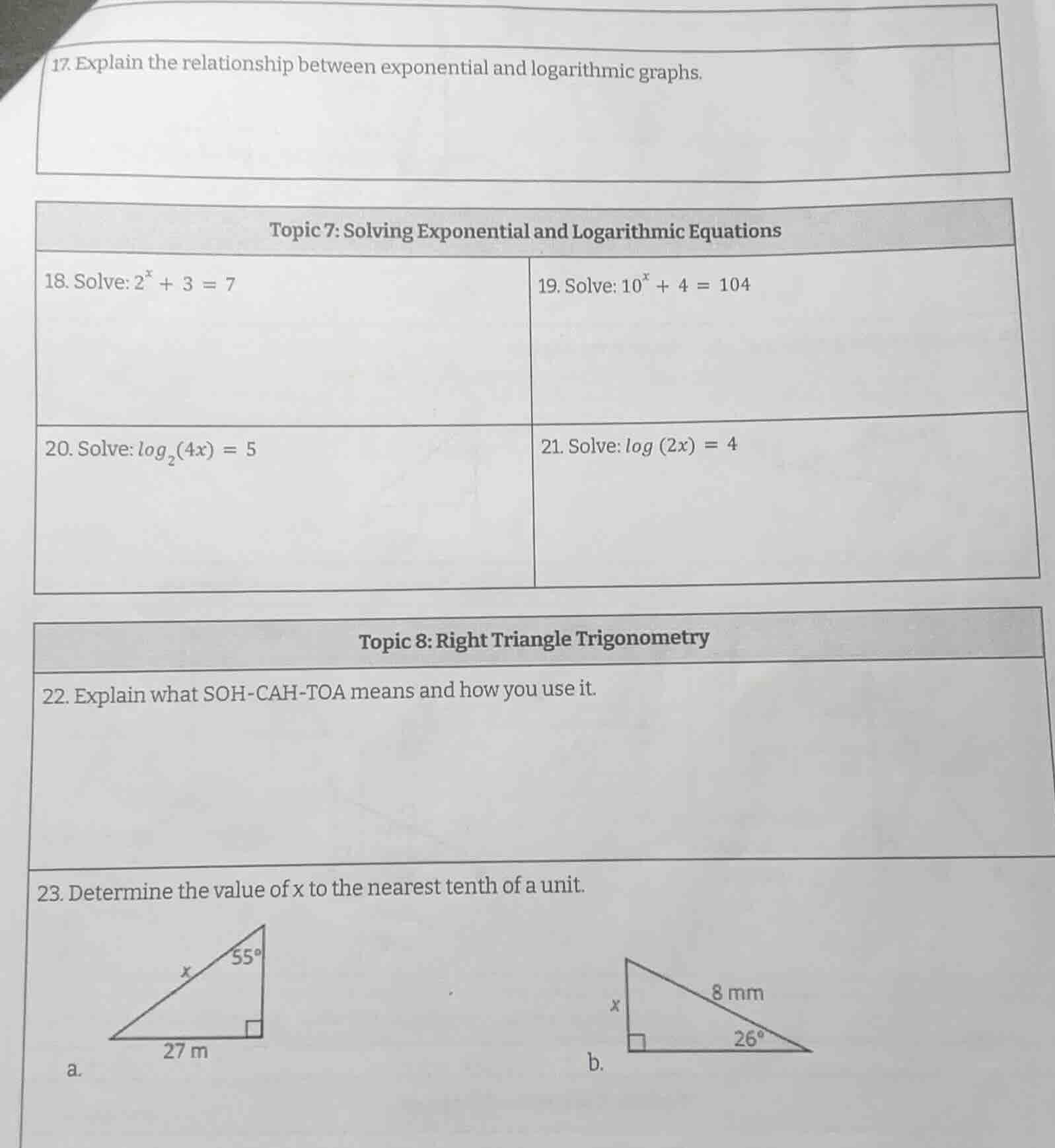
Question
- explain the relationship between exponential and logarithmic graphs.
topic 7: solving exponential and logarithmic equations
- solve: (2^x + 3 = 7)
- solve: (10^x + 4 = 104)
- solve: (log_2(4x) = 5)
- solve: (log(2x) = 4)
topic 8: right triangle trigonometry
- explain what soh-cah-toa means and how you use it.
- determine the value of x to the nearest tenth of a unit.
a.
b.
Relationship between exponential and logarithmic graphs
Using the Logarithmic Graphs and Exponential Functions knowledge points
- Exponential and logarithmic functions are inverse functions of each other.
- Their graphs are reflections of each other across the line \(y = x\).
- The domain of an exponential function is the range of its corresponding logarithmic function, and vice versa.
- The horizontal asymptote of the exponential graph \(y = a^x\) at \(y = 0\) becomes the vertical asymptote of the logarithmic graph \(y = \log_a(x)\) at \(x = 0\).
Solving exponential equations (Questions 18 and 19)
Using the Exponential Functions knowledge point
- For Question 18:
- For Question 19:
Solving logarithmic equations (Questions 20 and 21)
- For Question 20:
- For Question 21:
SOH-CAH-TOA definition
Using the Right Triangle Trigonometry knowledge point
- SOH-CAH-TOA is a mnemonic device used to remember the definitions of the three primary trigonometric ratios in a right triangle:
- SOH: \(\sin(\theta) = \frac{\text{Opposite}}{\text{Hypotenuse}}\)
- CAH: \(\cos(\theta) = \frac{\text{Adjacent}}{\text{Hypotenuse}}\)
- TOA: \(\tan(\theta) = \frac{\text{Opposite}}{\text{Adjacent}}\)
- To use it, identify the given angle, label the sides relative to that angle, and select the ratio containing the known values and the unknown variable.
Solving for missing sides (Question 23)
Using the Solving Right Triangles and Right Triangle Trigonometry knowledge points
- For part a:
- Relative to the \(55^\circ\) angle, the opposite side is \(27\text{ m}\) and the hypotenuse is \(x\).
- Using SOH:
- For part b:
- Relative to the \(26^\circ\) angle, the opposite side is \(x\) and the hypotenuse is \(8\text{ mm}\).
- Using SOH:

Snap & solve any problem in the app
Get step-by-step solutions on Sovi AI
Photo-based solutions with guided steps
Explore more problems and detailed explanations
Question 17
Exponential and logarithmic functions are inverses of each other. Consequently, their graphs are reflections of one another across the line \(y = x\). The horizontal asymptote \(y = 0\) of the exponential function \(y = a^x\) corresponds to the vertical asymptote \(x = 0\) of the logarithmic function \(y = \log_a(x)\).
Question 18
\(x = 2\)
Question 19
\(x = 2\)
Question 20
\(x = 8\)
Question 21
\(x = 5000\)
Question 22
SOH-CAH-TOA is a mnemonic helper for right triangle trigonometric ratios:
- SOH: \(\sin(\theta) = \frac{\text{Opposite}}{\text{Hypotenuse}}\)
- CAH: \(\cos(\theta) = \frac{\text{Adjacent}}{\text{Hypotenuse}}\)
- TOA: \(\tan(\theta) = \frac{\text{Opposite}}{\text{Adjacent}}\)
To use it, label the sides of the right triangle relative to a given acute angle \(\theta\) as Opposite, Adjacent, and Hypotenuse, then choose the ratio that connects your known values with the unknown variable.
Question 23
- a. \(x \approx 33.0\text{ m}\)
- b. \(x \approx 3.5\text{ mm}\)