QUESTION IMAGE
Question
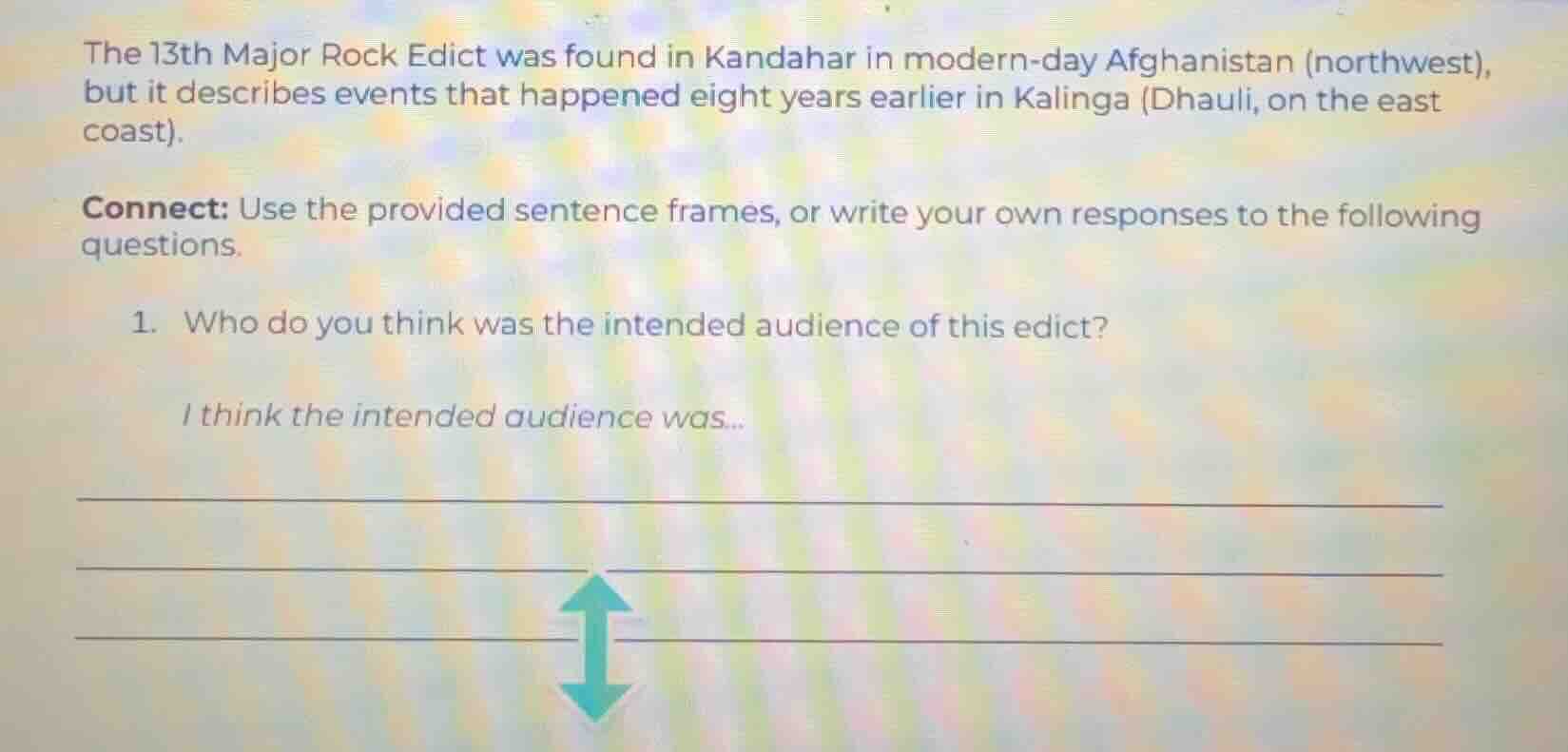
the 13th major rock edict was found in kandahar in modern-day afghanistan (northwest), but it describes events that happened eight years earlier in kalinga (dhauli, on the east coast).
connect: use the provided sentence frames, or write your own responses to the following questions.
- who do you think was the intended audience of this edict?
i think the intended audience was...
Analyze the context of the 13th Major Rock Edict
The prompt states that the 13th Major Rock Edict was discovered in Kandahar (modern-day Afghanistan, in the northwest of the Mauryan Empire), but it describes the Kalinga War, which took place eight years earlier in Kalinga (on the east coast of India). This geographical spread is a key piece of Historical Evidence Analysis.
Identify the intended audience
Using our understanding of Ashoka Edicts, we can determine who the message was meant for:
- Local populations and travelers in the frontier regions: By placing the edict in Kandahar (a multicultural, multilingual hub on the northwestern border), Emperor Ashoka targeted diverse subjects, including Greek and Aramaic speakers, to project his power, express his remorse over the Kalinga War, and declare his commitment to Dhamma (righteousness).
- Neighboring kingdoms and foreign rulers: The edict served as a diplomatic message to neighboring states, warning them of his strength while assuring them of his peaceful intentions.
- Future generations and administrators: Ashoka wanted his successors and officials to understand his philosophy of conquest by Dhamma rather than military force.

Snap & solve any problem in the app
Get step-by-step solutions on Sovi AI
Photo-based solutions with guided steps
Explore more problems and detailed explanations
The 13th Major Rock Edict was found in Kandahar in modern-day Afghanistan (northwest), but it describes events that happened eight years earlier in Kalinga (Dhauli, on the east coast).
Connect: Use the provided sentence frames, or write your own responses to the following questions.
- Who do you think was the intended audience of this edict?
I think the intended audience was <blank>the diverse subjects living in the northwestern frontier of the Mauryan Empire, foreign travelers, and neighboring rulers, as placing this message of remorse and peaceful conquest through Dhamma in a distant border region like Kandahar warned them of his power while declaring his commitment to peace.</blank>