QUESTION IMAGE
Question
j 139a kumon
root-coefficient relationships
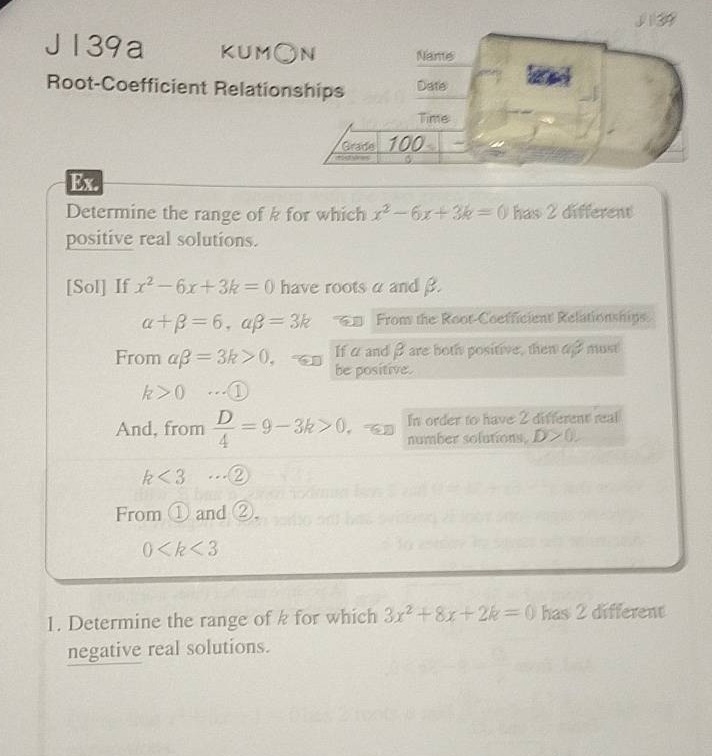
ex. determine the range of (k) for which (x^2 - 6x + 3k = 0) has 2 different positive real solutions.
sol if (x^2 - 6x + 3k = 0) have roots (alpha) and (\beta).
(alpha + \beta = 6), (alpha\beta = 3k) (from the root-coefficient relationships)
from (alpha\beta = 3k > 0), (if (alpha) and (\beta) are both positive, then (alpha\beta) must be positive.)
(k > 0) ... (1)
and, from (\frac{d}{4} = 9 - 3k > 0), (in order to have 2 different real number solutions, (d > 0).)
(k < 3) ... (2)
from (1) and (2),
(0 < k < 3)
- determine the range of (k) for which (3x^2 + 8x + 2k = 0) has 2 different negative real solutions.
Step1: Identify root-coefficient relationships
Let \(\alpha\) and \(\beta\) be the roots of \(3x^2 + 8x + 2k = 0\).
Step2: Apply condition for negative roots
Since both roots are negative, their product must be positive.
Step3: Apply discriminant condition
For two different real solutions, the discriminant must be positive.
Step4: Combine the inequalities
Find the intersection of the two intervals.

Snap & solve any problem in the app
Get step-by-step solutions on Sovi AI
Photo-based solutions with guided steps
Explore more problems and detailed explanations
\(0 < k < \frac{8}{3}\)