QUESTION IMAGE
Question
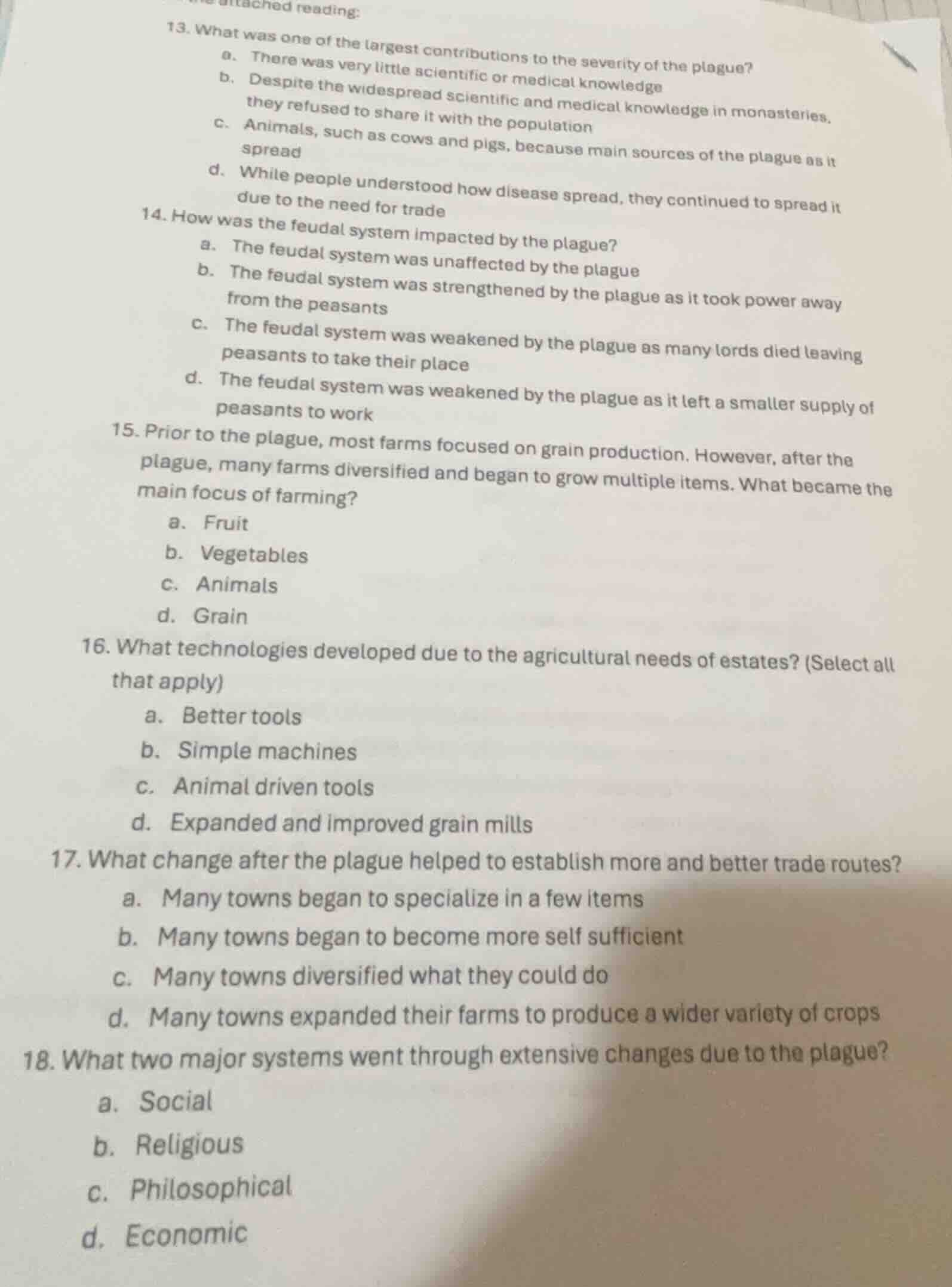
- what was one of the largest contributions to the severity of the plague?
a. there was very little scientific or medical knowledge
b. despite the widespread scientific and medical knowledge in monasteries, they refused to share it with the population
c. animals, such as cows and pigs, because main sources of the plague as it spread
d. while people understood how disease spread, they continued to spread it due to the need for trade
- how was the feudal system impacted by the plague?
a. the feudal system was unaffected by the plague
b. the feudal system was strengthened by the plague as it took power away from the peasants
c. the feudal system was weakened by the plague as many lords died leaving peasants to take their place
d. the feudal system was weakened by the plague as it left a smaller supply of peasants to work
- prior to the plague, most farms focused on grain production. however, after the plague, many farms diversified and began to grow multiple items. what became the main focus of farming?
a. fruit
b. vegetables
c. animals
d. grain
- what technologies developed due to the agricultural needs of estates? (select all that apply)
a. better tools
b. simple machines
c. animal driven tools
d. expanded and improved grain mills
- what change after the plague helped to establish more and better trade routes?
a. many towns began to specialize in a few items
b. many towns began to become more self sufficient
c. many towns diversified what they could do
d. many towns expanded their farms to produce a wider variety of crops
- what two major systems went through extensive changes due to the plague?
a. social
b. religious
c. philosophical
d. economic
- During the plague era, scientific/medical understanding of disease was extremely limited, which worsened the plague's impact.
- The plague killed a huge portion of the peasant workforce, making remaining peasants more valuable, weakening the feudal system's control over labor.
- After the plague, with fewer workers, raising animals required less labor than intensive grain farming, so it became the main focus.
- To compensate for labor shortages post-plague, estates developed better tools, simple machines, animal-driven tools, and improved grain mills to boost efficiency.
- Towns specializing in specific goods created demand for trade to access other items, driving the establishment of better trade routes.
- The plague drastically altered social structures (like feudalism) and economic systems (labor, farming, trade), leading to extensive changes in both.

Snap & solve any problem in the app
Get step-by-step solutions on Sovi AI
Photo-based solutions with guided steps
Explore more problems and detailed explanations
- a. There was very little scientific or medical knowledge
- d. The feudal system was weakened by the plague as it left a smaller supply of peasants to work
- c. Animals
- a. Better tools, b. Simple machines, c. Animal driven tools, d. Expanded and improved grain mills
- a. Many towns began to specialize in a few items
- a. Social, d. Economic