QUESTION IMAGE
Question
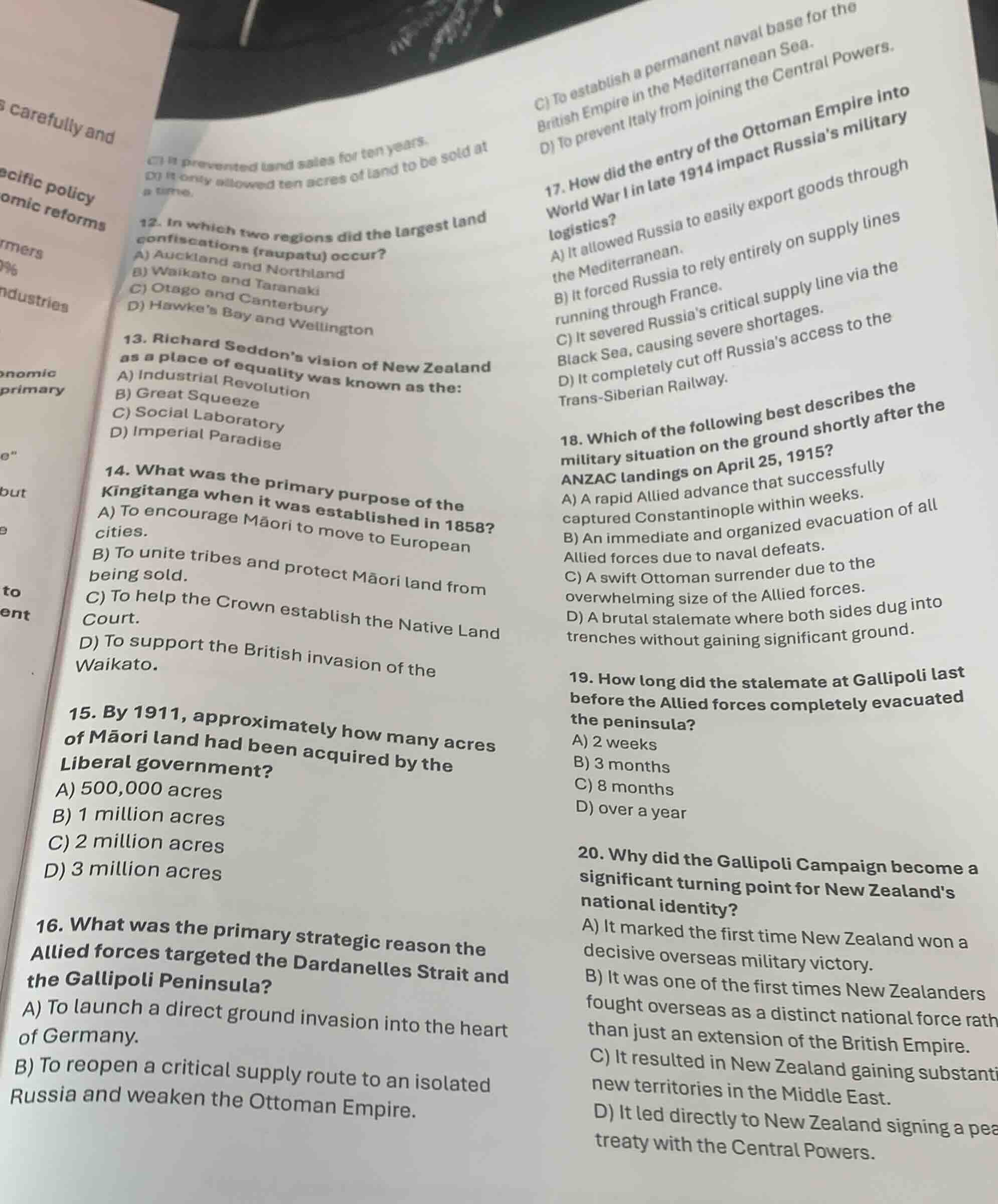
- in which two regions did the largest land confiscations (raupatu) occur?
a) auckland and northland
b) waikato and taranaki
c) otago and canterbury
d) hawkes bay and wellington
- richard seddons vision of new zealand as a place of equality was known as the:
a) industrial revolution
b) great squeeze
c) social laboratory
d) imperial paradise
- what was the primary purpose of the kingitanga when it was established in 1858?
a) to encourage māori to move to european cities.
b) to unite tribes and protect māori land from being sold.
c) to help the crown establish the native land court.
d) to support the british invasion of the waikato.
- by 1911, approximately how many acres of māori land had been acquired by the liberal government?
a) 500,000 acres
b) 1 million acres
c) 2 million acres
d) 3 million acres
- what was the primary strategic reason the allied forces targeted the dardanelles strait and the gallipoli peninsula?
a) to launch a direct ground invasion into the heart of germany.
b) to reopen a critical supply route to an isolated russia and weaken the ottoman empire.
c) to establish a permanent naval base for the british empire in the mediterranean sea.
d) to prevent italy from joining the central powers.
- how did the entry of the ottoman empire into world war i in late 1914 impact russias military logistics?
a) it allowed russia to easily export goods through the mediterranean.
b) it forced russia to rely entirely on supply lines running through france.
c) it severed russias critical supply line via the black sea, causing severe shortages.
d) it completely cut off russias access to the trans-siberian railway.
- which of the following best describes the military situation on the ground shortly after the anzac landings on april 25, 1915?
a) a rapid allied advance that successfully captured constantinople within weeks.
b) an immediate and organized evacuation of all allied forces due to naval defeats.
c) a swift ottoman surrender due to the overwhelming size of the allied forces.
) a brutal stalemate where both sides dug into trenches without gaining significant ground.
- how long did the stalemate at gallipoli last before the allied forces completely evacuated the peninsula?
a) 2 weeks
b) 3 months
c) 8 months
d) over a year
- why did the gallipoli campaign become a significant turning point for new zealands national identity?
a) it marked the first time new zealand won a decisive overseas military victory.
b) it was one of the first times new zealanders fought overseas as a distinct national force rather than just an extension of the british empire.
c) it resulted in new zealand gaining substantial new territories in the middle east.
d) it led directly to new zealand signing a peace treaty with the central powers.
Identify regions of largest land confiscations
The question asks where the largest land confiscations (Raupatu Land Confiscations) occurred. Historically, the New Zealand Settlements Act 1863 enabled the confiscation of vast areas of Māori land, primarily targeting tribes deemed to be in rebellion. The largest confiscations took place in the Waikato and Taranaki regions.
Identify Richard Seddon's vision name
The question asks for the name of Richard Seddon's vision of New Zealand as a place of equality. Richard Seddon and the Liberal Government promoted New Zealand as a pioneering social reformer, earning it the international reputation of being a Richard Seddon Social Laboratory for social and economic policy.
Determine primary purpose of Kingitanga
The question asks for the primary purpose of the Kingitanga Movement (Māori King Movement) when established in 1858. The movement was founded to unite Māori tribes under a single sovereign to halt inter-tribal land sales, protect Māori land from being sold to the Crown, and assert Māori authority.
Determine land acquired by Liberal government
The question asks for the approximate acreage of Māori land acquired by the Liberal government by 1911. Under the Liberal Government Maori Land Policy, aggressive purchasing strategies and legislation resulted in the acquisition of approximately 3 million acres of Māori land between 1891 and 1911.
Determine strategic reason for Gallipoli Campaign
The question asks for the primary strategic reason the Allied forces targeted the Dardanelles Strait and the Gallipoli Peninsula. During the Gallipoli Campaign, the Allies aimed to secure a sea route to Russia (reopening critical supply lines to an isolated ally) and knock the Ottoman Empire out of the war.
Determine impact of Ottoman entry on Russia
The question asks how the entry of the Ottoman Empire into WWI in late 1914 impacted Russia's military logistics. By controlling the Dardanelles and the Black Sea access, the Ottoman Empire severed Russia's critical supply line via the Black Sea, causing severe shortages of military supplies and grain exports.
Describe military situation after ANZAC landings
The question asks for the description of the military situation shortly after the ANZAC landings on April 25, 1915. Instead of a rapid breakthrough, the campaign quickly turned into a brutal stalemate where both Allied and Ottoman forces dug into trenches, unable to make significant territorial gains.
Determine duration of Gallipoli stalemate
The question asks how long the stalemate at Gallipoli lasted before the Allied forces evacuated. The campaign began with the landings in April 1915 and concluded with the final evacuations in December…

Snap & solve any problem in the app
Get step-by-step solutions on Sovi AI
Photo-based solutions with guided steps
Explore more problems and detailed explanations
Question 12
- (A) Auckland and Northland
- (B) Waikato and Taranaki (Correct answer)
- (C) Otago and Canterbury
- (D) Hawke's Bay and Wellington
Question 13
- (A) Industrial Revolution
- (B) Great Squeeze
- (C) Social Laboratory (Correct answer)
- (D) Imperial Paradise
Question 14
- (A) To encourage Māori to move to European cities.
- (B) To unite tribes and protect Māori land from being sold. (Correct answer)
- (C) To help the Crown establish the Native Land Court.
- (D) To support the British invasion of the Waikato.
Question 15
- (A) 500,000 acres
- (B) 1 million acres
- (C) 2 million acres
- (D) 3 million acres (Correct answer)
Question 16
- (A) To launch a direct ground invasion into the heart of Germany.
- (B) To reopen a critical supply route to an isolated Russia and weaken the Ottoman Empire. (Correct answer)
- (C) To establish a permanent naval base for the British Empire in the Mediterranean Sea.
- (D) To prevent Italy from joining the Central Powers.
Question 17
- (A) It allowed Russia to easily export goods through the Mediterranean.
- (B) It forced Russia to rely entirely on supply lines running through France.
- (C) It severed Russia's critical supply line via the Black Sea, causing severe shortages. (Correct answer)
- (D) It completely cut off Russia's access to the Trans-Siberian Railway.
Question 18
- (A) A rapid Allied advance that successfully captured Constantinople within weeks.
- (B) An immediate and organized evacuation of all Allied forces due to naval defeats.
- (C) A swift Ottoman surrender due to the overwhelming size of the Allied forces.</mcq-correct>
- (D) A brutal stalemate where both sides dug into trenches without gaining significant ground. (Correct answer)
Question 19
<mcq-option>(A) 2 weeks
- (B) 3 months
- (C) 8 months (Correct answer)
- (D) over year
Question 20
- (A) It marked the first time New Zealand won a decisive overseas military victory.
- (B) It was one of the first times New Zealanders fought overseas as a distinct national force rather than just an extension of the British Empire. (Correct answer)
- (C) It resulted in New Zealand gaining substantial new territories in the Middle East.
- (D) It led directly to New Zealand signing a peace treaty with the Central Powers.