QUESTION IMAGE
Question
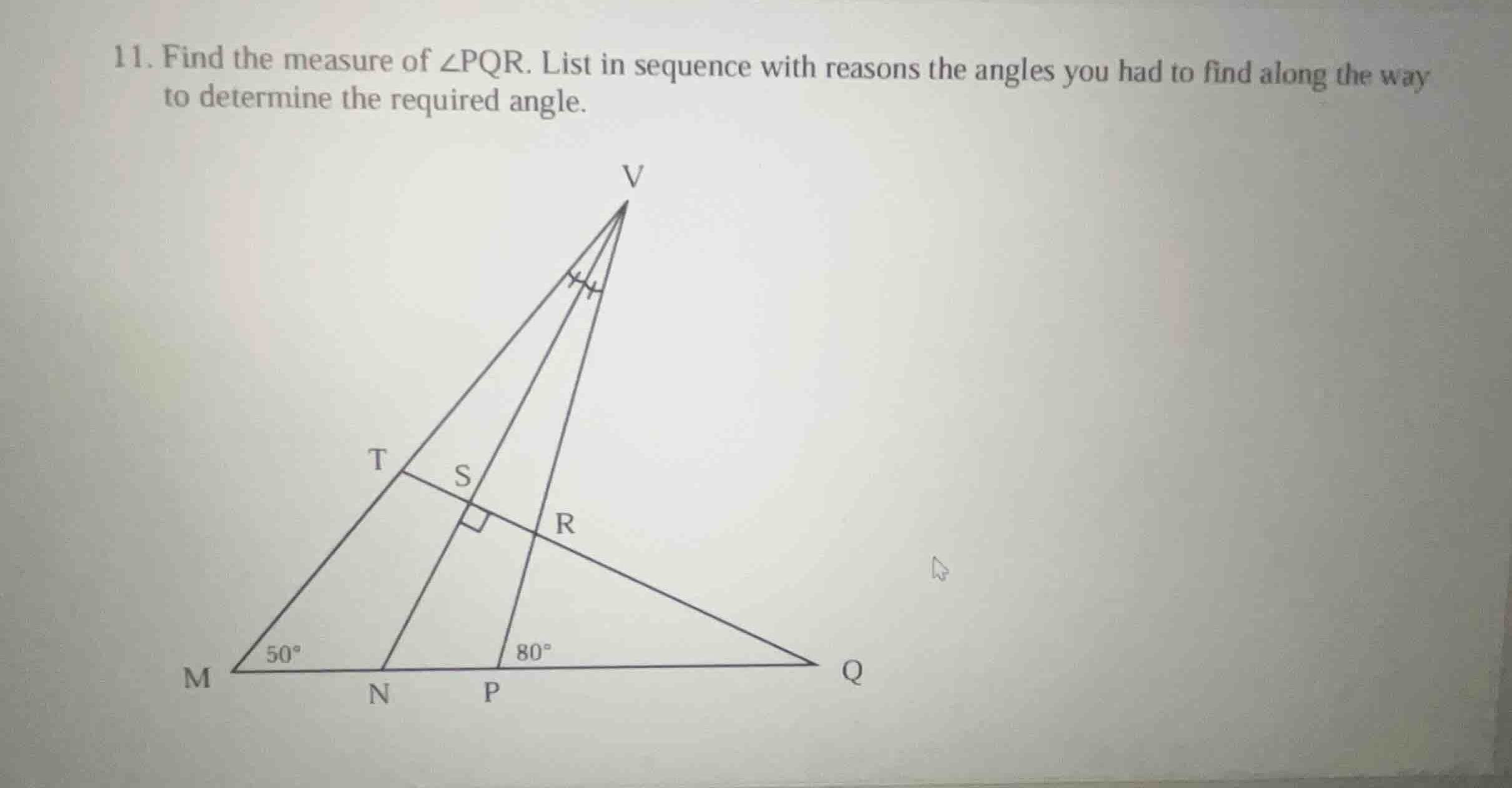
- find the measure of \\(\angle pqr\\). list in sequence with reasons the angles you had to find along the way to determine the required angle.
Identify the given geometric properties
We are given a geometric figure with several intersecting lines and triangles. Let's list the key given information:
- Points \(M, N, P, Q\) lie on a straight line in that order.
- The angle \(\angle VMN = 50^\circ\).
- The angle \(\angle VPQ = 80^\circ\).
- The line segment \(TQ\) intersects \(VN\) at point \(S\) and \(VP\) at point \(R\).
- There is a right-angle mark at the intersection \(S\), meaning \(TQ \perp VN\), so \(\angle VSQ = \angle VSN = 90^\circ\).
- The angle markings at vertex \(V\) show that \(VN\) bisects \(\angle MVR\). Specifically, \(\angle MVN = \angle NVR\). Let this angle be \(\alpha\).
Find the angles of triangle VMN
Using the Straight Angle Theorem knowledge point
Using the Triangle Angle Sum Theorem knowledge point
Since \(VN\) bisects \(\angle MVR\), we have \(\angle MVN = \angle NVR = \alpha\).
Let's find \(\angle MVN\) in \(\triangle VMN\):
Also, \(\angle VNM\) is the exterior angle to \(\triangle VNP\):
Thus:
Let's use \(\triangle VMN\) and \(\triangle VNP\) directly:
Let's look at the right triangle \(\triangle VSG\) or the perpendicularity.
Since \(TQ \perp VN\), in the right-angled triangle \(\triangle VSR\):
In \(\triangle VSR\), the angles are \(\angle RVS = \alpha\) and \(\angle VSR = 90^\circ\). Therefore:
Since \(M, N, P, Q\) is a straight line, let's find the relations in \(\triangle VMQ\):
The sum of angles in \(\triangle VMQ\) is:
Let's find \(\alpha\) using \(\triangle VNP\):
In \(\triangle VNP\), the angles are \(\angle VNP\), \(\angle VPN = 100^\circ\), and \(\angle NVN = 30^\circ - \alpha\).
Since \(\angle VNM = 180^\circ - \angle VNP\):
In \(\triangle VMN\):
Determine the remaining angles
Since \(\alpha = 30^\circ\):
Since \(…

Snap & solve any problem in the app
Get step-by-step solutions on Sovi AI
Photo-based solutions with guided steps
Explore more problems and detailed explanations
To find the measure of \(\angle PQR\), the sequence of angles determined along the way is:
- \(\angle VPN = 100^\circ\) (by the Straight Angle Theorem: \(180^\circ - 80^\circ\))
- \(\angle MVP = 30^\circ\) (by the Triangle Angle Sum Theorem on \(\triangle VMP\): \(180^\circ - 50^\circ - 100^\circ\))
- \(\angle MVN = 30^\circ\) (by setting up the angle sum of \(\triangle VMN\) and \(\triangle VNP\), yielding \(2\alpha = 60^\circ\))
- \(\angle VRS = 60^\circ\) (by the Triangle Angle Sum Theorem on right \(\triangle VSR\): \(180^\circ - 90^\circ - 30^\circ\))
- \(\angle PRQ = 60^\circ\) (by the Vertical Angles Theorem with \(\angle VRS\))
- \(\angle PQR = 40^\circ\) (by the Triangle Angle Sum Theorem on \(\triangle PRQ\): \(180^\circ - 80^\circ - 60^\circ\))
The final measure is: