QUESTION IMAGE
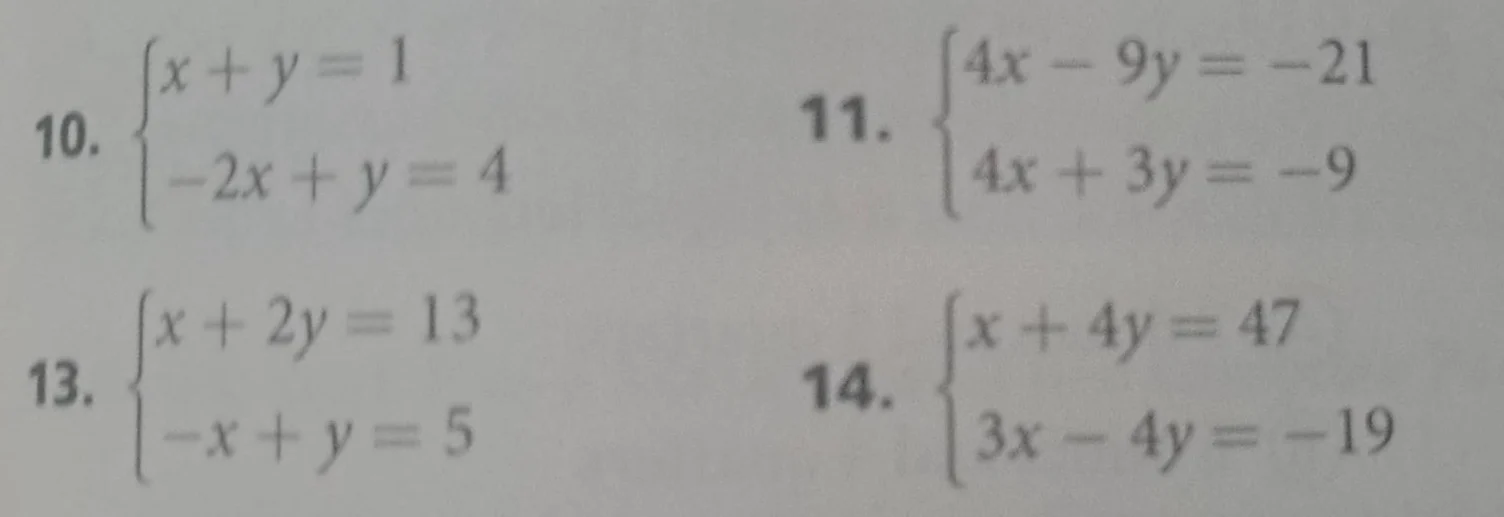
Question
- \\(\
\\) 11. \\(\
\\) 13. \\(\
\\) 14. \\(\
\\)
Let's solve each system of equations one by one using the elimination or substitution method.
Problem 10
We have the system:
Step 1: Eliminate \( y \)
Subtract equation (1) from equation (2):
Step 2: Solve for \( x \)
Divide both sides by \(-3\):
Step 3: Substitute \( x = -1 \) into equation (1)
Add \( 1 \) to both sides:
So the solution for problem 10 is \( x = -1, y = 2 \).
Problem 11
We have the system:
Step 1: Eliminate \( x \)
Subtract equation (1) from equation (2):
Step 2: Solve for \( y \)
Divide both sides by \( 12 \):
Step 3: Substitute \( y = 1 \) into equation (2)
Subtract \( 3 \) from both sides:
Divide both sides by \( 4 \):
So the solution for problem 11 is \( x = -3, y = 1 \).
Problem 13
We have the system:
Step 1: Eliminate \( x \)
Add equation (1) and equation (2):
Step 2: Solve for \( y \)
Divide both sides by \( 3 \):
Step 3: Substitute \( y = 6 \) into equation (2)
Subtract \( 6 \) from both sides:
Multiply both sides by \(-1\):
So the solution for problem 13 is \( x = 1, y = 6 \).
Problem 14
We have the system:
Step 1: Eliminate \( y \)
Add equation (1) and equation (2):
Step 2: Solve for \( x \)
Divide both sides by \( 4 \):
Step 3: Substitute \( x = 7 \) into equation (1)
Subtract \( 7 \) from both sides:
Divide both sides by \( 4 \):
So the solution for problem 14 is \( x = 7, y = 10 \).
Final Answers
- Problem 10: \( \boldsymbol{x = -1, y = 2} \)
- Problem 11: \( \boldsymbol{x = -3, y = 1} \)
- Problem 13: \( \boldsymbol{x = 1, y = 6} \)
- Problem 14: \( \boldsymbol{x = 7, y = 10} \)

Snap & solve any problem in the app
Get step-by-step solutions on Sovi AI
Photo-based solutions with guided steps
Explore more problems and detailed explanations
Let's solve each system of equations one by one using the elimination or substitution method.
Problem 10
We have the system:
Step 1: Eliminate \( y \)
Subtract equation (1) from equation (2):
Step 2: Solve for \( x \)
Divide both sides by \(-3\):
Step 3: Substitute \( x = -1 \) into equation (1)
Add \( 1 \) to both sides:
So the solution for problem 10 is \( x = -1, y = 2 \).
Problem 11
We have the system:
Step 1: Eliminate \( x \)
Subtract equation (1) from equation (2):
Step 2: Solve for \( y \)
Divide both sides by \( 12 \):
Step 3: Substitute \( y = 1 \) into equation (2)
Subtract \( 3 \) from both sides:
Divide both sides by \( 4 \):
So the solution for problem 11 is \( x = -3, y = 1 \).
Problem 13
We have the system:
Step 1: Eliminate \( x \)
Add equation (1) and equation (2):
Step 2: Solve for \( y \)
Divide both sides by \( 3 \):
Step 3: Substitute \( y = 6 \) into equation (2)
Subtract \( 6 \) from both sides:
Multiply both sides by \(-1\):
So the solution for problem 13 is \( x = 1, y = 6 \).
Problem 14
We have the system:
Step 1: Eliminate \( y \)
Add equation (1) and equation (2):
Step 2: Solve for \( x \)
Divide both sides by \( 4 \):
Step 3: Substitute \( x = 7 \) into equation (1)
Subtract \( 7 \) from both sides:
Divide both sides by \( 4 \):
So the solution for problem 14 is \( x = 7, y = 10 \).
Final Answers
- Problem 10: \( \boldsymbol{x = -1, y = 2} \)
- Problem 11: \( \boldsymbol{x = -3, y = 1} \)
- Problem 13: \( \boldsymbol{x = 1, y = 6} \)
- Problem 14: \( \boldsymbol{x = 7, y = 10} \)