QUESTION IMAGE
Question
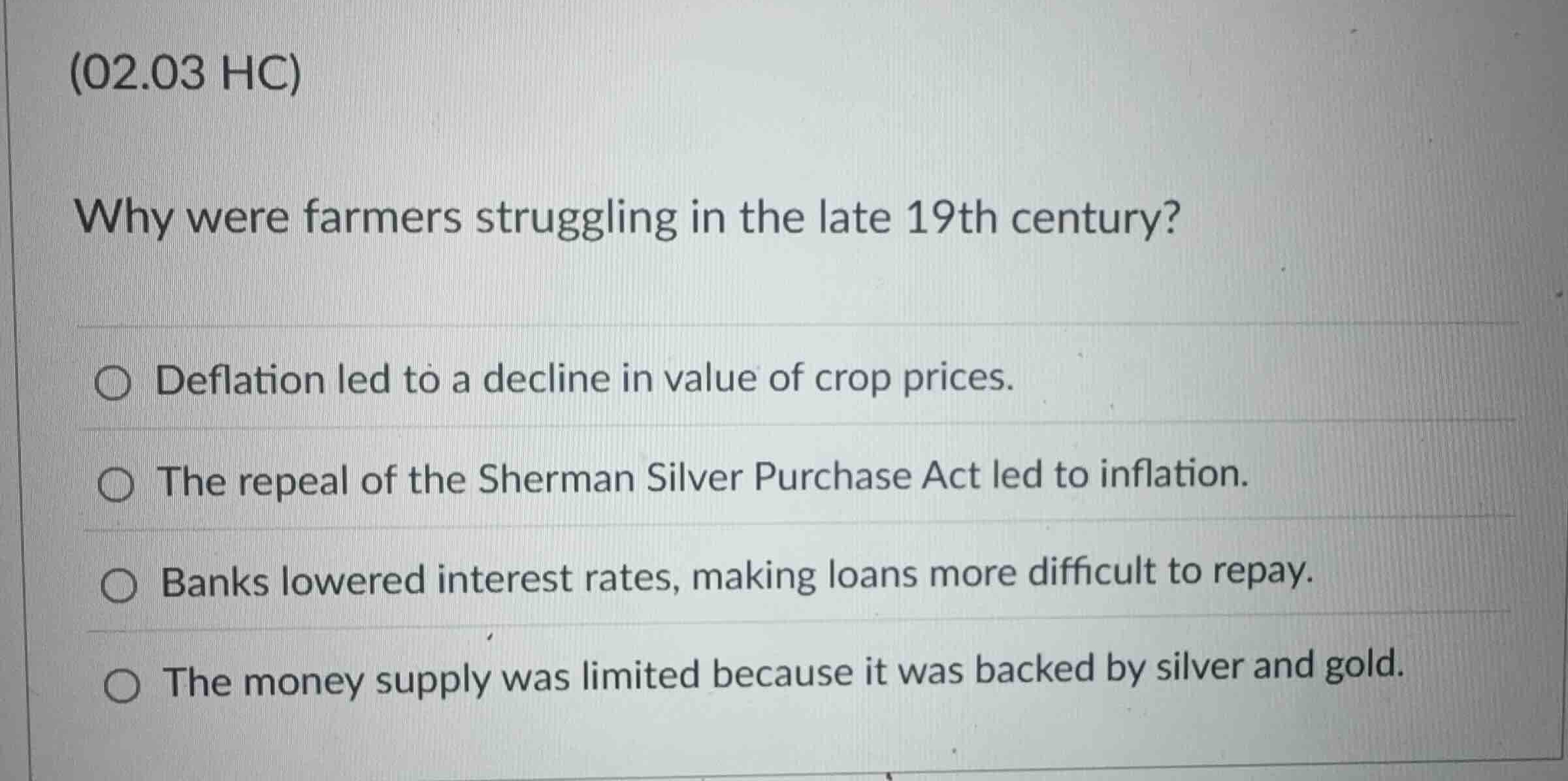
(02.03 hc)
why were farmers struggling in the late 19th century?
deflation led to a decline in value of crop prices.
the repeal of the sherman silver purchase act led to inflation.
banks lowered interest rates, making loans more difficult to repay.
the money supply was limited because it was backed by silver and gold.
Analyze the economic conditions of late 19th-century farmers
Using the Agrarian Economic Challenges knowledge point
During the late 19th century, American farmers faced severe economic hardships driven primarily by overproduction and a contracting money supply. The federal government's post-Civil War monetary policy focused on returning to the gold standard, which restricted the amount of money in circulation. This contraction of the money supply led to persistent deflation.
Evaluate the impact of deflation on crop prices
Using the Agrarian Economic Challenges knowledge point
Deflation directly caused a continuous, long-term decline in the prices of agricultural commodities like wheat and cotton. As crop prices plummeted, farmers received less income for their harvests while their fixed costs, such as mortgage payments and shipping rates, remained constant or effectively increased in real value. This price drop made it extremely difficult for farmers to turn a profit or pay off their debts.
Assess the incorrect options
Using the Agrarian Economic Challenges knowledge point
- The repeal of the Sherman Silver Purchase Act led to inflation: The repeal in 1893 actually restricted silver coinage further, worsening deflationary pressures rather than causing inflation.
- Banks lowered interest rates, making loans more difficult to repay: Lower interest rates would make loans easier to repay, but in reality, farmers faced high interest rates and a tight credit market.
- The money supply was limited because it was backed by silver and gold: During the height of the gold standard era, the money supply was limited because it was backed almost exclusively by gold (especially after the Coinage Act of 1873, or the "Crime of '73"), not both metals. Farmers actively campaigned for "free silver" (bimetallism) to expand the money supply.

Snap & solve any problem in the app
Get step-by-step solutions on Sovi AI
Photo-based solutions with guided steps
Explore more problems and detailed explanations
- (A) Deflation led to a decline in value of crop prices. (Correct answer)
- (B) The repeal of the Sherman Silver Purchase Act led to inflation.
- (C) Banks lowered interest rates, making loans more difficult to repay.
- (D) The money supply was limited because it was backed by silver and gold.