QUESTION IMAGE
Question
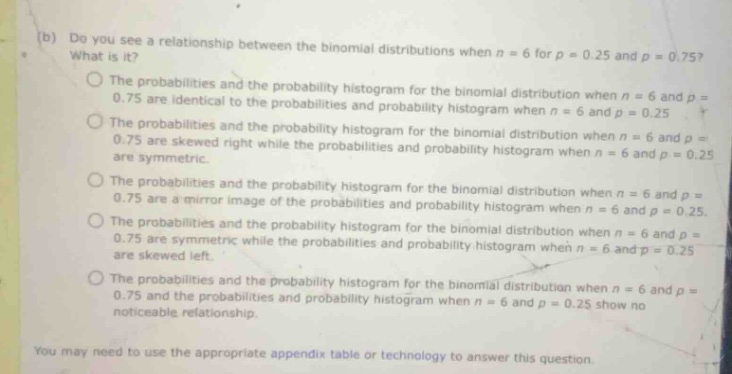
(b) do you see a relationship between the binomial distributions when \\(n = 6\\) for \\(p = 0.25\\) and \\(p = 0.75\\)? what is it?
- the probabilities and the probability histogram for the binomial distribution when \\(n = 6\\) and \\(p = 0.75\\) are identical to the probabilities and probability histogram when \\(n = 6\\) and \\(p = 0.25\\)
- the probabilities and the probability histogram for the binomial distribution when \\(n = 6\\) and \\(p = 0.75\\) are skewed right while the probabilities and probability histogram when \\(n = 6\\) and \\(p = 0.25\\) are symmetric.
- the probabilities and the probability histogram for the binomial distribution when \\(n = 6\\) and \\(p = 0.75\\) are a mirror image of the probabilities and probability histogram when \\(n = 6\\) and \\(p = 0.25\\).
- the probabilities and the probability histogram for the binomial distribution when \\(n = 6\\) and \\(p = 0.75\\) are symmetric while the probabilities and probability histogram when \\(n = 6\\) and \\(p = 0.25\\) are skewed left.
- the probabilities and the probability histogram for the binomial distribution when \\(n = 6\\) and \\(p = 0.75\\) and the probabilities and probability histogram when \\(n = 6\\) and \\(p = 0.25\\) show no noticeable relationship.
you may need to use the appropriate appendix table or technology to answer this question.
Analyze the binomial parameters
Using the Binomial Probability Distribution knowledge point
We are comparing two binomial distributions with the same number of trials \(n = 6\):
- Distribution 1: \(p_1 = 0.25\) (probability of success) and \(q_1 = 1 - p_1 = 0.75\) (probability of failure)
- Distribution 2: \(p_2 = 0.75\) (probability of success) and \(q_2 = 1 - p_2 = 0.25\) (probability of failure)
Compare probability formulas
Using the Binomial Probability Distribution knowledge point
The probability of getting \(k\) successes in \(n\) trials is given by:
For the first distribution with \(p = 0.25\):
For the second distribution with \(p = 0.75\):
Since \(\binom{6}{k} = \binom{6}{6-k}\), we have:
Determine the geometric relationship
Using the Binomial Probability Distribution knowledge point
The relation \(P(X_1 = k) = P(X_2 = 6-k)\) means that the probability of \(k\) successes in the first distribution is exactly equal to the probability of \(6-k\) successes in the second distribution.
Geometrically, this reverses the order of the probabilities along the horizontal axis.
Therefore, the probability histogram for \(p = 0.75\) is a perfect mirror image of the histogram for \(p = 0.25\).

Snap & solve any problem in the app
Get step-by-step solutions on Sovi AI
Photo-based solutions with guided steps
Explore more problems and detailed explanations
- (A) The probabilities and the probability histogram for the binomial distribution when \(n = 6\) and \(p = 0.75\) are identical to the probabilities and probability histogram when \(n = 6\) and \(p = 0.25\).
- (B) The probabilities and the probability histogram for the binomial distribution when \(n = 6\) and \(p = 0.75\) are skewed right while the probabilities and probability histogram when \(n = 6\) and \(p = 0.25\) are symmetric.
- (C) The probabilities and the probability histogram for the binomial distribution when \(n = 6\) and \(p = 0.75\) are a mirror image of the probabilities and probability histogram when \(n = 6\) and \(p = 0.25\). (Correct answer)
- (D) The probabilities and the probability histogram for the binomial distribution when \(n = 6\) and \(p = 0.75\) are symmetric while the probabilities and probability histogram when \(n = 6\) and \(p = 0.25\) are skewed left.
- (E) The probabilities and the probability histogram for the binomial distribution when \(n = 6\) and \(p = 0.75\) and the probabilities and probability histogram when \(n = 6\) and \(p = 0.25\) show no noticeable relationship.