QUESTION IMAGE
Question
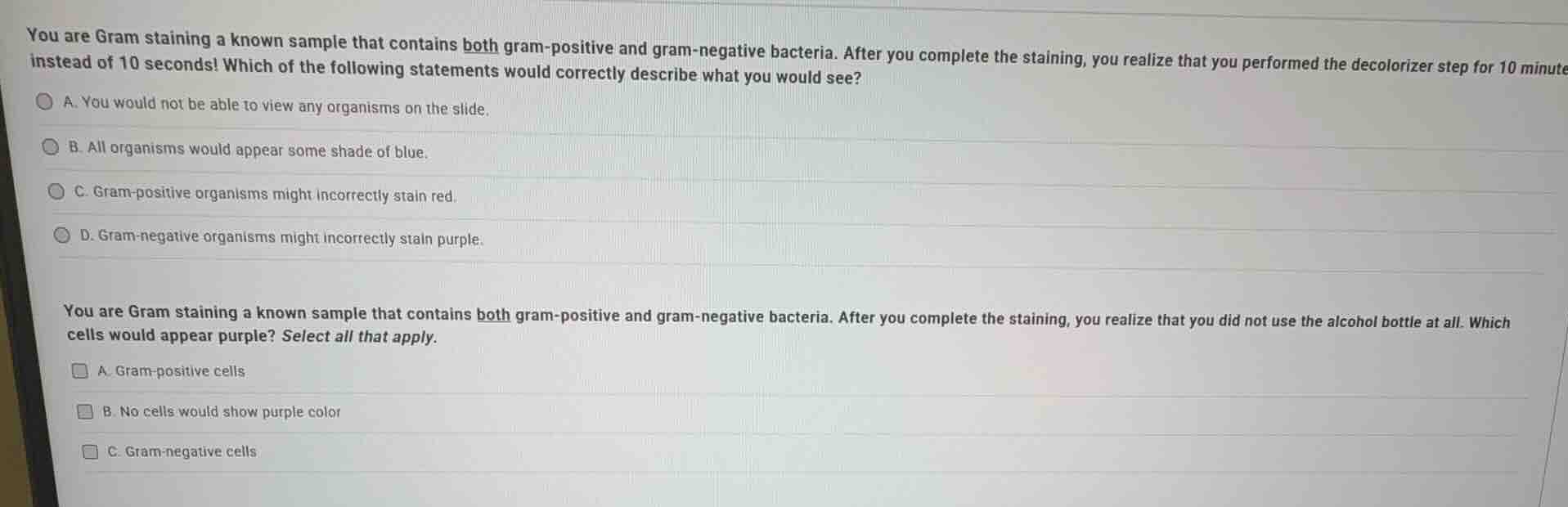
you are gram staining a known sample that contains both gram-positive and gram-negative bacteria. after you complete the staining, you realize that you performed the decolorizer step for 10 minutes instead of 10 seconds! which of the following statements would correctly describe what you would see?
a. you would not be able to view any organisms on the slide.
b. all organisms would appear some shade of blue.
c. gram-positive organisms might incorrectly stain red.
d. gram-negative organisms might incorrectly stain purple.
you are gram staining a known sample that contains both gram-positive and gram-negative bacteria. after you complete the staining, you realize that you did not use the alcohol bottle at all. which cells would appear purple? select all that apply.
a. gram-positive cells
b. no cells would show purple color
c. gram-negative cells
Analyze over-decolorization in Gram staining
Over-decolorizing (10 minutes instead of 10 seconds) washes out the crystal violet-iodine complex from both Gram-negative and Gram-positive cell walls. Consequently, Gram-positive cells lose their purple color and take up the counterstain (safranin), incorrectly staining red/pink.
Analyze omission of the decolorizer step
Omitting the decolorizer (alcohol) entirely means the crystal violet-iodine complex is never washed out from any cells. Therefore, both Gram-positive and Gram-negative cells retain the primary dye and appear purple.

Snap & solve any problem in the app
Get step-by-step solutions on Sovi AI
Photo-based solutions with guided steps
Explore more problems and detailed explanations
Question 1
- A. You would not be able to view any organisms on the slide.
- B. All organisms would appear some shade of blue.
- C. Gram-positive organisms might incorrectly stain red. (Correct answer)
- D. Gram-negative organisms might incorrectly stain purple.
Question 2
- A. Gram-positive cells (Correct answer)
- B. No cells would show purple color
- C. Gram-negative cells (Correct answer)