QUESTION IMAGE
Question
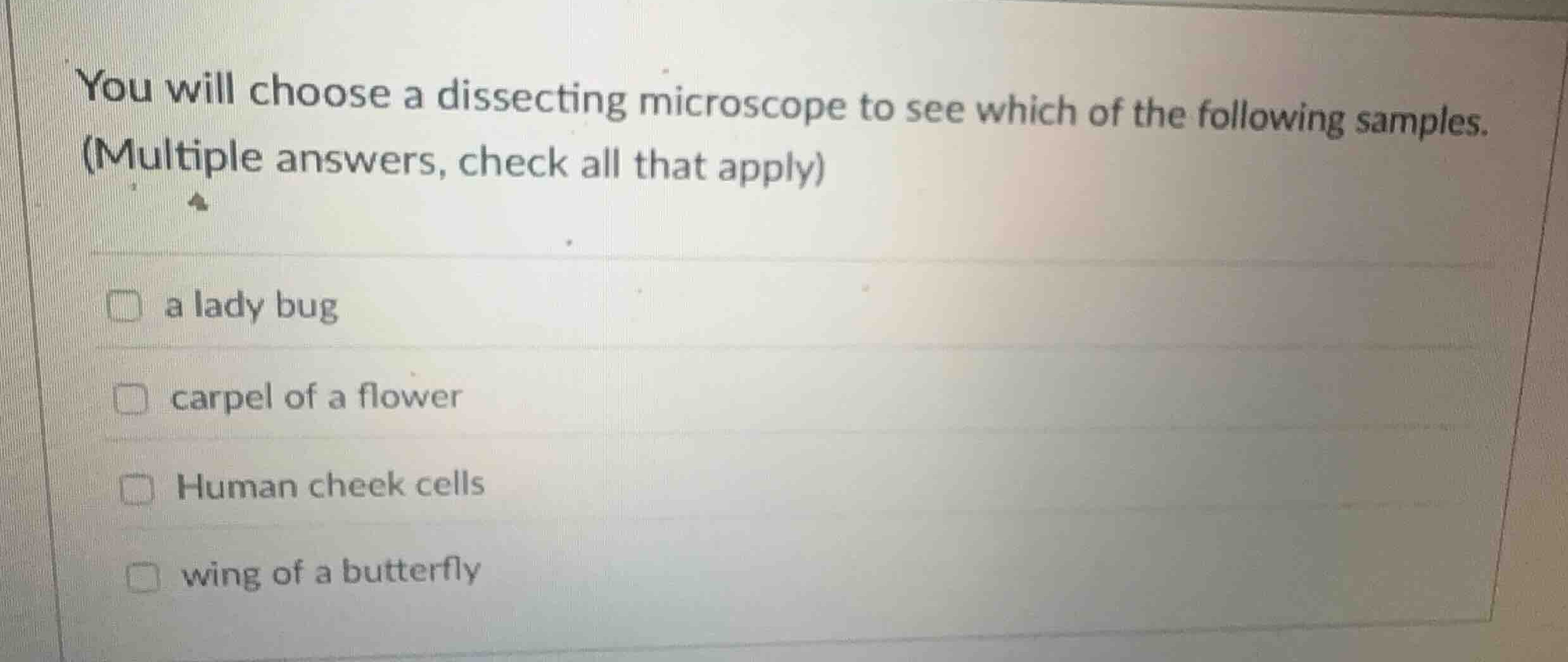
you will choose a dissecting microscope to see which of the following samples. (multiple answers, check all that apply)
a lady bug
carpel of a flower
human cheek cells
wing of a butterfly
🆕 New Concept Discovered: Microscope Selection
Choosing the right microscope based on specimen size and transparency.
Step 1: Understand the function of a dissecting microscope
A dissecting microscope (also known as a stereomicroscope) is designed for viewing large, three-dimensional, opaque specimens.
- It uses lower magnification (typically \(2\times\) to \(40\times\)).
- It provides a 3D view of the surface of an object.
- Light usually shines down onto the specimen (reflected light) rather than passing through it.
Step 2: Evaluate each sample option
- a lady bug: This is a relatively large, whole, opaque organism. A dissecting microscope is perfect for viewing its external features in 3D. (Select)
- carpel of a flower: This is a macroscopic, three-dimensional plant structure. A dissecting microscope is ideal for observing its surface details or dissecting it. (Select)
- Human cheek cells: These are microscopic, transparent, single cells. They require high magnification and transmitted light to be seen, which means they must be viewed under a compound light microscope. (Do not select)
- wing of a butterfly: This is a larger, flat, opaque structure with detailed surface scales. A dissecting microscope is excellent for viewing the intricate surface patterns of a butterfly wing. (Select)

Snap & solve any problem in the app
Get step-by-step solutions on Sovi AI
Photo-based solutions with guided steps
Explore more problems and detailed explanations
- a lady bug
- carpel of a flower
- wing of a butterfly