QUESTION IMAGE
Question
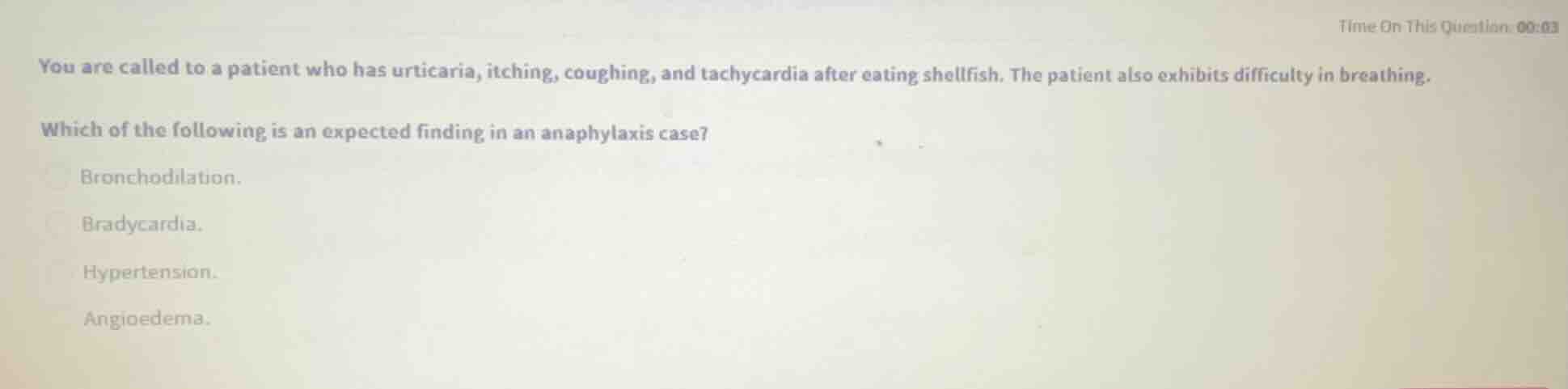
you are called to a patient who has urticaria, itching, coughing, and tachycardia after eating shellfish. the patient also exhibits difficulty in breathing.
which of the following is an expected finding in an anaphylaxis case?
bronchodilation.
bradycardia.
hypertension.
angioedema.
Analyze the clinical presentation
The patient presents with classic signs of a severe systemic allergic reaction (anaphylaxis) after consuming shellfish: urticaria (hives), itching, coughing, tachycardia, and difficulty breathing.
Evaluate the physiological mechanisms
Using the Anaphylaxis Management knowledge point
- Bronchodilation: Anaphylaxis causes bronchoconstriction (narrowing of the airways), not bronchodilation.
- Bradycardia: The body typically responds with tachycardia (increased heart rate) to compensate for systemic vasodilation and hypotension.
- Hypertension: Anaphylaxis leads to widespread vasodilation and increased capillary permeability, resulting in hypotension (low blood pressure) rather than hypertension.
- Angioedema: This is the localized swelling of deep subcutaneous or submucosal tissues, commonly affecting the face, lips, tongue, and airway, which is a hallmark finding in severe anaphylactic reactions.
Select the correct finding
Based on the pathophysiological changes during anaphylaxis, angioedema is an expected and characteristic clinical finding.

Snap & solve any problem in the app
Get step-by-step solutions on Sovi AI
Photo-based solutions with guided steps
Explore more problems and detailed explanations
- Bronchodilation.
- Bradycardia.
- Hypertension.
- Angioedema. (Correct answer)