QUESTION IMAGE
Question
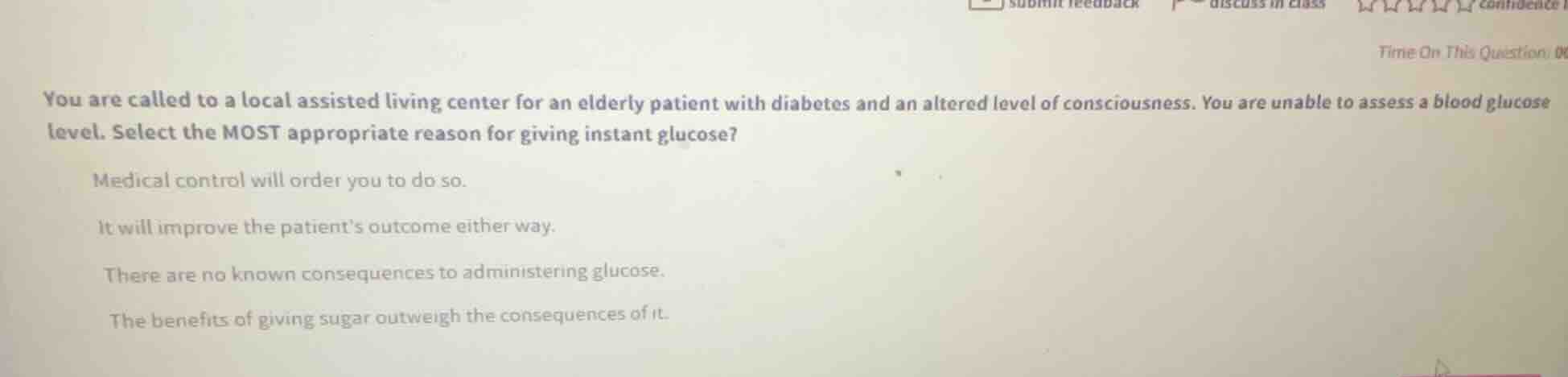
you are called to a local assisted living center for an elderly patient with diabetes and an altered level of consciousness. you are unable to assess a blood glucose level. select the most appropriate reason for giving instant glucose?
medical control will order you to do so.
it will improve the patients outcome either way.
there are no known consequences to administering glucose.
the benefits of giving sugar outweigh the consequences of it.
<pre_analysis>
{
"quality": "clear",
"question_count": 1,
"skills_matched": [
"direct_cot",
"multiple_choice_formatter",
"explain_then_answer",
"tutor",
"mastery_adaptive_brevity"
],
"needs_drawing": false,
"concepts_used": [
"Altered Mental Status Management",
"Oral Glucose Indications"
],
"new_concepts": [],
"current_concepts": [
"Altered Mental Status Management",
"Oral Glucose Indications",
"Hypoglycemia Pathophysiology"
]
}
</pre_analysis>
<reasoning>
Analyze the clinical scenario
Using the Altered Mental Status Management knowledge point
The patient is an elderly individual with diabetes presenting with an altered level of consciousness. A blood glucose level cannot be obtained. In emergency medical services (EMS), when a diabetic patient has an altered mental status and blood glucose cannot be measured, hypoglycemia must be assumed and treated immediately because brain cells depend on a continuous supply of glucose.
Evaluate the physiological consequences
Using the Oral Glucose Indications knowledge point
If the patient is hypoglycemic, administering glucose is life-saving and prevents irreversible brain damage. If the patient is actually hyperglycemic, administering a small amount of oral glucose will slightly elevate their blood sugar further, but this minor increase is not acutely life-threatening compared to the immediate danger of untreated hypoglycemia. Therefore, the potential benefits of administering glucose far outweigh the potential risks or consequences of doing so.
Assess the given options
- Medical control will order you to do so: While medical control may provide orders, this is not the clinical justification or the "most appropriate reason" for the action.
- It will improve the patient's outcome either way: This is incorrect because administering glucose to a hyperglycemic patient does not clinically improve their outcome, though it does not cause immediate severe harm.
- There are no known consequences to administering glucose: This is incorrect because administering glucose to a patient who cannot swallow or protect their airway carries a risk of aspiration, and it can worsen severe hyperglycemia.
- The benefits of giving sugar outweigh the consequences of it: This is correct because the immediate threat of brain death from hypoglycemia is far more critical than the minor, manageable risk of slightly worsening hyperglycemia.
</reasoning>
<answer>
<mcq-option>Medical control will order you to do so.</mcq-option>
<mcq-option>It will improve the patient's outcome either way.</mcq-option>
<mcq-option>There are no known consequences to administering glucose.</mcq-option>
<mcq-correct>The benefits of giving sugar outweigh the consequences of it.</mcq-correct>
</answer>
<post_analysis>
{
"subject": "Natural Science",
"question_type": "Multiple Choice",
"knowledge_point": [
"Natural Science",
"Medicine",
"Emergency Medical Services"
]
}
</post_analysis>
Snap & solve any problem in the app
Get step-by-step solutions on Sovi AI
Photo-based solutions with guided steps
Explore more problems and detailed explanations
<pre_analysis>
{
"quality": "clear",
"question_count": 1,
"skills_matched": [
"direct_cot",
"multiple_choice_formatter",
"explain_then_answer",
"tutor",
"mastery_adaptive_brevity"
],
"needs_drawing": false,
"concepts_used": [
"Altered Mental Status Management",
"Oral Glucose Indications"
],
"new_concepts": [],
"current_concepts": [
"Altered Mental Status Management",
"Oral Glucose Indications",
"Hypoglycemia Pathophysiology"
]
}
</pre_analysis>
<reasoning>
Analyze the clinical scenario
Using the Altered Mental Status Management knowledge point
The patient is an elderly individual with diabetes presenting with an altered level of consciousness. A blood glucose level cannot be obtained. In emergency medical services (EMS), when a diabetic patient has an altered mental status and blood glucose cannot be measured, hypoglycemia must be assumed and treated immediately because brain cells depend on a continuous supply of glucose.
Evaluate the physiological consequences
Using the Oral Glucose Indications knowledge point
If the patient is hypoglycemic, administering glucose is life-saving and prevents irreversible brain damage. If the patient is actually hyperglycemic, administering a small amount of oral glucose will slightly elevate their blood sugar further, but this minor increase is not acutely life-threatening compared to the immediate danger of untreated hypoglycemia. Therefore, the potential benefits of administering glucose far outweigh the potential risks or consequences of doing so.
Assess the given options
- Medical control will order you to do so: While medical control may provide orders, this is not the clinical justification or the "most appropriate reason" for the action.
- It will improve the patient's outcome either way: This is incorrect because administering glucose to a hyperglycemic patient does not clinically improve their outcome, though it does not cause immediate severe harm.
- There are no known consequences to administering glucose: This is incorrect because administering glucose to a patient who cannot swallow or protect their airway carries a risk of aspiration, and it can worsen severe hyperglycemia.
- The benefits of giving sugar outweigh the consequences of it: This is correct because the immediate threat of brain death from hypoglycemia is far more critical than the minor, manageable risk of slightly worsening hyperglycemia.
</reasoning>
<answer>
<mcq-option>Medical control will order you to do so.</mcq-option>
<mcq-option>It will improve the patient's outcome either way.</mcq-option>
<mcq-option>There are no known consequences to administering glucose.</mcq-option>
<mcq-correct>The benefits of giving sugar outweigh the consequences of it.</mcq-correct>
</answer>
<post_analysis>
{
"subject": "Natural Science",
"question_type": "Multiple Choice",
"knowledge_point": [
"Natural Science",
"Medicine",
"Emergency Medical Services"
]
}
</post_analysis>