QUESTION IMAGE
Question
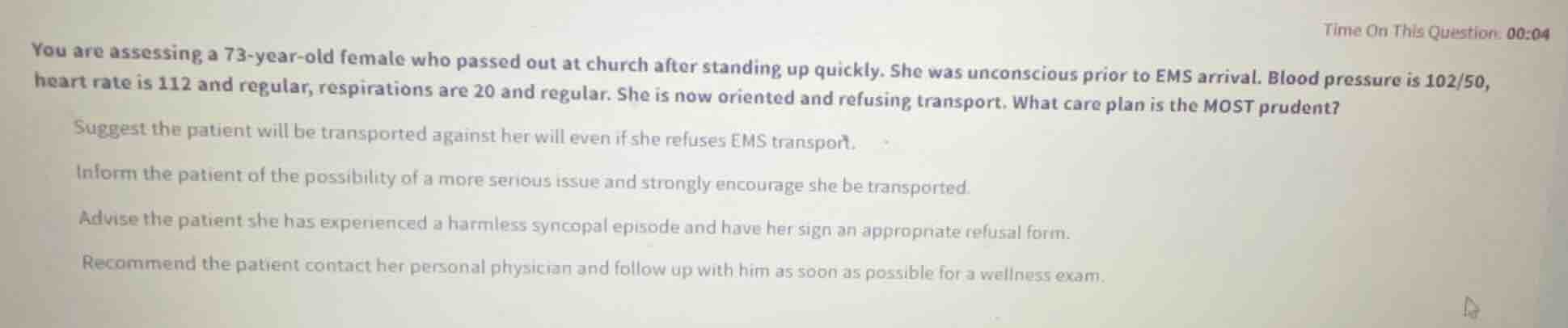
you are assessing a 73-year-old female who passed out at church after standing up quickly. she was unconscious prior to ems arrival. blood pressure is 102/50, heart rate is 112 and regular, respirations are 20 and regular. she is now oriented and refusing transport. what care plan is the most prudent?
suggest the patient will be transported against her will even if she refuses ems transport.
inform the patient of the possibility of a more serious issue and strongly encourage she be transported.
advise the patient she has experienced a harmless syncopal episode and have her sign an appropriate refusal form.
recommend the patient contact her personal physician and follow up with him as soon as possible for a wellness exam.
<pre_analysis>
{
"quality": "clear",
"question_count": 1,
"skills_matched": [
"direct_cot",
"multiple_choice_formatter",
"explain_then_answer",
"tutor"
],
"needs_drawing": false,
"concepts_used": [
"Syncope Etiology",
"Geriatric Patient Assessment"
],
"new_concepts": [
"Patient Refusal Protocols",
"Informed Refusal"
],
"current_concepts": [
"Syncope Etiology",
"Geriatric Patient Assessment",
"Patient Refusal Protocols",
"Informed Refusal"
]
}
</pre_analysis>
<reasoning>
Analyze the patient's clinical presentation
The patient is a 73-year-old female who experienced a transient loss of consciousness (Syncope Etiology) after standing up quickly. Her vital signs show mild tachycardia (HR 112 bpm) and borderline low blood pressure (BP 102/50 mmHg). In a geriatric patient (Geriatric Patient Assessment), syncope is a high-risk presentation that can stem from serious underlying cardiovascular or neurological issues, rather than just benign orthostatic changes.
Evaluate the patient's legal rights and autonomy
The patient is currently alert, oriented, and refusing transport. Competent adult patients have the legal right to refuse medical care and transport (autonomy). EMS cannot transport a competent patient against their will, as doing so constitutes battery. Therefore, forcing transport is incorrect.
Determine the most prudent care plan
Because the patient is competent but at high risk due to her age and vital signs, the paramedic must ensure an informed refusal. This requires explaining the potential risks of refusing care, including life-threatening complications, and strongly encouraging transport. Simply letting her sign a refusal form while calling it a "harmless" episode is medically negligent and unsafe.
Select the correct option
The second option ("Inform the patient of the possibility of a more serious issue and strongly encourage she be transported") correctly balances patient autonomy with the clinical duty to inform the patient of risks to facilitate a safe, informed decision.
</reasoning>
<answer>
<mcq-option>Suggest the patient will be transported against her will even if she refuses EMS transport.</mcq-option>
<mcq-correct>Inform the patient of the possibility of a more serious issue and strongly encourage she be transported.</mcq-correct>
<mcq-option>Advise the patient she has experienced a harmless syncopal episode and have her sign an appropriate refusal form.</mcq-option>
<mcq-option>Recommend the patient contact her personal physician and follow up with him as soon as possible for a wellness exam.</mcq-option>
</answer>
<post_analysis>
{
"subject": "Natural Science",
"question_type": "Multiple Choice",
"knowledge_point": [
"Natural Science",
"Medicine",
"Emergency Medical Services"
]
}
</post_analysis>
Snap & solve any problem in the app
Get step-by-step solutions on Sovi AI
Photo-based solutions with guided steps
Explore more problems and detailed explanations
<pre_analysis>
{
"quality": "clear",
"question_count": 1,
"skills_matched": [
"direct_cot",
"multiple_choice_formatter",
"explain_then_answer",
"tutor"
],
"needs_drawing": false,
"concepts_used": [
"Syncope Etiology",
"Geriatric Patient Assessment"
],
"new_concepts": [
"Patient Refusal Protocols",
"Informed Refusal"
],
"current_concepts": [
"Syncope Etiology",
"Geriatric Patient Assessment",
"Patient Refusal Protocols",
"Informed Refusal"
]
}
</pre_analysis>
<reasoning>
Analyze the patient's clinical presentation
The patient is a 73-year-old female who experienced a transient loss of consciousness (Syncope Etiology) after standing up quickly. Her vital signs show mild tachycardia (HR 112 bpm) and borderline low blood pressure (BP 102/50 mmHg). In a geriatric patient (Geriatric Patient Assessment), syncope is a high-risk presentation that can stem from serious underlying cardiovascular or neurological issues, rather than just benign orthostatic changes.
Evaluate the patient's legal rights and autonomy
The patient is currently alert, oriented, and refusing transport. Competent adult patients have the legal right to refuse medical care and transport (autonomy). EMS cannot transport a competent patient against their will, as doing so constitutes battery. Therefore, forcing transport is incorrect.
Determine the most prudent care plan
Because the patient is competent but at high risk due to her age and vital signs, the paramedic must ensure an informed refusal. This requires explaining the potential risks of refusing care, including life-threatening complications, and strongly encouraging transport. Simply letting her sign a refusal form while calling it a "harmless" episode is medically negligent and unsafe.
Select the correct option
The second option ("Inform the patient of the possibility of a more serious issue and strongly encourage she be transported") correctly balances patient autonomy with the clinical duty to inform the patient of risks to facilitate a safe, informed decision.
</reasoning>
<answer>
<mcq-option>Suggest the patient will be transported against her will even if she refuses EMS transport.</mcq-option>
<mcq-correct>Inform the patient of the possibility of a more serious issue and strongly encourage she be transported.</mcq-correct>
<mcq-option>Advise the patient she has experienced a harmless syncopal episode and have her sign an appropriate refusal form.</mcq-option>
<mcq-option>Recommend the patient contact her personal physician and follow up with him as soon as possible for a wellness exam.</mcq-option>
</answer>
<post_analysis>
{
"subject": "Natural Science",
"question_type": "Multiple Choice",
"knowledge_point": [
"Natural Science",
"Medicine",
"Emergency Medical Services"
]
}
</post_analysis>