QUESTION IMAGE
Question
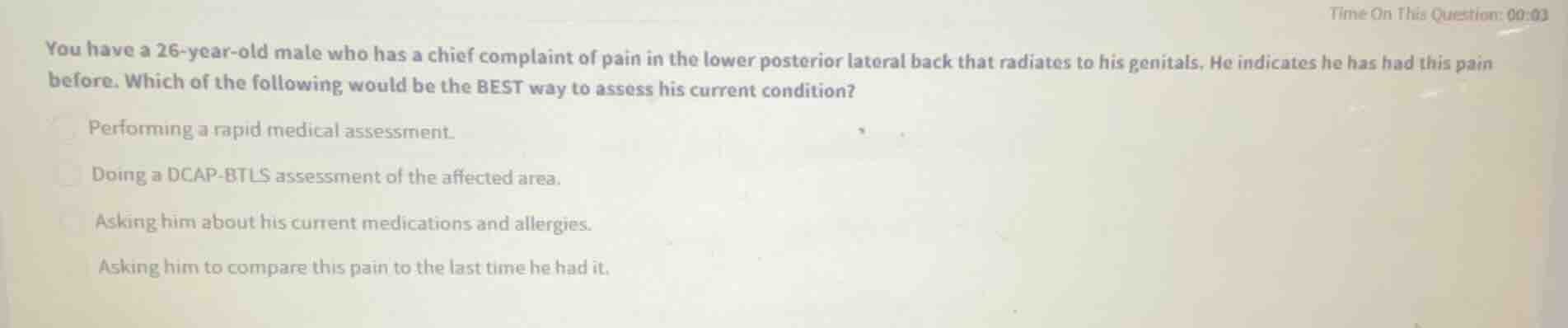
you have a 26-year-old male who has a chief complaint of pain in the lower posterior lateral back that radiates to his genitals. he indicates he has had this pain before. which of the following would be the best way to assess his current condition?
performing a rapid medical assessment.
doing a dcap-btls assessment of the affected area.
asking him about his current medications and allergies.
asking him to compare this pain to the last time he had it.
Analyze the clinical presentation
The patient is a 26-year-old male presenting with severe flank pain (lower posterior lateral back) radiating to his genitals. This classic presentation is highly indicative of renal colic (kidney stones). The prompt notes that he has experienced this exact pain before.
Evaluate the assessment options
Using the Medical History Taking knowledge point:
- Performing a rapid medical assessment is too broad and does not focus on his specific, localized, recurring complaint.
- Doing a DCAP-BTLS assessment is used for trauma, whereas this is a non-traumatic medical presentation.
- Asking about current medications and allergies is a standard part of the SAMPLE history, but it does not help assess or characterize his current pain episode.
- Asking him to compare this pain to the last time he had it directly addresses his history of similar pain, helping to confirm if this is a recurrence of kidney stones and assessing the severity/progression of his current condition.
Determine the best clinical action
Comparing the current episode to a known previous episode provides immediate diagnostic utility and helps gauge the severity of the current obstruction or spasm. Therefore, asking him to compare this pain to the last time is the most focused and useful assessment step.

Snap & solve any problem in the app
Get step-by-step solutions on Sovi AI
Photo-based solutions with guided steps
Explore more problems and detailed explanations
- Performing a rapid medical assessment.
- Doing a DCAP-BTLS assessment of the affected area.
- Asking him about his current medications and allergies.
- Asking him to compare this pain to the last time he had it. (Correct answer)