QUESTION IMAGE
Question
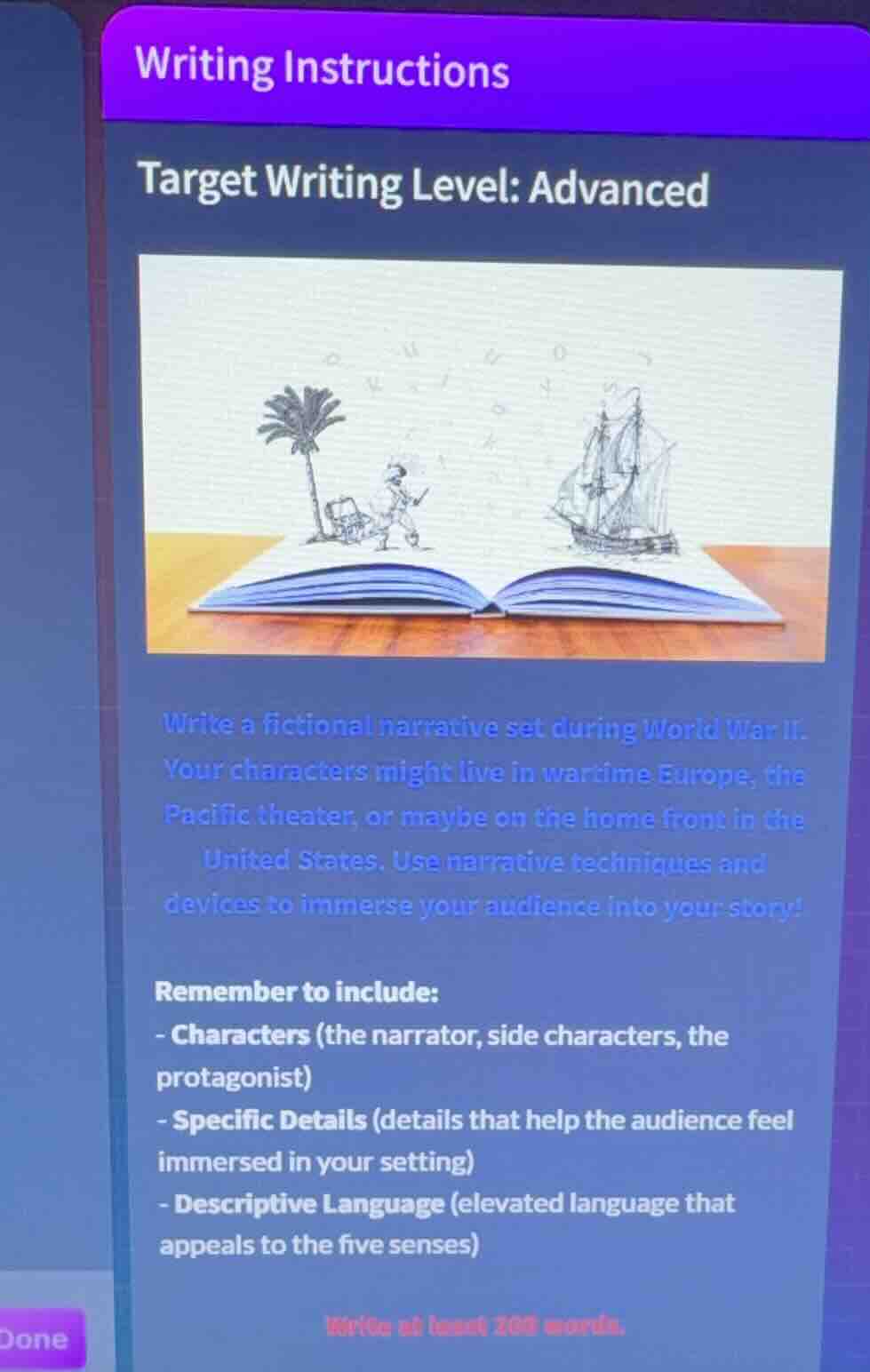
writing instructions
target writing level: advanced
write a fictional narrative set during world war ii. your characters might live in wartime europe, the pacific theater, or maybe on the home front in the united states. use narrative techniques and devices to immerse your audience into your story!
remember to include:
- characters (the narrator, side characters, the protagonist)
- specific details (details that help the audience feel immersed in your setting)
- descriptive language (elevated language that appeals to the five senses)
write at least 200 words.
⚡ Using: character development and narrative arcs · 🆕 New: Historical Fiction Narrative Writing
Bringing history to life through personal stories
Step 1: Brainstorming the Setting and Characters
To write an immersive historical narrative set during World War II, we need a compelling setting and relatable characters. Let's choose the London Blitz (the home front in Europe) as our setting.
- Protagonist/Narrator: Arthur, an elderly watchmaker who volunteers as an Air Raid Warden.
- Side Character: Lily, a young girl separated from her mother during an evacuation rush.
- Setting Details: The smell of damp brick dust, the rhythmic sweep of searchlights, the distant drone of bomber engines, and the cold night air of an underground tube station.
Step 2: Structuring the Narrative Arc
We will structure the story with a clear beginning, middle, and end:
- Beginning (Exposition): Establish the tense atmosphere of London at night during an air raid. Introduce Arthur on patrol.
- Middle (Rising Action & Climax): The sirens wail, and bombs begin to fall. Arthur hears a cry and finds Lily trapped or frightened near a crumbling doorway. He must guide her to safety as the world shakes around them.
- End (Resolution): They reach the safety of the underground station. A quiet, emotional moment of connection and hope amidst the devastation.
Step 3: Drafting with Sensory Details and Advanced Vocabulary
We will use elevated language and appeal to the five senses (sight, sound, smell, touch, taste) to meet the "Advanced" writing level requirement.
- Sight: "Amber fingers of searchlights clawing the bruised purple sky."
- Sound: "The low, guttural thrum of Heinkel bombers."
- Smell/Taste: "The acrid taste of pulverized limestone and sulfur on the tongue."
- Touch: "The cold, gritty iron of the railing."
---

Snap & solve any problem in the app
Get step-by-step solutions on Sovi AI
Photo-based solutions with guided steps
Explore more problems and detailed explanations
Here is an original, advanced-level historical fiction narrative of approximately 250 words based on the prompt:
The Watchmaker of Aldgate
The night air of London did not smell of autumn anymore; it tasted of pulverized brick, sulfur, and the cold, metallic tang of fear. Above us, the sky was a bruised canvas of violet and soot, clawed by the amber fingers of searchlights searching for the enemy. I adjusted my heavy wool warden’s coat, the white "W" on my helmet catching the flickering glow of a distant fire.
The sirens began their rising, mournful wail—a mechanical beast warning us of the approaching storm. Soon came the low, guttural thrum of Heinkel engines vibrating deep within my chest.
"Down here! Quickly!" I urged, waving my torch toward the entrance of the Aldgate tube station. A stream of pale, hurried faces descended into the earth.
Suddenly, a sharp whimper cut through the din. Near the shadow of a crumbling bakery, a small girl sat huddled against a iron lamppost, clutching a tattered ragdoll. Her eyes were wide, reflecting the flashes of anti-aircraft fire.
"Come along, little one," I said, kneeling so my boots crunched softly on the broken glass. I held out a hand, my fingers calloused from decades of winding delicate watch gears. "We must find your mother inside."
She hesitated, then gripped my hand with surprising strength. As the first detonation shook the pavement beneath our feet, showering us in plaster dust, we plunged down the stairs into the warm, crowded sanctuary of the underground. Safe beneath the concrete, her breathing slowed. In the darkest hours of the war, survival was measured not in grand victories, but in these quiet, shared moments of rescue.