QUESTION IMAGE
Question
writing exercises
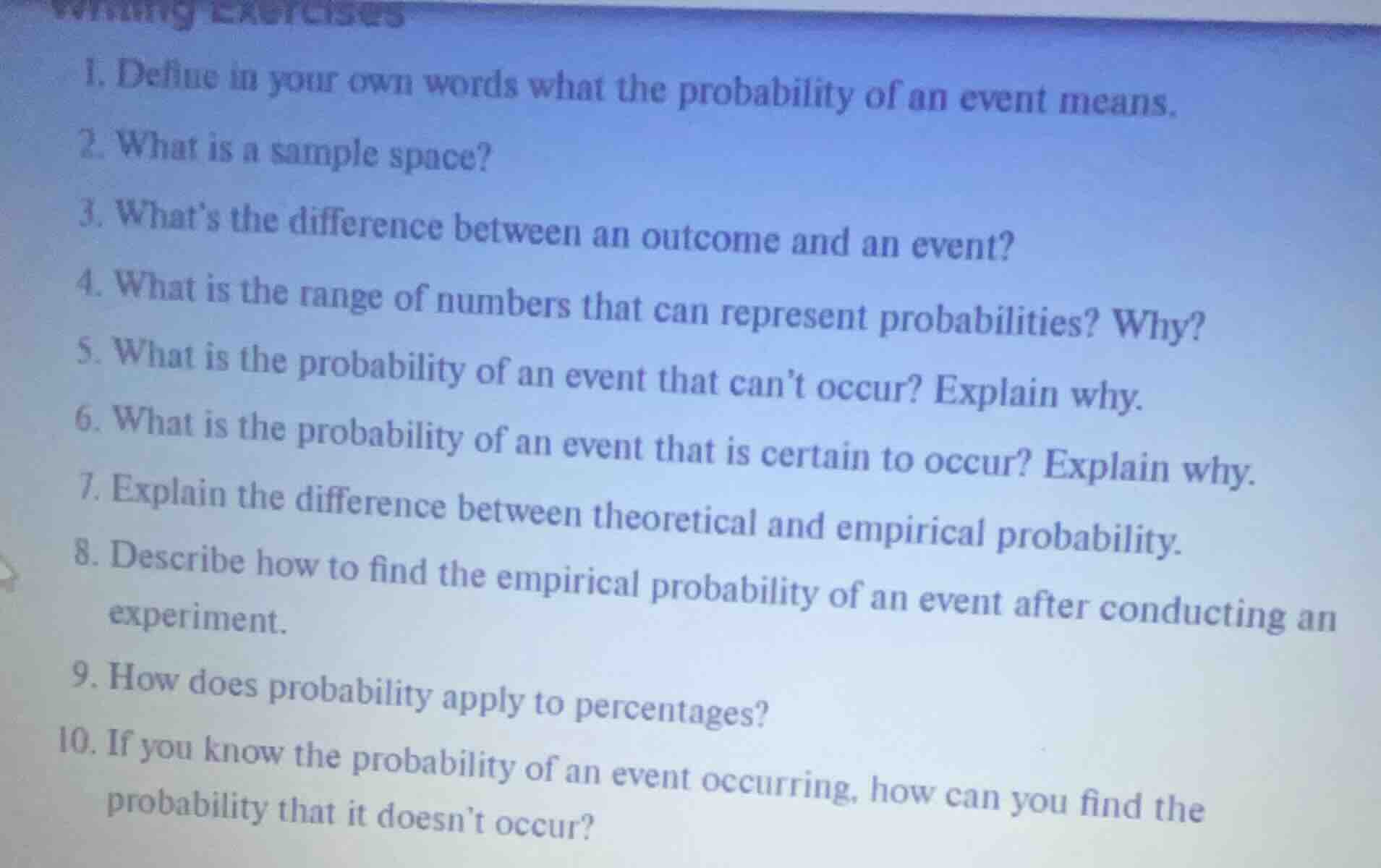
- define in your own words what the probability of an event means.
- what is a sample space?
- whats the difference between an outcome and an event?
- what is the range of numbers that can represent probabilities? why?
- what is the probability of an event that cant occur? explain why.
- what is the probability of an event that is certain to occur? explain why.
- explain the difference between theoretical and empirical probability.
- describe how to find the empirical probability of an event after conducting an experiment.
- how does probability apply to percentages?
- if you know the probability of an event occurring, how can you find the probability that it doesnt occur?
Define probability of an event
Probability measures the likelihood of an event occurring. It is a numerical value representing chance.
Define sample space
A sample space is the set of all possible outcomes. It represents every potential result of an experiment.
Distinguish outcome and event
An outcome is a single result of an experiment. An event is a subset of outcomes.
Determine probability range
Probabilities range from \(0\) to \(1\) inclusive. This represents \(0\%\) to \(100\%\) likelihood.
Explain impossible event probability
An impossible event has a probability of \(0\). It cannot occur under any circumstances.
Explain certain event probability
A certain event has a probability of \(1\). It is guaranteed to occur every time.
Compare theoretical and empirical probability
Theoretical probability uses mathematical analysis of outcomes. Empirical probability uses observed data from experiments.
Calculate empirical probability
Empirical probability is the ratio of successful trials to total trials.
Relate probability to percentages
Probabilities convert to percentages by multiplying by \(100\). A probability of \(0.5\) equals \(50\%\).
Find complement probability
Subtract the probability of occurrence from \(1\).

Snap & solve any problem in the app
Get step-by-step solutions on Sovi AI
Photo-based solutions with guided steps
Explore more problems and detailed explanations
Question 1
The probability of an event is a numerical measure from \(0\) to \(1\) that represents the likelihood or chance of that specific event occurring.
Question 2
A sample space is the set of all possible outcomes of a probability experiment.
Question 3
An outcome is a single, specific result of a single trial of an experiment, whereas an event is a collection of one or more outcomes.
Question 4
The range of numbers is \(0\) to \(1\) (inclusive), because an event cannot occur less than \(0\%\) of the time or more than \(100\%\) of the time.
Question 5
The probability is \(0\), because there are zero favorable outcomes in the sample space for an event that cannot happen.
Question 6
The probability is \(1\), because the event includes all possible outcomes in the sample space and is guaranteed to happen.
Question 7
Theoretical probability is based on known, equally likely outcomes without running trials, whereas empirical probability is based on actual observations and data collected from running an experiment.
Question 8
Divide the number of times the event actually occurred by the total number of trials conducted in the experiment:
Question 9
Probabilities expressed as decimals or fractions can be converted to percentages by multiplying the value by \(100\) and adding a percent sign (\%).
Question 10
Subtract the probability of the event occurring from \(1\):