QUESTION IMAGE
Question
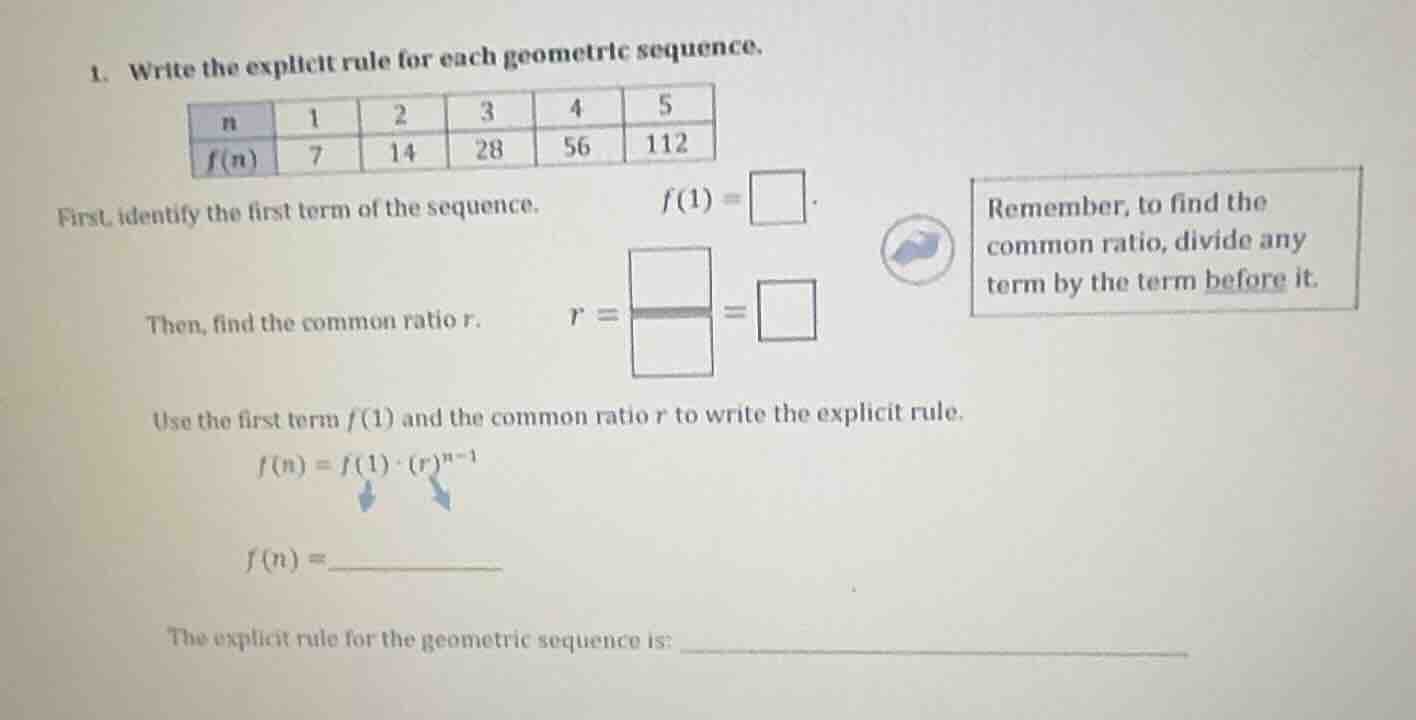
- write the explicit rule for each geometric sequence.
\
first, identify the first term of the sequence. \\(f(1) = \square\\).
then, find the common ratio \\(r\\). \\(r = \frac{\square}{\square} = \square\\).
remember, to find the common ratio, divide any term by the term before it.
use the first term \\(f(1)\\) and the common ratio \\(r\\) to write the explicit rule.
\\(f(n) = f(1) \cdot (r)^{n-1}\\)
\\(f(n) = \underline{\quad\quad\quad\quad}\\)
the explicit rule for the geometric sequence is: \underline{\quad\quad\quad\quad\quad\quad\quad\quad\quad\quad\quad\quad\quad\quad\quad\quad}
Identify the first term
From the table, when \(n = 1\), \(f(1) = 7\).
Find the common ratio
Divide the second term by the first term:
Write the explicit rule
Substitute \(f(1) = 7\) and \(r = 2\) into the formula \(f(n) = f(1) \cdot (r)^{n-1}\):

Snap & solve any problem in the app
Get step-by-step solutions on Sovi AI
Photo-based solutions with guided steps
Explore more problems and detailed explanations
- Write the explicit rule for each geometric sequence.
First, identify the first term of the sequence.
\(f(1) =\) <blank>7</blank>.
Then, find the common ratio \(r\).
\(r =\) <blank>\(\frac{14}{7}\)</blank> \(=\) <blank>2</blank>.
Use the first term \(f(1)\) and the common ratio \(r\) to write the explicit rule.
\(f(n) = f(1) \cdot (r)^{n-1}\)
\(f(n) =\) <blank>\(7 \cdot (2)^{n-1}\)</blank>
The explicit rule for the geometric sequence is: <blank>\(f(n) = 7 \cdot (2)^{n-1}\)</blank>