QUESTION IMAGE
Question
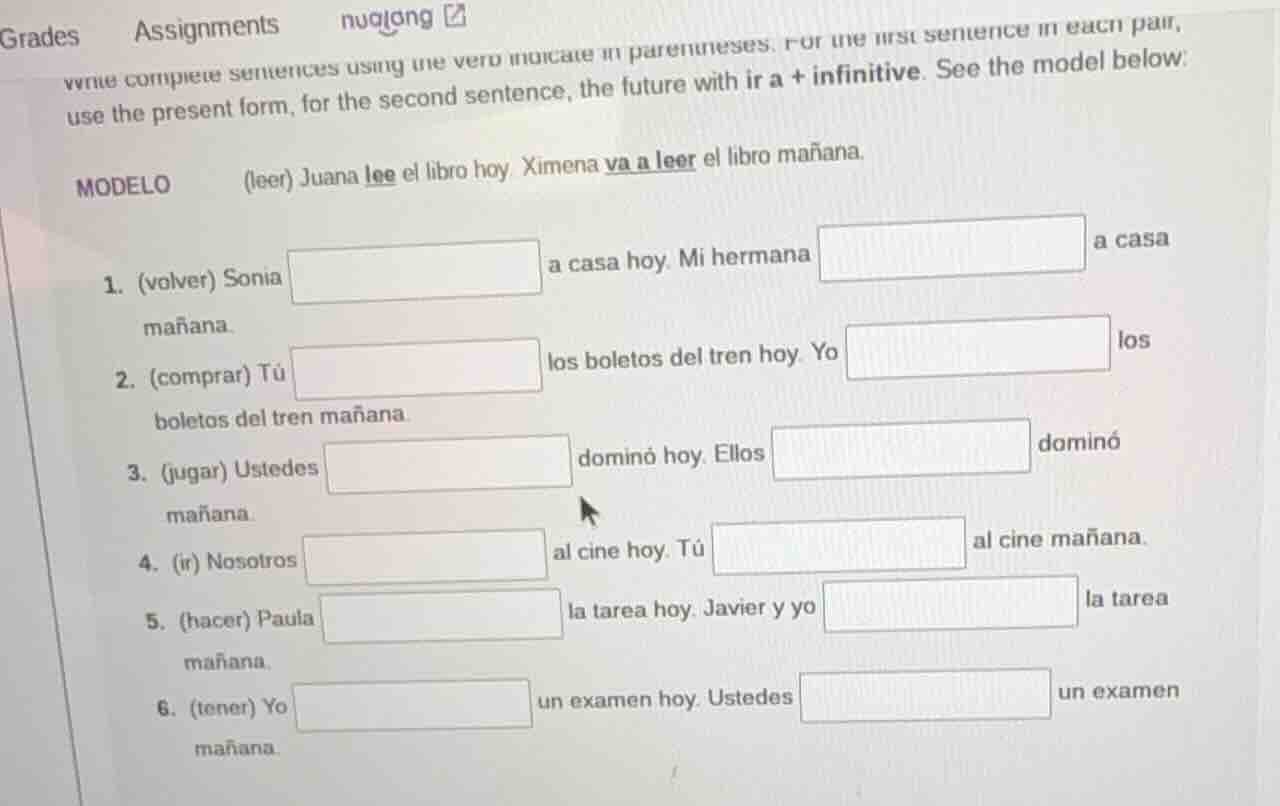
write complete sentences using the verb indicated in parentheses. for the first sentence in each pair, use the present form, for the second sentence, the future with ir a + infinitive. see the model below:
modelo (leer) juana lee el libro hoy. ximena va a leer el libro mañana.
- (volver) sonia a casa hoy. mi hermana a casa mañana.
- (comprar) tú los boletos del tren hoy. yo los boletos del tren mañana.
- (jugar) ustedes dominó hoy. ellos dominó mañana.
- (ir) nosotros al cine hoy. tú al cine mañana.
- (hacer) paula la tarea hoy. javier y yo la tarea mañana.
- (tener) yo un examen hoy. ustedes un examen mañana.
<pre_analysis>
{
"quality": "clear",
"question_count": 6,
"skills_matched": [
"direct_cot",
"explain_then_answer",
"quick"
],
"needs_drawing": false,
"concepts_used": [],
"new_concepts": [],
"current_concepts": [
"Spanish Verb Conjugation",
"Present Tense Spanish",
"Ir + a + Infinitive"
]
}
</pre_analysis>
<reasoning>
Conjugate verbs for items 1 to 3
- Item 1 (volver): Sonia (third-person singular present) is "vuelve" (stem-changing o->ue). Mi hermana (third-person singular near future) is "va a volver".
- Item 2 (comprar): Tú (second-person singular present) is "compras". Yo (first-person singular near future) is "voy a comprar".
- Item 3 (jugar): Ustedes (third-person plural present) is "juegan" (stem-changing u->ue). Ellos (third-person plural near future) is "van a jugar".
Conjugate verbs for items 4 to 6
- Item 4 (ir): Nosotros (first-person plural present) is "vamos". Tú (second-person singular near future) is "vas a ir".
- Item 5 (hacer): Paula (third-person singular present) is "hace". Javier y yo (first-person plural near future) is "vamos a hacer".
- Item 6 (tener): Yo (first-person singular present) is "tengo" (irregular yo). Ustedes (third-person plural near future) is "van a tener".
</reasoning>
<answer>
- Sonia vuelve a casa hoy. Mi hermana va a volver a casa mañana.
- Tú compras los boletos del tren hoy. Yo voy a comprar los boletos del tren mañana.
- Ustedes juegan dominó hoy. Ellos van a jugar dominó mañana.
- Nosotros vamos al cine hoy. Tú vas a ir al cine mañana.
- Paula hace la tarea hoy. Javier y yo vamos a hacer la tarea mañana.
- Yo tengo un examen hoy. Ustedes van a tener un examen mañana.
</answer>
<post_analysis>
{
"subject": "Others",
"question_type": "Fill-in-the-blank",
"knowledge_point": [
"Others",
"Linguistics",
"Spanish Grammar"
]
}
</post_analysis>
Snap & solve any problem in the app
Get step-by-step solutions on Sovi AI
Photo-based solutions with guided steps
Explore more problems and detailed explanations
<pre_analysis>
{
"quality": "clear",
"question_count": 6,
"skills_matched": [
"direct_cot",
"explain_then_answer",
"quick"
],
"needs_drawing": false,
"concepts_used": [],
"new_concepts": [],
"current_concepts": [
"Spanish Verb Conjugation",
"Present Tense Spanish",
"Ir + a + Infinitive"
]
}
</pre_analysis>
<reasoning>
Conjugate verbs for items 1 to 3
- Item 1 (volver): Sonia (third-person singular present) is "vuelve" (stem-changing o->ue). Mi hermana (third-person singular near future) is "va a volver".
- Item 2 (comprar): Tú (second-person singular present) is "compras". Yo (first-person singular near future) is "voy a comprar".
- Item 3 (jugar): Ustedes (third-person plural present) is "juegan" (stem-changing u->ue). Ellos (third-person plural near future) is "van a jugar".
Conjugate verbs for items 4 to 6
- Item 4 (ir): Nosotros (first-person plural present) is "vamos". Tú (second-person singular near future) is "vas a ir".
- Item 5 (hacer): Paula (third-person singular present) is "hace". Javier y yo (first-person plural near future) is "vamos a hacer".
- Item 6 (tener): Yo (first-person singular present) is "tengo" (irregular yo). Ustedes (third-person plural near future) is "van a tener".
</reasoning>
<answer>
- Sonia vuelve a casa hoy. Mi hermana va a volver a casa mañana.
- Tú compras los boletos del tren hoy. Yo voy a comprar los boletos del tren mañana.
- Ustedes juegan dominó hoy. Ellos van a jugar dominó mañana.
- Nosotros vamos al cine hoy. Tú vas a ir al cine mañana.
- Paula hace la tarea hoy. Javier y yo vamos a hacer la tarea mañana.
- Yo tengo un examen hoy. Ustedes van a tener un examen mañana.
</answer>
<post_analysis>
{
"subject": "Others",
"question_type": "Fill-in-the-blank",
"knowledge_point": [
"Others",
"Linguistics",
"Spanish Grammar"
]
}
</post_analysis>