QUESTION IMAGE
Question
wrap up the lesson
answer the guiding questions
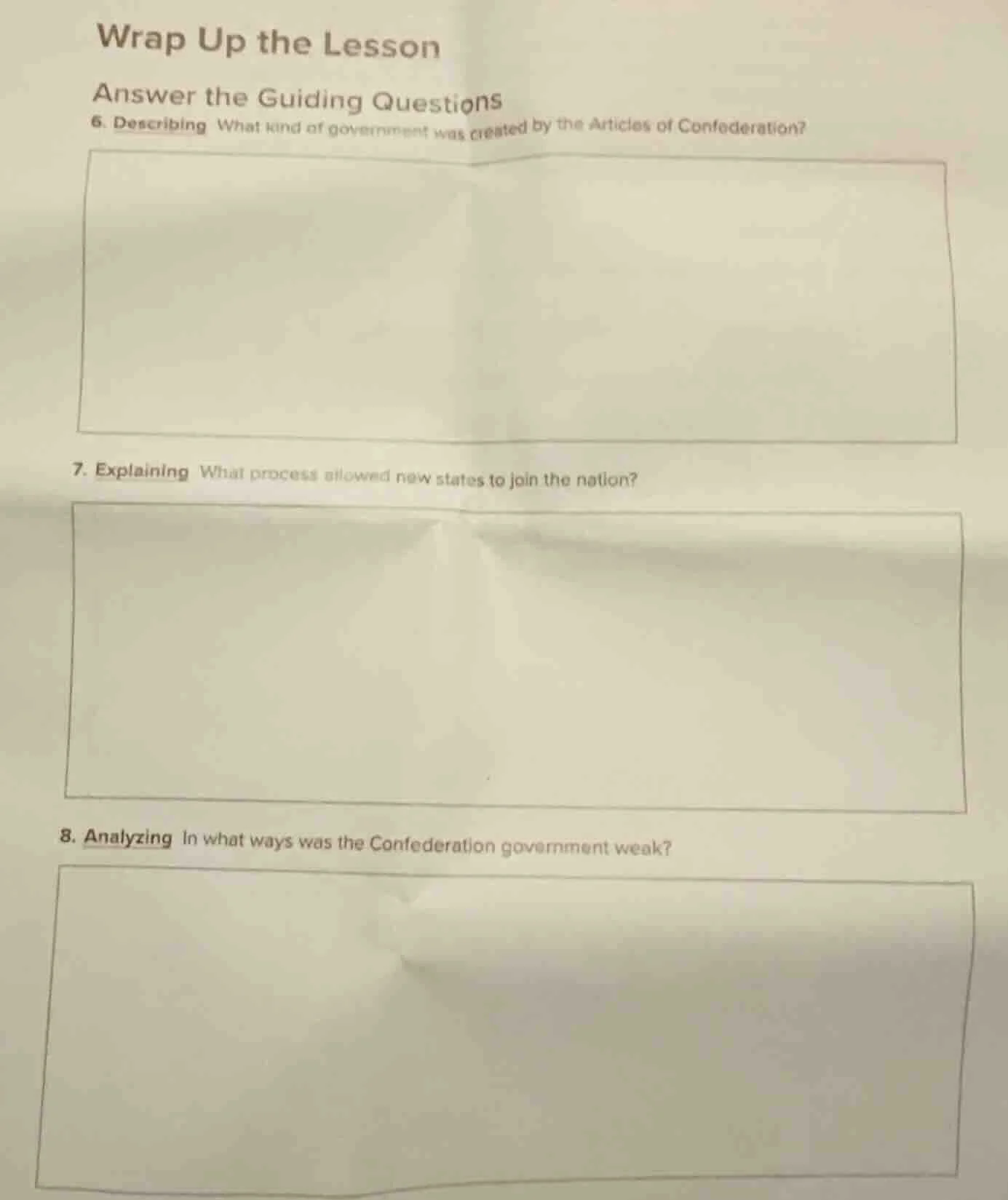
- describing what kind of government was created by the articles of confederation?
- explaining what process allowed new states to join the nation?
- analyzing in what ways was the confederation government weak?
Question 6
The Articles of Confederation established a confederation - a loose alliance of sovereign states. There was a unicameral (one - house) Congress where each state had one vote. The central government (Congress) had limited powers, such as the power to declare war, make treaties, and coin money, but it lacked the power to tax, regulate trade, or enforce laws. The states retained most of the power.
The process that allowed new states to join the nation was the Northwest Ordinance of 1787. It established a procedure for territories to become states. A territory had to have a certain population, draft a constitution, and then apply for statehood. Once these steps were met, the territory could be admitted as a state on an equal footing with the original states.
The Confederation government was weak in several ways. It had no power to tax, so it couldn't raise revenue. It couldn't regulate interstate or foreign trade, leading to economic chaos. There was no executive branch to enforce laws, and no national court system. Amendments to the Articles required unanimous consent of the states, which was nearly impossible. Also, each state had one vote in Congress regardless of size, and the central government relied on states for funding and military support, which states often didn't provide.

Snap & solve any problem in the app
Get step-by-step solutions on Sovi AI
Photo-based solutions with guided steps
Explore more problems and detailed explanations
The Articles of Confederation created a confederation - a weak central government (a unicameral Congress with each state having one vote) where the states retained most of the political power. The central government (Congress) had limited powers like declaring war and making treaties but lacked powers such as taxation and trade regulation.