QUESTION IMAGE
Question
workbook 1a
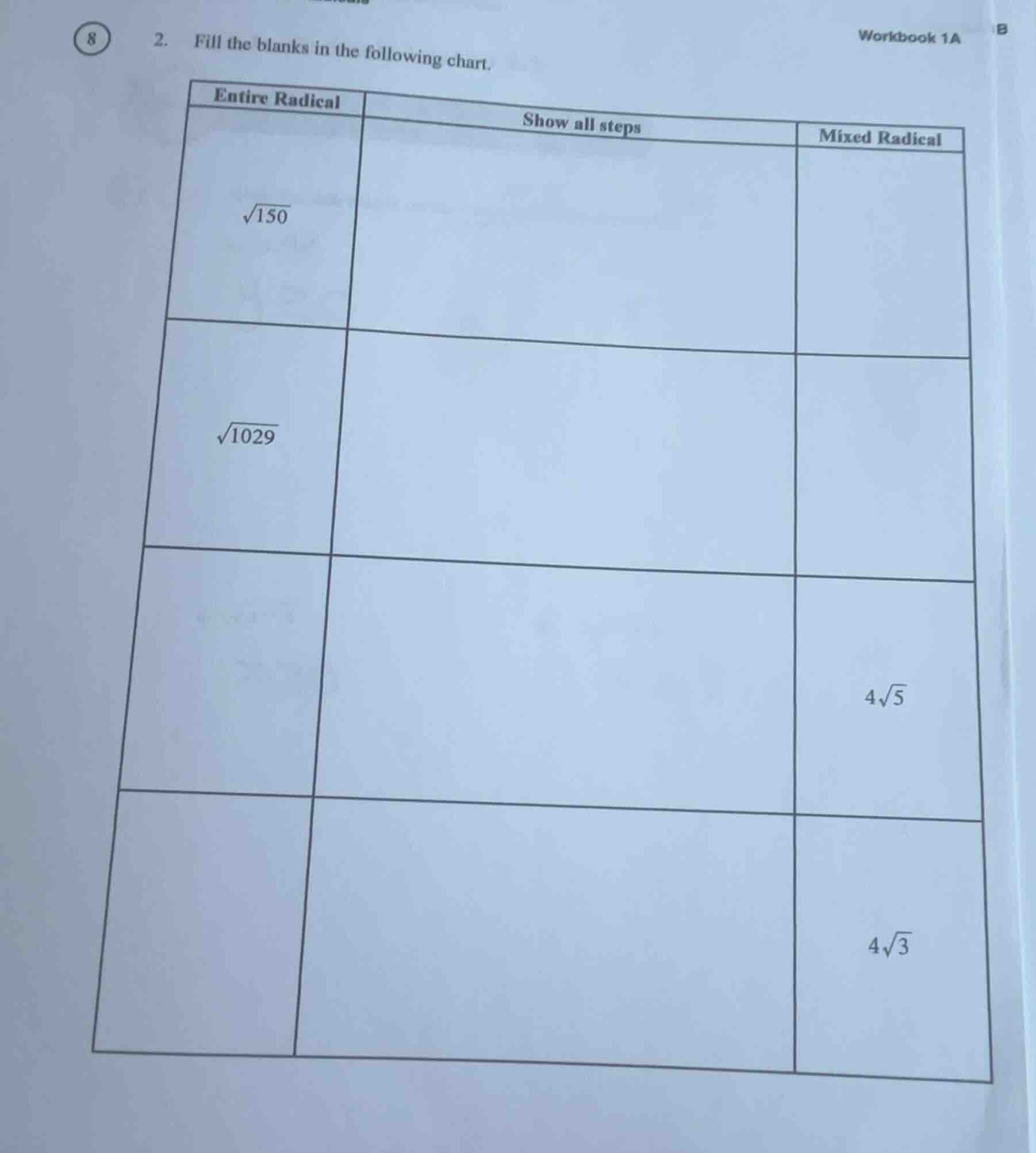
- fill the blanks in the following chart.
\
$$\begin{tabular}{|c|c|c|}
\\hline
\\textbf{entire radical} & \\textbf{show all steps} & \\textbf{mixed radical} \\\\
\\hline
\\sqrt{150} & & \\\\
\\hline
\\sqrt{1029} & & \\\\
\\hline
& & 4\\sqrt{5} \\\\
\\hline
& & 4\\sqrt{3} \\\\
\\hline
\\end{tabular}$$
Identify the task
We need to fill in the missing cells of the table, converting between entire radicals and mixed radicals.
Simplify the first entire radical
We simplify \(\sqrt{150}\) by finding the largest perfect square factor of 150.
$$
150 = 25 \times 6
$$
$$
\sqrt{150} = \sqrt{25 \times 6} = \sqrt{25} \times \sqrt{6} = 5\sqrt{6}
$$
Simplify the second entire radical
We simplify \(\sqrt{1029}\) by finding the largest perfect square factor of 1029.
$$
1029 = 49 \times 21
$$
$$
\sqrt{1029} = \sqrt{49 \times 21} = \sqrt{49} \times \sqrt{21} = 7\sqrt{21}
$$
Convert the first mixed radical to an entire radical
We convert \(4\sqrt{5}\) to an entire radical by moving the coefficient inside the square root.
$$
4\sqrt{5} = \sqrt{4^2 \times 5} = \sqrt{16 \times 5} = \sqrt{80}
$$
Convert the second mixed radical to an entire radical
We convert \(4\sqrt{3}\) to an entire radical by moving the coefficient inside the square root.
$$
4\sqrt{3} = \sqrt{4^2 \times 3} = \sqrt{16 \times 3} = \sqrt{48}
$$

Snap & solve any problem in the app
Get step-by-step solutions on Sovi AI
Photo-based solutions with guided steps
Explore more problems and detailed explanations
| Entire Radical | Show all steps | Mixed Radical |
|---|---|---|
| \(\sqrt{1029}\) | \(\sqrt{49 \times 21} = 7\sqrt{21}\) | \(7\sqrt{21}\) |
| \(\sqrt{80}\) | \(4\sqrt{5} = \sqrt{16 \times 5} = \sqrt{80}\) | \(4\sqrt{5}\) |
| \(\sqrt{48}\) | \(4\sqrt{3} = \sqrt{16 \times 3} = \sqrt{48}\) | \(4\sqrt{3}\) |