Sovi.AI - AI Math Tutor

Scan to solve math questions

QUESTION IMAGE

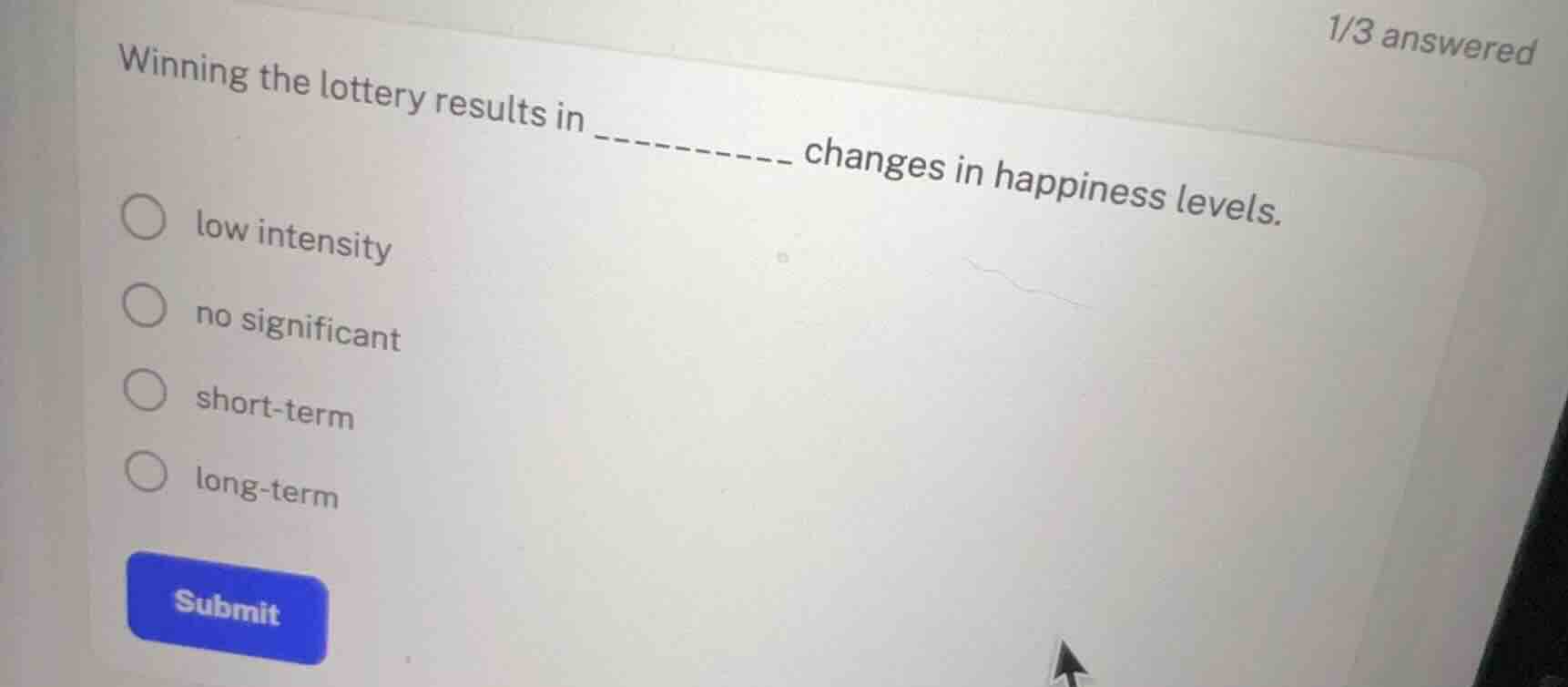
winning the lottery results in __________ changes in happiness levels. …

Question

winning the lottery results in __________ changes in happiness levels.

  • low intensity
  • no significant
  • short-term
  • long-term

Explanation:

Response

<pre_analysis>
{
"quality": "clear",
"question_count": 1,
"skills_matched": [
"direct_cot",
"multiple_choice_formatter",
"explain_then_answer",
"tutor"
],
"needs_drawing": false,
"concepts_used": [],
"new_concepts": [
"Hedonic Treadmill",
"Subjective Well-Being",
"Lottery Winner Study"
],
"current_concepts": [
"Hedonic Treadmill",
"Subjective Well-Being",
"Lottery Winner Study"
]
}
</pre_analysis>

<reasoning>

Identify the core psychological concept

The question asks about the impact of winning the lottery on long-term happiness levels. This relates to the psychological concept of the Hedonic Treadmill (or hedonic adaptation), which suggests that people repeatedly return to their baseline level of happiness regardless of major positive or negative life events.

Analyze the classic research

A famous 1978 study by Brickman, Coates, and Janoff-Bulman investigated the happiness levels of lottery winners compared to control groups. The researchers found that while lottery winners experienced an initial spike in happiness, over time, their overall happiness levels returned to their baseline. Thus, winning the lottery results in no significant long-term changes in happiness levels.

Evaluate the given options

  • low intensity: Incorrect, as the initial emotional reaction is typically high in intensity.
  • no significant: Correct, because adaptation returns individuals to their baseline happiness, resulting in no lasting significant difference.
  • short-term: While there are short-term changes, the sentence structure "results in ________ changes" is best completed by "no significant" to describe the overall, lasting impact on happiness levels according to psychological consensus.
  • long-term: Incorrect, as studies show there are no permanent long-term increases in happiness.

</reasoning>

<answer>
<mcq-option>low intensity</mcq-option>
<mcq-correct>no significant</mcq-correct>
<mcq-option>short-term</mcq-option>
<mcq-option>long-term</mcq-option>
</answer>

<post_analysis>
{
"subject": "Social Science",
"question_type": "Multiple Choice",
"knowledge_point": [
"Social Science",
"Psychology",
"Hedonic Adaptation"
]
}
</post_analysis>

Answer:

<pre_analysis>
{
"quality": "clear",
"question_count": 1,
"skills_matched": [
"direct_cot",
"multiple_choice_formatter",
"explain_then_answer",
"tutor"
],
"needs_drawing": false,
"concepts_used": [],
"new_concepts": [
"Hedonic Treadmill",
"Subjective Well-Being",
"Lottery Winner Study"
],
"current_concepts": [
"Hedonic Treadmill",
"Subjective Well-Being",
"Lottery Winner Study"
]
}
</pre_analysis>

<reasoning>

Identify the core psychological concept

The question asks about the impact of winning the lottery on long-term happiness levels. This relates to the psychological concept of the Hedonic Treadmill (or hedonic adaptation), which suggests that people repeatedly return to their baseline level of happiness regardless of major positive or negative life events.

Analyze the classic research

A famous 1978 study by Brickman, Coates, and Janoff-Bulman investigated the happiness levels of lottery winners compared to control groups. The researchers found that while lottery winners experienced an initial spike in happiness, over time, their overall happiness levels returned to their baseline. Thus, winning the lottery results in no significant long-term changes in happiness levels.

Evaluate the given options

  • low intensity: Incorrect, as the initial emotional reaction is typically high in intensity.
  • no significant: Correct, because adaptation returns individuals to their baseline happiness, resulting in no lasting significant difference.
  • short-term: While there are short-term changes, the sentence structure "results in ________ changes" is best completed by "no significant" to describe the overall, lasting impact on happiness levels according to psychological consensus.
  • long-term: Incorrect, as studies show there are no permanent long-term increases in happiness.

</reasoning>

<answer>
<mcq-option>low intensity</mcq-option>
<mcq-correct>no significant</mcq-correct>
<mcq-option>short-term</mcq-option>
<mcq-option>long-term</mcq-option>
</answer>

<post_analysis>
{
"subject": "Social Science",
"question_type": "Multiple Choice",
"knowledge_point": [
"Social Science",
"Psychology",
"Hedonic Adaptation"
]
}
</post_analysis>