QUESTION IMAGE
Question
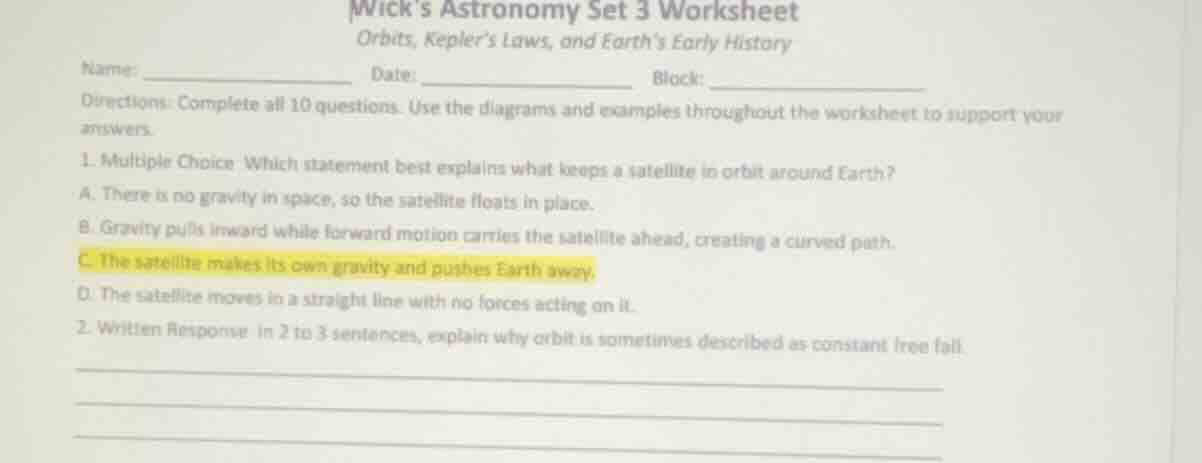
wicks astronomy set 3 worksheet
orbits, keplers laws, and earths early history
name: ____ date: __ block: ____
directions: complete all 10 questions. use the diagrams and examples throughout the worksheet to support your answers.
- multiple choice which statement best explains what keeps a satellite in orbit around earth?
a. there is no gravity in space, so the satellite floats in place.
b. gravity pulls inward while forward motion carries the satellite ahead, creating a curved path.
c. the satellite makes its own gravity and pushes earth away.
d. the satellite moves in a straight line with no forces acting on it.
- written response in 2 to 3 sentences, explain why orbit is sometimes described as constant free fall.
Analyze satellite orbital motion forces
- Gravity acts as a centripetal force pulling the satellite toward Earth's center.
- The satellite's forward tangential velocity carries it forward, resulting in a continuous curved path around Earth.
- Correct option: B.
Explain orbit as constant free fall
- A satellite in orbit is constantly falling toward Earth due to gravity.
- Because of its high forward tangential speed, Earth curves away beneath the satellite at the same rate that the satellite falls.
- Consequently, the satellite remains at a constant altitude, continuously falling around Earth without ever hitting the surface.

Snap & solve any problem in the app
Get step-by-step solutions on Sovi AI
Photo-based solutions with guided steps
Explore more problems and detailed explanations
Question 1
- A. There is no gravity in space, so the satellite floats in place.
- B. Gravity pulls inward while forward motion carries the satellite ahead, creating a curved path. (Correct answer)
- C. The satellite makes its own gravity and pushes Earth away.
- D. The satellite moves in a straight line with no forces acting on it.
Question 2
An object in orbit is constantly falling toward Earth due to the pull of gravity. However, because of its high forward tangential velocity, Earth's surface curves away at the same rate that the object falls. As a result, the object remains in a continuous state of falling around Earth without ever hitting the ground.