QUESTION IMAGE
Question
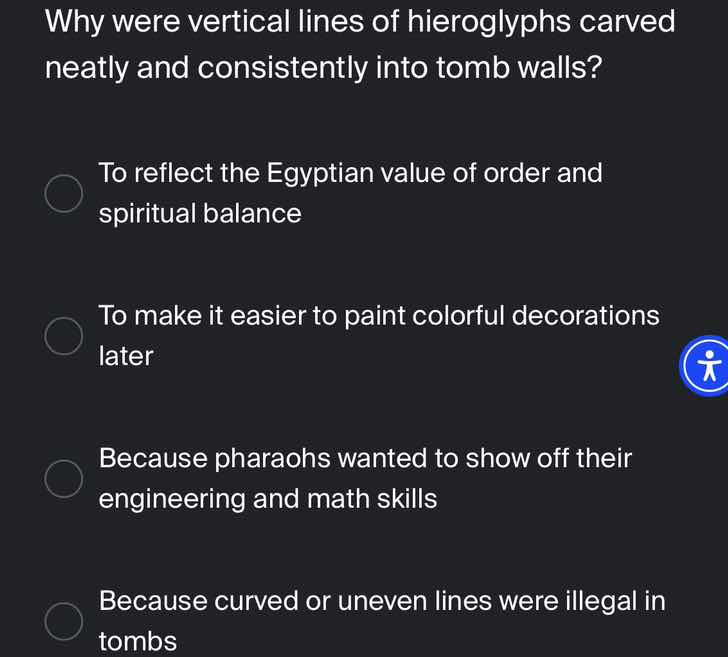
why were vertical lines of hieroglyphs carved neatly and consistently into tomb walls?
to reflect the egyptian value of order and spiritual balance
to make it easier to paint colorful decorations later
because pharaohs wanted to show off their engineering and math skills
because curved or uneven lines were illegal in tombs
Analyze Egyptian artistic principles
Ancient Egyptian art and writing were deeply tied to religious and spiritual beliefs. The concepts of order, symmetry, and balance (associated with the cosmic concept of Ma'at) governed how hieroglyphs and figures were arranged on tomb walls.
Evaluate the options
- Option 1: Reflecting order and spiritual balance directly aligns with the Egyptian cultural emphasis on Ma'at (cosmic order, truth, and balance), which was essential for a successful transition to the afterlife.
- Option 2: Hieroglyphs were often carved and painted simultaneously, or left unpainted; the neatness was not merely a preparation step for painting.
- Option 3: The primary purpose of tomb decorations was religious and funerary, not a secular display of engineering or mathematical skills.
- Option 4: There was no specific "law" making curved lines illegal; rather, the grid system and straight lines were stylistic and religious conventions.

Snap & solve any problem in the app
Get step-by-step solutions on Sovi AI
Photo-based solutions with guided steps
Explore more problems and detailed explanations
- To reflect the Egyptian value of order and spiritual balance (Correct answer)
- To make it easier to paint colorful decorations later
- Because pharaohs wanted to show off their engineering and math skills
- Because curved or uneven lines were illegal in tombs