QUESTION IMAGE
Question
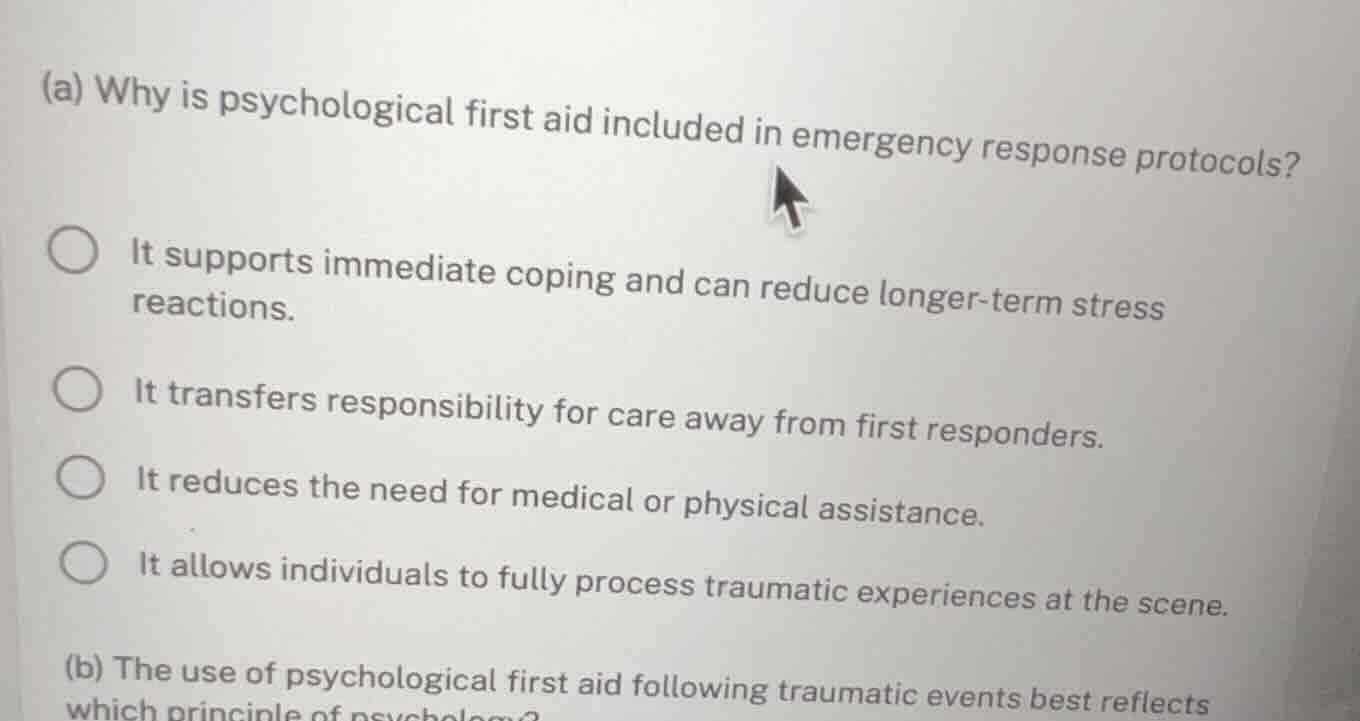
(a) why is psychological first aid included in emergency response protocols?
- it supports immediate coping and can reduce longer-term stress reactions.
- it transfers responsibility for care away from first responders.
- it reduces the need for medical or physical assistance.
- it allows individuals to fully process traumatic experiences at the scene.
(b) the use of psychological first aid following traumatic events best reflects which principle of psychology?
<pre_analysis>
{
"quality": "clear",
"question_count": 1,
"skills_matched": [
"direct_cot",
"multiple_choice_formatter",
"explain_then_answer",
"tutor",
"mastery_adaptive_brevity"
],
"needs_drawing": false,
"concepts_used": [
"Psychological First Aid",
"Emergency Response Protocols"
],
"new_concepts": [],
"current_concepts": [
"Psychological First Aid",
"Emergency Response Protocols"
]
}
</pre_analysis>
<reasoning>
Define Psychological First Aid
Using the Psychological First Aid and Emergency Response Protocols knowledge points
- Psychological First Aid (PFA) is designed to reduce initial distress caused by traumatic events.
- It fosters short-term adaptive functioning and coping.
Evaluate the options
Using the Psychological First Aid knowledge point
- Option 1: Correctly identifies that PFA supports immediate coping and reduces long-term stress reactions.
- Option 2: Incorrect, as PFA does not shift responsibility away from responders.
- Option 3: Incorrect, as PFA does not replace necessary medical or physical care.
- Option 4: Incorrect, because fully processing trauma is a long-term therapeutic goal, not a field-level PFA objective.
</reasoning>
<answer>
<mcq-correct>It supports immediate coping and can reduce longer-term stress reactions.</mcq-correct>
<mcq-option>It transfers responsibility for care away from first responders.</mcq-option>
<mcq-option>It reduces the need for medical or physical assistance.</mcq-option>
<mcq-option>It allows individuals to fully process traumatic experiences at the scene.</mcq-option>
</answer>
<post_analysis>
{
"subject": "Social Science",
"question_type": "Multiple Choice",
"knowledge_point": [
"Social Science",
"Psychology",
"Psychological First Aid"
]
}
</post_analysis>
Snap & solve any problem in the app
Get step-by-step solutions on Sovi AI
Photo-based solutions with guided steps
Explore more problems and detailed explanations
<pre_analysis>
{
"quality": "clear",
"question_count": 1,
"skills_matched": [
"direct_cot",
"multiple_choice_formatter",
"explain_then_answer",
"tutor",
"mastery_adaptive_brevity"
],
"needs_drawing": false,
"concepts_used": [
"Psychological First Aid",
"Emergency Response Protocols"
],
"new_concepts": [],
"current_concepts": [
"Psychological First Aid",
"Emergency Response Protocols"
]
}
</pre_analysis>
<reasoning>
Define Psychological First Aid
Using the Psychological First Aid and Emergency Response Protocols knowledge points
- Psychological First Aid (PFA) is designed to reduce initial distress caused by traumatic events.
- It fosters short-term adaptive functioning and coping.
Evaluate the options
Using the Psychological First Aid knowledge point
- Option 1: Correctly identifies that PFA supports immediate coping and reduces long-term stress reactions.
- Option 2: Incorrect, as PFA does not shift responsibility away from responders.
- Option 3: Incorrect, as PFA does not replace necessary medical or physical care.
- Option 4: Incorrect, because fully processing trauma is a long-term therapeutic goal, not a field-level PFA objective.
</reasoning>
<answer>
<mcq-correct>It supports immediate coping and can reduce longer-term stress reactions.</mcq-correct>
<mcq-option>It transfers responsibility for care away from first responders.</mcq-option>
<mcq-option>It reduces the need for medical or physical assistance.</mcq-option>
<mcq-option>It allows individuals to fully process traumatic experiences at the scene.</mcq-option>
</answer>
<post_analysis>
{
"subject": "Social Science",
"question_type": "Multiple Choice",
"knowledge_point": [
"Social Science",
"Psychology",
"Psychological First Aid"
]
}
</post_analysis>